
Galvanized Pipes: What the Signs Are Telling You
The short version
- A coin and a magnet settle the material: galvanized steel resists scratching, leaves a dull gray mark and grips the magnet, while lead cuts to bright silver and grips nothing (EPA).
- HUD places this material's heyday ahead of World War II, so what still carries water is mostly pre-1960 stock.
- Corrosion narrows the bore from the inside, and EPA reports lead particles gathering on the inner face of this steel.
- A galvanized service line sitting downstream of lead counts as GRR and rides the LCRI schedule that begins November 1, 2027.
- HomeGuide puts 2026 installed replacement at $2,000-$15,000; Angi attributes roughly 70 percent of a repipe bill to labor.
Three clues turn up together in an old basement: metal the color of ash, unions that screw rather than solder, and a magnet that refuses to fall off. Read as a set, they say galvanized pipes. EPA's label for the stuff is unglamorous, a line of iron or steel that went through a zinc bath meant to hold rust and corrosion off it. Zinc buys decades, not permanence, and the trouble begins on the inner wall nobody ever inspects.
This guide is arranged by symptom rather than by theory. Pin down the metal first; from there, skip ahead to whatever your own fixtures are doing. Grayfield publishes independently on problem piping and performs no plumbing work at all; the number printed here rings through to a licensed local plumbing partner.
Step one: a coin and a magnet
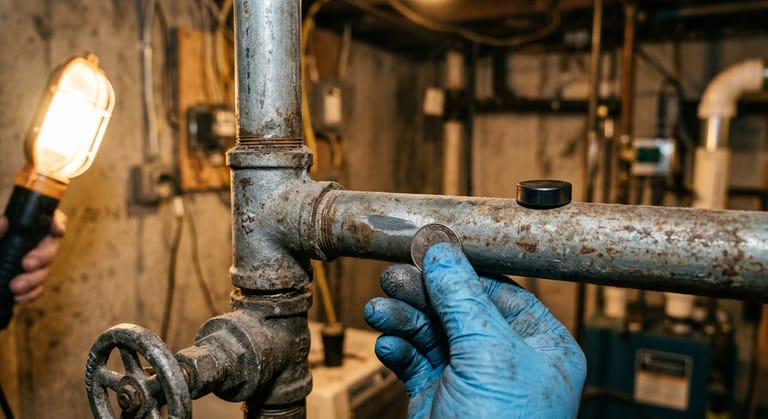
EPA publishes a homeowner version of this check, and its entire tool list is a penny or house key plus a magnet. Do the work where the service line comes through into the house, generally a basement or crawl space beside the meter or main shutoff, and pick your test spot on bare metal between that entry and the inlet valve.
- Open a small clean patch. A coin rim or the tip of a key is abrasive enough. Gloves on, EPA says, and sweep up the debris you knock loose.
- Read the mark you made. Steel resists the edge, and what shows through stays a dull ash gray. Lead surrenders at once and flashes bright silver.
- Hold the magnet to the wall of the pipe. Steel grabs it. Against lead or against copper it drops straight off.
- Try a second spot, then a third. Two or even three materials inside one house is routine rather than strange.
| Material | Under a coin | Magnet | Backup clue |
|---|---|---|---|
| Galvanized steel | Resists the edge, mark stays dull ash gray | Grabs it | Exterior runs dark gray toward black (City of Troy, NY); fittings are threaded |
| Lead | Gives way at once, mark flashes bright silver | No | A wiped joint, described by EPA as a rounded lead bulb where the line meets another material |
| Copper | Mark comes up bright and penny toned | No | Fittings are soldered, never screwed together |
| Plastic | No metal beneath the surface | No | Stamped codes such as PB2110, the polybutylene call out from the withdrawn ASTM D3309 |
Paint defeats the coin completely. Where scraping is not an option, EPA points to the swab kits sold for testing lead paint, which read a pipe surface just as well.
The era this material belongs to
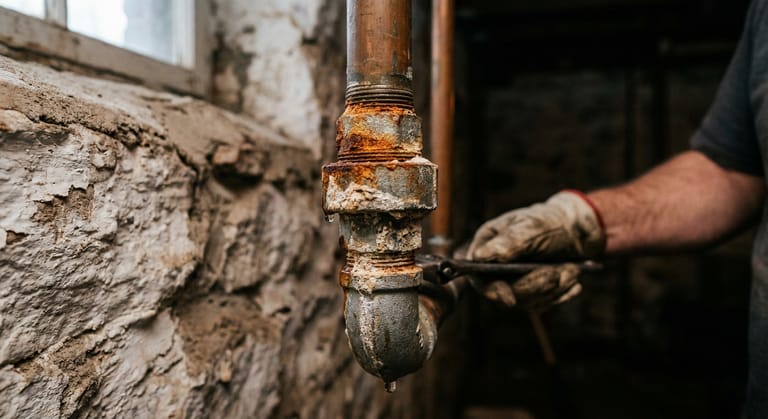
HUD's Rehab Guide, Volume 8, sets the order of events down plainly. Iron and steel supply piping enjoyed its popularity in the years before World War II; copper tubing claimed the market once the war ended, and from the 1970s plastics claimed it from copper. Anything of this metal still moving household water is therefore mostly pre-1960 stock, which by 2026 works out to some 65 years of service or beyond. HomeGuide's 2026 guide allows this supply pipe 20 to 50 years, so the average survivor is not approaching the end of that published span, it went past the far edge of it a while ago.
Rust, scale, and a bore that keeps shrinking
Galvanized pipe rusts, and it does so out of sight, on the surface no homeowner can examine. HUD records corrosion and scale collecting inside iron and steel piping where water conditions favor it, hot water runs hit hardest, and adds that heat working alongside adverse water chemistry sharpens the whole process. Deposits grow inward off the wall, so the channel left for water narrows season by season while the outside of the pipe gives away nothing at all. In an occupied house the tell tales are ordinary ones:
- a laundry tap downstairs still running hard while the top floor shower goes limp;
- brown or rust tinted water on the first morning draw, after the house has sat idle overnight;
- threaded joints that stay damp, because the pipe wall is thinnest exactly there;
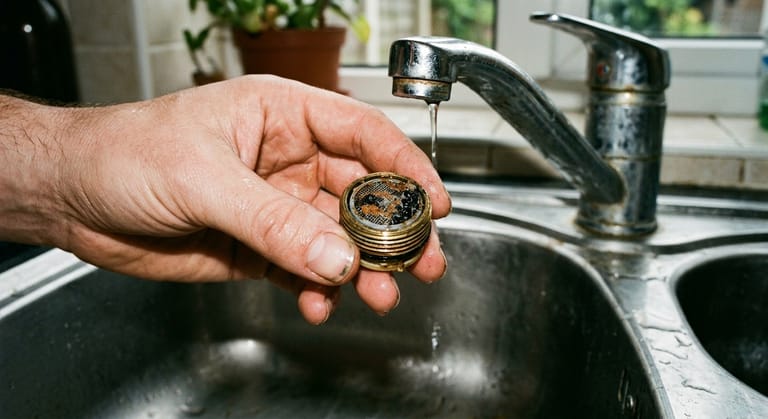
- sediment that plugs aerators and appliance screens again within weeks of every cleaning.
Galvanized steel water pipes and the lead they can hold
Corrosion brings a second consequence that no pressure gauge will ever register. The Philadelphia Water Department puts it in terms of what a roughened interior collects: as galvanized pipes corrode, decades of lead originating anywhere in a property's plumbing can settle into those pitted walls. EPA's consumer flyer carries the sequence a step further, noting that lead particles take hold on the inner walls of galvanized pipes, later travel out with the water people drink, and push the number at the tap upward.
Reading the two agencies literally. The maximum contaminant level goal EPA has set for lead in tap water is zero, which is a health target and not a line a utility can be cited for crossing; enforcement runs instead through the lead action level and the treatment technique attached to it. For children the agencies decline to name a threshold at all: EPA reports that a safe level of lead in children has never been identified, and CDC lands in the same place on blood lead.
Lead gives the senses nothing to work with, no tint, no flavor, no smell, so a certified laboratory is the only source of a trustworthy answer, and your state or local drinking water authority keeps the list of laboratories that qualify (EPA). While the pipe is still in place, EPA's holding advice is to take cold water for drinking, cooking and baby formula, to know that boiling strips out none of it, and to buy a filter certified to NSF/ANSI Standard 53 carrying a lead reduction claim. Health questions belong with a clinician, and questions about the line feeding your own address belong with the water utility.
Ready to talk to a licensed repipe pro?
Call (800) 555-0195No charge to call. A licensed repipe pro answers.Licensed repipe partners in your area- Every partner plumber is licensed and insured
- Calls routed around the clock
- Nothing billed for the call
- The plumber quotes you, and you say yes or no
Start with your symptom, read one page
- Pressure that fades upstairs: why the top floor goes first, what a plumber can genuinely clear from a scaled pipe, and where clearing stops buying anything.
- Brown water at the tap: what the color says about the inner wall, and how to tell a single fixture problem from a whole system one.
- A joint that keeps weeping: threaded unions, dielectric connections and the mixed metal joints that corrode fastest when new work meets old steel.
- A utility letter about lead: the direct answer on zinc coatings, accumulated lead, and what a "galvanized requiring replacement" classification means for your address.
- Is the water safe to drink: what EPA and CDC do and do not say about corroded supply lines, plus certified testing and filter standards worth paying for.
- Pricing the work first: 2026 ranges split by home size, fixture count and replacement material, including restoration and permit lines that quotes leave off.
- Scheduling the work: how a repipe runs from walkthrough to pressure test, how much of the house gets opened, how long the water stays off.
- Choosing what replaces the steel: a parameter by parameter comparison, with the scenarios where copper earns its premium and the ones where it does not.
Still weighing options? Compare materials in PEX versus copper, read the honest limits of cleaning a corroded system, or see what changes when old supply runs go to plastic in the switch to PVC. Older houses mix materials, so the lead service line guide and the polybutylene guide sit next door to this one, and the whole house walkthrough sorts everything at once.
When the decision is not yours
Inside the walls, replacing pipe is a spending decision. Out at the buried line it can stop being yours to make.
What turns a line into GRR. EPA files certain galvanized service lines under "galvanized requiring replacement": the ones fed by lead today, the ones fed by lead at any earlier point, and the ones fed by a line whose material nobody can name. Where a system cannot show that lead was never upstream, the rule tells it to assume lead was there (40 CFR 141.84(a)(4)(ii)).
The timetable. Ten years is what EPA allows water systems to locate lead pipes and take them out, in the agency's own plain language description of the Lead and Copper Rule Improvements. Compliance begins November 1, 2027 (40 CFR 141.80(a)(3)); covered lines then come out across 10 program years, which puts the approximate horizon in late 2037. A system carrying an unusually heavy replacement load may legally run past that, on a deferred schedule its state approves, so the thing worth reading is your own utility's published plan, not a calendar.
Partial jobs are off the table. 40 CFR 141.84(g) bars replacing only part of a lead or GRR line, and leaves two openings: emergency repair, and work timed to coincide with other infrastructure projects. EPA discourages partial replacement regardless, warning that galvanized pipe, like other pipe materials, can end up compromised when only a portion of it comes out.
What replacement costs in 2026
Ranges, not quotes. HomeGuide's 2026 figure for replacing this supply pipe, installed, runs $2,000 to $15,000, and where a job sits inside that spread depends on whether PEX, copper or something else goes back in. Angi's 2026 numbers for repiping a whole house run $1,500 to $15,000 against a national average near $7,500, with roughly 70 percent of the money going to labor. Early estimates habitually drop two lines: closing up the drywall that had to be opened, $300 to $1,500 and upward (HomeGuide), and the water line replacement permit, which averages $30 to $500 (HomeGuide).
Access, flooring and finish work decide where a real bid lands inside those numbers, which is why an itemized estimate teaches more than any national average.
Searching for galvanized pipes near me?
Two unrelated people type that search. The first wants a supply house selling threaded pipe by the foot. The second owns the house and needs somebody to cut into a wall and look, and what ought to filter that search is a plumber who repipes older homes week after week, not whichever listing sits nearest. Put the page down and call if any of this describes your house:
- brown water showing up at every fixture, especially in the days after street work nearby;
- a ceiling stain that keeps spreading, or a joint that weeps on after somebody tightened it;
- upstairs pressure down to a trickle while the ground floor runs normally;
- a utility letter placing your service line in the lead, GRR or unknown category.
Call (800) 555-0195. The call costs nothing, it connects you with a licensed and insured local plumbing partner, and scope and price are agreed with that plumber directly.