
Lead pipes by city: who pays, and who sends the bill
The short version
- Chicago carries over 400,000 lead service lines, the largest inventory of any US city (Chicago Department of Water Management).
- Flint pulled its last known active line on July 31, 2026, after excavating almost 32,000 properties to find about 11,600 (State of Michigan).
- Free is not the national rule: Milwaukee bills the owner a $3,454 average for the private side, while Denver Water covers it out of water rates.
- New York City cannot compel replacement because every known line is private property, and only 63 percent of owners offered a free swap accepted (NYC DEP).
- A 10 year clock under EPA's Improvements rule opens on November 1, 2027, though a state approved deferred schedule can let the worst hit cities run past that date.
Two houses with the same buried metal, one in Denver and one in Milwaukee, get opposite answers about who funds the digging. Denver Water replaces customer owned lines at no direct cost. Milwaukee invoices the owner for the private side.
Nothing about the pipe explains that gap, which is why searches for Chicago lead pipes, Flint replacements or a city map behave like six subjects rather than one.
This hub sorts six programs by what actually decides your bill, city by city. Grayfield is an independent publisher, not a contractor.
What actually changes when you cross a city line
Three things, none of them technical. Ownership: the buried run has a public side and a private side, and local policy alone decides who funds the second. Calendar: state statutes set very different paces. Proof: every system now keeps an inventory and must publish where its lead lines are (EPA), as a searchable lookup in one city and a PDF in the next.
| City | Lead lines on the books | Who funds the private side | Working horizon |
|---|---|---|---|
| Chicago | Over 400,000 (Water Management) | Free on four of five tracks | State pace from April 2027 |
| New York City | About 121,100 (DEP) | Owner, unless City work disturbs it | Plan filed December 2025 |
| Washington, DC | Over 42,000 (DC Water) | Free outside the voluntary option | Aligned to 2037 |
| Flint | About 11,600 replaced (Michigan) | Free, under a court settlement | Finished July 2026 |
| Milwaukee | About 65,000 left (Water Works) | Owner, on the Owner Request track | All lines by 2037 |
| Denver | 57,953 estimated (Denver Water) | Denver Water, funded by rates | 15 year plan approved 2019 |
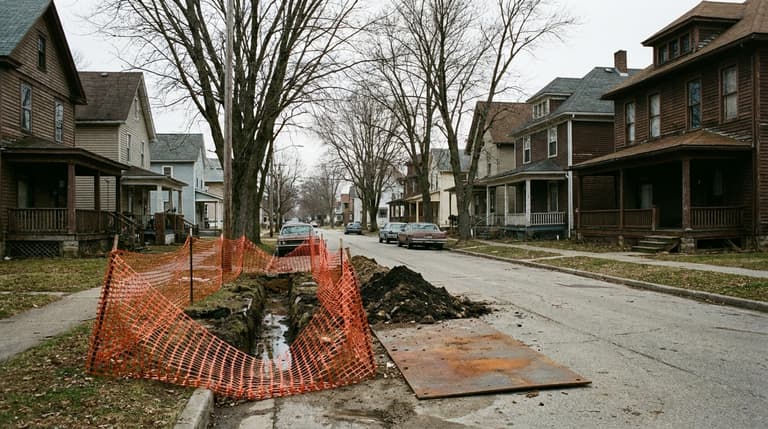
Chicago lead pipes: the biggest inventory in the country
Nowhere else is close. The Chicago Department of Water Management counts over 400,000 lead service lines, and its 2026 budget statement calls their removal a huge multi year, multi billion dollar effort.
A 2024 JAMA Pediatrics study traces the reason: until the 1986 federal ban, city code required the material. That framing is the journal's, not City Hall's.
Five tracks make up Lead-Safe Chicago: Equity, Daycares, Leaks and Breaks, Block-Level and Homeowner-Initiated. On four of them both halves come out at no charge. The Homeowner-Initiated route is the exception, billing the owner for the pipe work while the City drops its usual permit fees.
Springfield, not City Hall, sets the schedule for Chicago lead pipes. Illinois wrote it into 415 ILCS 5/17.12, the notification and replacement act for lead service lines. Replacement is mandatory from April 15, 2027, and systems holding 100,000 lines or more move at 2 percent a year for 50 years. An unplanned repair that opens such a line forces the whole run out within 30 days, or 120 days where conditions block it.
Chicago reported $20,000 to $26,000 per unit for its first construction phase to the Illinois EPA advisory board in 2023, against $4,275 to $13,324 per line across Illinois programs outside the city. The replacement cost breakdown explains that spread.
The Chicago lead pipes map people search for is really an address lookup, hosted at sli.chicagowaterquality.org with the program hub at LeadSafeChicago.org. That Chicago lead pipe lookup returns the recorded material for both halves of your line.
Flint, Michigan: the one city here that finished its lead pipes
Michigan's governor announced that the last known active line came out on July 31, 2026. Reaching that took excavating almost 32,000 properties to find roughly 11,600 lead pipes, at a cost near $140 million. Records stay guesses until somebody digs.
None of it was optional. A federal court order, the NRDC and Concerned Pastors settlement, obliged the city to reach more than 11,000 lines. It hit that mark in July 2025, then another 500 surfaced.
Sampling through the first six months of 2026 came back at a 90th percentile of 3 parts per billion, below the 15 ppb federal action level and Michigan's stricter 12 ppb limit.
Flint also documents what replacement day looks like:
- Water off, anywhere from 4 to 24 hours.
- The crew runs the taps 15 minutes before leaving.
- You flush again, 15 minutes minimum, at full flow.
- Filters stay in use for at least six months after.
New York City: private lines and a 63 percent yes rate
DEP logs roughly 121,100 lines as lead or galvanized, spread across every borough, and all of them are privately owned, so the agency cannot order a replacement.
It published its federally required plan on December 18, 2025, two years early, promising no cost swaps wherever City main work disturbs a line.
New lead lines stayed legal here through 1961, and spot repairs to ones already in the ground until 2009.
Because nothing compels an owner to agree, only 63 percent of those offered a free replacement have accepted. DEP prices a line at $5,000 to $10,000 by length and site conditions, and says City contracting runs 25 to 50 percent above a private contractor's price.
Ready to talk to a licensed repipe pro?
Call (800) 555-0195No charge to call. A licensed repipe pro answers.Licensed repipe partners in your area- Every partner plumber is licensed and insured
- Calls routed around the clock
- Nothing billed for the call
- The plumber quotes you, and you say yes or no
Three more ways to split the same bill
Washington, DC: free unless you jump the queue
DC Water's Lead Free DC program lists more than 42,000 service lines of lead or galvanized iron pipe, revised up from 28,000 with the 2023 inventory map.
Most tracks are free and cover public and private space. Only the Voluntary Full Replacement Program, which pulls your address ahead of its scheduled block, charges the owner, averaging $2,500 to $4,500.
Milwaukee: the clearest counter example
Milwaukee Water Works counts roughly 65,000 remaining lines and aims to replace them all by 2037, with more than 13,000 done as of April 2026.
It funds the public portion only. On the voluntary Owner Request track the owner pays the lesser of actual cost or the average, and the utility takes 200 properties a year.
Ordinance 225-22.5 forces full replacement anyway in three cases:
- Licensed childcare sites.
- A leak on either portion.
- Water main replacement or road reconstruction.
Denver: paid for out of water rates
Denver Water estimated 57,953 lead service lines at the end of 2025, down from a 63,955 baseline in September 2019, and has replaced 36,816 since 2020.
Lines are customer owned there too, yet Denver Water lead pipe replacement costs the household nothing directly, funded through water rates and bonds. Pitchers and cartridges certified for lead come free until six months past the swap, and the utility lifts water pH to 8.8 instead of dosing orthophosphate.
Look up your address before you call anyone
EPA's Lead and Copper Rule Revisions forced every system to file a service line inventory, and the Improvements rule adds a yearly letter to anyone whose record reads lead, galvanized requiring replacement, or unknown. Start there, not from your home's build date.
- Find your system's inventory. Chicago runs an address lookup at sli.chicagowaterquality.org, Denver Water, Milwaukee and DC Water publish dashboards, and a small system may post a PDF you read by street.
- Have a certified lab run the sample; in New York City, dialing 311 gets a free kit in the mail.
- Dispute a record that looks wrong. Under the Improvements rule, systems must explain how to flag a misclassified pipe and ask for tap sampling.
- Verify the metal where the line enters the building. The pipe identification hub covers the scratch and magnet method.
Certified water testing covers collection and reading the result.
What it costs when no program is paying
Ranges, not quotes. The economic analysis EPA ran for its 2019 proposed rule priced a full replacement between $1,852 and $7,056 per line in 2016 dollars, a figure repeated in the 2023 Illinois EPA advisory board report. That same report logged $4,275 to $13,324 from programs actually running in Illinois. Over five years, Milwaukee's private side has averaged $3,454.
Digging, not pipe, separates one invoice from the next: Angi's 2026 figures put trench work and backfill alone between $1,500 and $13,000. City policy then decides how much of that reaches a household. How the job is done walks through the sequence.
Refuse a half job. EPA's Science Advisory Board reported that leaving half the line in the ground pushes lead at the tap sharply higher for days to weeks and sometimes several months, and it would not endorse the practice as safe or effective against short term exposure. Under 40 CFR 141.84(g), partial work is barred outside emergency repair and coordinated infrastructure projects.
Where to go next
- Flint's replacement record: the court ordered timeline, the excavation counts behind the headline, and what residents were told to do afterwards.
- New York City programs: how DEP works where the customer owns the pipe, and what a 63 percent consent rate means at a sale.
- Washington DC replacement: the Lead Free DC tracks side by side, who qualifies, and why the funding gap sits on the private half.
- American Water programs: what changes when an investor owned utility runs your system, and where its schedule is published.
When to call a licensed plumber
Everything above is policy, and policy is the utility's department. The private half of the line is where a plumber is the right person to ask, and the question you bring depends on who funds that half in your city.
Where a program pays for both sides, the job is verification: what the metal is, and whether it matches the record. Where the owner is billed, as in Milwaukee and by default in New York, the question is money, and a citywide average will not settle it.
None of this is an emergency. Call (800) 555-0195, say what your inventory record shows, and get a plumber's take on the private half. That line rings through to a partner network of licensed and insured plumbers, costs nothing to dial, and leaves pricing between you and the plumber.
Ready to talk to a licensed repipe pro?
Call (800) 555-0195No charge to call. A licensed repipe pro answers.Licensed repipe partners in your area- Every partner plumber is licensed and insured
- Calls routed around the clock
- Nothing billed for the call
- The plumber quotes you, and you say yes or no