
DC Water lead pipe replacement is free for most District homeowners
The short version
- The District records more than 42,000 service lines as lead or galvanized iron, revised up from 28,000 by the 2023 inventory map (DC Water).
- Block-by-Block, Small Diameter, Emergency Repair and LPRAP swaps are free to the owner and cover public and private space (DC Water).
- Only the Voluntary Full Replacement Program bills the owner: $2,500-$4,500 on average for the private half (DC Water).
- More than 6,900 lines came out between 2019 and October 1, 2024, saving customers an estimated $16 million (DC Water).
- The 2019 goal of finishing by 2030 has moved out with the bigger inventory, and the schedule now tracks EPA's 2037 horizon.
More than 42,000 service lines in the District still run on lead or galvanized iron, a count the utility revised up from 28,000 after its 2023 inventory map (DC Water, FY2024 summary). Four of the five routes cost the owner nothing, on both sides of the curb stop. Only the route that lets you pick your date sends a bill.
Grayfield covers these programs independently and employs no plumbers.
Does DC still have lead pipes?
Tens of thousands. Galvanized rides in the same tally by EPA's rulebook: a zinc coated line that ever sat behind a lead one carries the heading galvanized requiring replacement, because the coating keeps what the older pipe fed it and releases it once that pipe goes. Only the 1986 Safe Drinking Water Act amendments forced new pipe, solder and flux at public water systems to be lead free (EPA). Galvanized supply piping carries its own tells.
Is there a DC Water lead pipe replacement map?
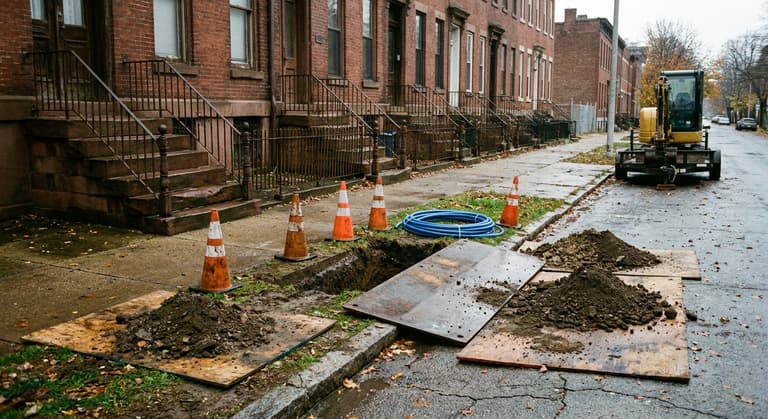
There is, and it is the first thing to open: the Lead Free DC hub at dcwater.com/resources/lead, with a status dashboard at dcwater.com/LFDCDashboard. Type in an address and the utility shows what it has on file for public space and for private space, listed apart.
What the file says is not what sits in the trench. The Lead and Copper Rule Revisions gave systems until October 16, 2024 to catalogue every service line and make the locations of the lead ones public. Entries also come back as unknown: nobody wrote the material down.
Which program covers your address
Every DC lead pipe replacement program below runs on the same eligibility rule: the utility states that each District homeowner with lead or galvanized iron has a route (DC Water).
- Block-by-Block. The swap follows the capital schedule, street by street.
- Small Diameter Water Main. It rides along when an undersized main is renewed.
- Emergency Repair Replacement. The line comes out when a break has already opened the trench.
- Lead Pipe Replacement Assistance Program (LPRAP). Run with the DC Department of Energy and Environment; a record 544 swaps in the year to September 30, 2024.
- Voluntary Full Replacement Program (VFRP). You request work ahead of your street's turn and fund the private half.
Who pays for the private half
Ownership splits at the curb stop: the main side belongs to the utility, the building side to the deed holder. That is why who pays changes city by city.
The short version of DC Water lead pipe replacement is that the utility carries almost all of it. The first four routes are free on both sides, paid with District and federal money. Under VFRP the owner covers the private side, because the job is pulled forward outside the capital schedule, while the utility still pays for public space (DC Water).
The effort is priced near $1.8 billion, of which $1,418.8 million is rate payer money for public space. A private-side gap of $152.9 million remains (DC Water, FY2024), on exactly the stretch under your yard.
What replacement day looks like from your side
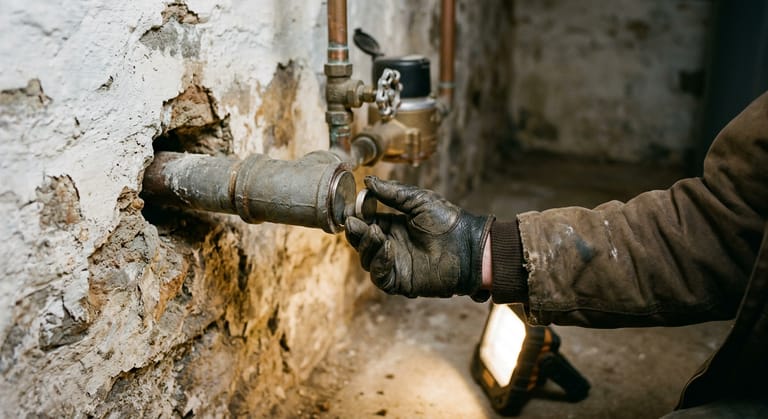
- Pull up both halves of your dashboard record, then verify at the meter or shutoff with the coin and magnet check EPA describes.
- Ask the utility which route covers your address, or request the voluntary program to pick your own date. Crews ride along with main work so the street is paved once, holding cost down (DC Water).
- Plan on the supply being off for part of the day, then run the house through and clean the aerators: cutting a pipe knocks particles loose (EPA).
How a service line swap is performed covers the sequence.
Ready to talk to a licensed repipe pro?
Call (800) 555-0195No charge to call. A licensed repipe pro answers.Licensed repipe partners in your area- Every partner plumber is licensed and insured
- Calls routed around the clock
- Nothing billed for the call
- The plumber quotes you, and you say yes or no
What the owner pays, route by route
| Route | What the owner pays | Source |
|---|---|---|
| Block-by-Block, Small Diameter, Emergency Repair, LPRAP | $0, both sides | DC Water |
| Voluntary Full Replacement, private half | $2,500-$4,500 average | DC Water, FY2024 |
| National estimate per line, 2016 dollars | $1,852-$7,056 | EPA 2019, via Illinois EPA |
Read the averages as averages. In the District the decisive figure is not the trench but which route name lands on your address: four put the whole run at zero, one puts the private half on an invoice. Inside that fifth route the spread comes from the length between curb stop and building, and from what has to go back over it. The full cost breakdown opens each line item.
Why a partial swap is not a shortcut
Take out half a run and the tap reading often moves the wrong way. EPA's Science Advisory Board found partial replacement had not been shown to reliably lower lead over the short term, a window it counted in days to months and possibly longer, and read the evidence as suggesting potential for harm rather than benefit (EPA). Sawing a line apart and rejoining it shakes particles free, and surviving pipe bolted to a different metal starts to corrode galvanically.
November 1, 2027 is the day the Lead and Copper Rule Improvements bite. A system then gets 10 program years to pull the lines it controls, averaging at least 10 percent a year, and the action level tightens to 0.010 mg/L. A state approved schedule can stretch that where the burden is heaviest, so 2037 is no promise.
While your street waits its turn
Nothing about this metal reaches your senses, so a DC water lead test counts only when a state certified laboratory runs the sample, where EPA sends households. Certified testing walks through collection. What EPA suggests for the wait:
- Anything you drink, cook with or mix formula in comes off the cold tap; heat does not remove the metal.
- Move the standing column first: shower, wash cycle, running tap.
- The screen at the spout tip collects grit; unthread and rinse it.
- A filter counts only where the certification reads NSF/ANSI 53 with a lead reduction claim and the cartridge is in date.
Ask either agency for a safe number and neither has one: EPA has identified none for children, and CDC's position on blood levels runs the same way. Zero follows, the maximum contaminant level goal EPA sets for lead in drinking water, a target for health rather than a limit anyone enforces. Not medical advice: clinician for exposure, utility for the line.
Is it worth replacing lead water pipes?
By the record the District thinks so and is paying: more than 6,900 lines came out between 2019 and October 1, 2024, 2,199 of them in FY2024, an estimated $16 million saved for customers through the free routes (DC Water). Lead Free DC launched in 2019 promising completion by 2030; the bigger inventory moved that out, and the schedule now tracks the federal horizon.
Elsewhere it lands differently: Flint's court-ordered record, New York, where every known line is private, and the city by city comparison.
When to call a licensed plumber
Queue questions belong to the utility. A plumber answers the two it will not: what the run under your own yard is made of, and what the private half would cost if the bill were yours.
Waiting on a free route. Verification is the whole job: establish what the pipe is where it comes through the wall, and say so if the dashboard record disagrees.
Weighing the voluntary route. Get a bid on your own trench to set against the $2,500 to $4,500 average DC Water reports, since that average came out of other people's yards.
Neither case is urgent. (800) 555-0195 reaches a licensed, insured local plumber from the partner network, free to the caller, for a read on the half you own. Grayfield publishes, never contracts, and may take a referral fee that leaves your price alone.
Ready to talk to a licensed repipe pro?
Call (800) 555-0195No charge to call. A licensed repipe pro answers.Licensed repipe partners in your area- Every partner plumber is licensed and insured
- Calls routed around the clock
- Nothing billed for the call
- The plumber quotes you, and you say yes or no