
Lead Water Pipe Testing: Two Checks, One Decision
The short version
- Two separate checks: a coin and a magnet identify the pipe, a certified laboratory measures the water. Neither one replaces the other.
- EPA routes home water testing to a laboratory certified by your state or local drinking water authority, because nothing at the tap reveals the metal by sight, taste or smell.
- The federal action level drops from 0.015 to 0.010 mg/L on the November 1, 2027 compliance date, and it is a system-wide trigger, not a household pass mark.
- Utilities had to compile a service line inventory by October 16, 2024 and make lead line locations public, and the 2024 rule gives you a route to contest your classification and ask for a tap sample.
Lead water pipe testing covers two jobs that get mixed up. One identifies the pipe: a coin and a magnet settle that, using EPA's published quick check. The other measures what is dissolved in the tap water you drank this morning, and EPA sends that one to a certified laboratory. A hardware store strip replaces neither.
Does your utility's notice file this address under lead, galvanized requiring replacement, or lead status unknown? Call (800) 555-0195 at no charge, and a licensed, insured plumber working your area picks up, ready to settle the material where the pipe enters.
Lead water pipe testing: which check answers which question
Three records exist about the pipe under your yard, and they rarely agree. Reading them in order stops you buying evidence you already have.
| Check | What it settles | Who performs it |
|---|---|---|
| Coin and magnet at the entry point | The material of the pipe you can reach and see | You, on site, by EPA's method |
| Tap sample sent for analysis | How much of the metal was in that glass, that day | A laboratory certified by your state authority |
| Service line inventory | Federal label on your address: lead, galvanized requiring replacement, non-lead or lead status unknown | Your water system, under the federal inventory rule |
Start where the pipe enters the house
- Find the spot. EPA points to where the service line enters the building, usually a basement or crawl space near the main shutoff or meter, and says to test between that entry and the inlet valve.
- Scratch it with a coin or a key. EPA describes the soft metal as dull silver gray, scratching easily to a bright mark. The City of Troy, New York publishes the result table: shiny silver means lead, dull gray means galvanized steel, shiny copper means copper. Gloves on, and clean up after.
- Hold a magnet against it. Nothing sticks to the soft metal, while galvanized steel is magnetic, per EPA's inventory guidance. That one step separates the two materials that look alike.
- Look at the joint. EPA describes a wiped joint as a rounded ball of lead where the old run meets another material, the strongest secondary clue near the meter.
- Painted pipe? EPA notes that the approved lead paint surface swab kits work on pipe too.
Photographs and the walkthrough sit on our guide to identifying lead pipes; install dates are on when the federal ban took effect.
Testing the water itself: a certified laboratory, not a strip
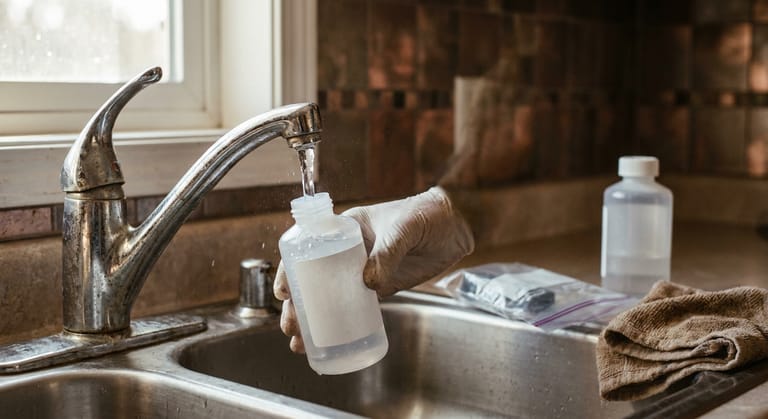
EPA's instruction on home water testing is short: a certified laboratory, listed by your state or local drinking water authority. Sight, taste and smell tell a homeowner nothing here, so a measured sample is the only evidence.
Your utility is the first call. The 2024 Lead and Copper Rule Improvements require annual notification to everyone on an affected or unknown line, with instructions for contesting that classification and requesting a sample. Some systems hand out kits: New York City DEP lists free test kits by calling 311.
Lead water test kit or certified lab: what to ask for
A search for a lead water test near me returns shelf products first, and a retail lead water test kit reports a number in your kitchen with no certified laboratory behind it. Ask three things instead: whether the utility samples at no charge, whether the laboratory is state certified, and how the instructions say to draw the sample.
Ready to talk to a licensed repipe pro?
Call (800) 555-0195No charge to call. A licensed repipe pro answers.Licensed repipe partners in your area- Every partner plumber is licensed and insured
- Calls routed around the clock
- Nothing billed for the call
- The plumber quotes you, and you say yes or no
What a result proves, and what it does not
EPA's health goal for the metal in drinking water is zero, a goal rather than an enforceable limit. The enforceable mechanism is the action level, measured across a system's sampling pool at the 90th percentile. It judges a utility, not one kitchen. Your number describes that faucet, that morning.
For scale, Flint's first half 2026 monitoring produced a 90th percentile of 3 parts per billion across 61 validated sites, per the Michigan governor's office.
Why the same faucet gives different numbers
Three documented mechanisms move a result, so one clean sample is not a certificate. Water standing in low use plumbing changes chemistry: EPA's corrosion control guidance notes that higher water age drops pH and costs the chlorine residual, worsening corrosion.
Disturbance is the second. EPA cites 2013 field research where most results above the action level then in force came from disturbed lines. Treatment is the third: Flint's failure, as EPA's Inspector General documented, was corrosion control not maintained after a source switch. The buried run never changed. The chemistry did.
If the number comes back high
- Drinking, cooking and formula come off the cold side; heat leaves the metal in place.
- Move the standing volume out first: a shower, a laundry cycle, an open faucet.
- Rinse the aerator screens, where upstream flakes settle.
- Shop by certification, not by wording on the box: NSF/ANSI Standard 53 with a lead reduction claim, cartridges swapped on the printed schedule. EPA also points to Standard 42, Class I, for particulates.
The 2024 rule bars partial swaps outside emergency repairs and planned infrastructure work, and EPA's Science Advisory Board found partial jobs often raise tap levels for days to months. Whether replacement reaches your bill depends on the local program, and our guide to service line replacement programs tracks who funds which half. The work itself is described in lead water pipe replacement, with the arithmetic in what replacement costs per line.
When to call a licensed plumber
Call if the scratch comes up soft and shiny, if a magnet slides off a dull gray line, if the letter says unknown status, if the tap runs discolored after street work, or if a buyer wants the material confirmed before closing. A plumber exposes the run, confirms what it is, and prices the private side.
Read the material off the pipe instead of guessing: call (800) 555-0195. Grayfield publishes and does not plumb, holding no contractor's license. Answering is a licensed plumber from the partner network in your area, and that plumber may pay Grayfield a referral fee you are never billed for.