
Lead Water Pipe Replacement: What the Job Involves
The short version
- A lead line cannot be repaired into a safe one: EPA's health goal for the metal in drinking water is zero, so the pipe has to come out.
- The line has two halves. Utilities commonly fund the public side; the private side is the owner's, and the local program decides whether you get a bill.
- Federal rules at 40 CFR 141.84(g) bar partial swaps except in an emergency repair or alongside planned infrastructure work. EPA's Science Advisory Board found half a line frequently drives tap readings up for days or months.
- Published per line figures run from $1,852 to $7,056 (EPA analysis, 2016 dollars) up to $20,000 to $26,000 per unit in Chicago.
A lead service line cannot be repaired into a safe one. The metal itself is the source, which is why lead water pipe replacement is the only durable fix, and why EPA's health goal for it in drinking water is zero.
If your utility letter says lead, galvanized requiring replacement, or unknown, three questions follow: who owns which half of the line, what your city program covers, and what the rest costs.
Letter in hand, a wet patch in the yard, or a closing date? Dial (800) 555-0195 free to reach a nearby plumber who holds a license and insurance.
Which half of the line belongs to you
Between the street main and your house the run splits at the curb stop, a buried valve near the property boundary, as Chicago's 2022 water quality report maps it. Utilities commonly fund the public half. Everything past that valve belongs to the owner in law, so an invoice depends on the local program.
In its consumer flyer EPA ranks these service lines among the biggest contributors of the metal to drinking water, counting goose necks and pigtails, the stubby connectors joining line to main, as part of that run. Installation dates decide what you are likely to find; our page on when lead pipes were banned gives them.
| Program | Cost to the owner |
|---|---|
| Denver Water Lead Reduction Program | No direct cost, rate funded |
| Lead Free DC, block by block | Free to the owner (FY2024) |
| The same program's voluntary early swap | Private side, about $2,500 to $4,500 (FY2024) |
| Milwaukee Owner Request Program | Billed, five year average $3,454 |
Eligibility shifts by city and year; our guide to lead service line replacement programs tracks who runs what.
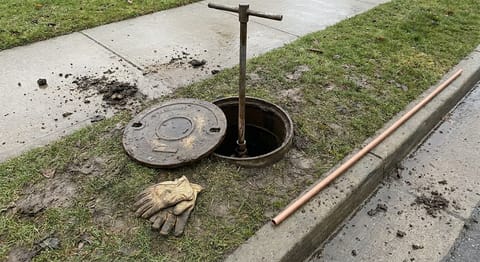
Can lead pipes be repaired instead?
Patch a leak and the metal stays the same. A clamp, epoxy putty, a coupling to plastic: each stops water escaping. None alters what the pipe wall sheds into your glass.
Jostling the line has its own penalty. Field sampling in EPA's corrosion control guidance shows that knocking the pipe about during infrastructure work sets the metal loose; it cites 2013 research where most samples over the action level then in force were traced to disturbed pipe.
On a line losing water now, a patch buys time. It never replaces pulling the pipe.
Partial jobs: half a line is not a fix
At 40 CFR 141.84(g) federal rules shut the door on half a line, with two openings: an emergency repair, or work timed to planned infrastructure. Where the whole run sits within the water system's reach, the whole run comes out; any half swap needs a dielectric coupling.
EPA's Science Advisory Board was blunt. Nothing in the evidence, it concluded, shows half a job bringing tap readings down dependably over the short run, and such work often sends them sharply the other way, for days or months. Neither the size nor the duration of that rise can be predicted house by house.
Ready to talk to a licensed repipe pro?
Call (800) 555-0195No charge to call. A licensed repipe pro answers.Licensed repipe partners in your area- Every partner plumber is licensed and insured
- Calls routed around the clock
- Nothing billed for the call
- The plumber quotes you, and you say yes or no
Replacing lead water pipes: how the work is done
Three methods, one finish: an unbroken new run from main to meter, no old pipe left.
- Confirm the material. A coin and a magnet are all EPA's field check needs. The older metal is soft, dull silver gray, scratching to a bright shiny streak no magnet grips. Galvanized steel does the reverse: dull scratch, magnet sticks. Photos sit on our guide to identifying lead pipes.
- Check the inventory. October 16, 2024 was the Lead and Copper Rule Revisions deadline for systems to publish an inventory of their service lines. The 2024 Improvements rule opened a route for disputing your classification and requesting a tap sample.
- Quote and permit. A plumbing permit averages $30 to $500 (HomeGuide 2026); the contractor normally pulls it.
- The dig, the pull or the bore. Open cut means a trench across the yard, pipe pulling hauls the new run along the old path, directional boring threads under lawns. Chicago's split, given to the Illinois EPA advisory board in 2023: 53 percent open cut, 30 percent pulling, 17 percent boring.
- Flush the line. Any disturbance stirs scale loose, so work the taps as your plumber says.
- Restore the ground. Fresh sod runs $1.50 to $4.00 per square foot, drywall patching around access holes $300 to $1,500 (HomeGuide 2026).
What lead water pipe replacement costs in 2026
What moves the number is rarely the pipe: distance, depth, crossings under driveways and sidewalks, whether crews are on your block. The breakdown sits in our lead service line replacement cost guide.
While you wait: the interim steps EPA publishes
- Draw drinking, cooking and formula water cold only. Heating drives none of the metal off, so boiling is no workaround.
- Push water through the pipes first: run a shower, start a laundry cycle, let a tap run.
- Give faucet screens an occasional rinse. Particles drop into the aerator and settle there.
- Choose a filter whose packaging carries NSF/ANSI Standard 53 certification with a lead reduction claim, and swap cartridges on schedule.
Searching for a lead water test near me? What EPA points to is a laboratory your state or local authority has certified; our tap water testing guide walks through booking one.
When to call a licensed plumber
Reach for the phone if any of this fits: a wet spot or pressure drop above the buried run, discolored water after street work, a utility letter putting your line in any category but copper or plastic, or an inspector flagging it. At the entry point a plumber confirms the material, prices the private half and squares timing with the utility.
Ready to price your own lead water pipe replacement? Ring (800) 555-0195. Grayfield publishes independently; it is not a contractor. The call costs nothing and reaches a plumbing partner near you who holds a license and carries insurance; you set scope and price with the plumber.
Ready to talk to a licensed repipe pro?
Call (800) 555-0195No charge to call. A licensed repipe pro answers.Licensed repipe partners in your area- Every partner plumber is licensed and insured
- Calls routed around the clock
- Nothing billed for the call
- The plumber quotes you, and you say yes or no