
Lead Service Line Replacement: What Happens and Who Pays
The short version
- EPA's 2024 Lead and Copper Rule Improvements set a compliance date of November 1, 2027, and systems then have 10 program years to finish.
- EPA counted roughly 9.2 million of these pipes nationally in its 2023 infrastructure needs survey, and the level it treats as safe at the tap is zero.
- Published prices for one pipe run from $1,852-$7,056 (EPA 2019 analysis, in 2016 dollars) to $20,000-$26,000 per unit in Chicago.
- Chicago, Denver and DC Water cover both halves in most programs; Milwaukee bills the owner a five-year average of $3,454.
- Partial work is restricted by 40 CFR 141.84(g), and EPA's Science Advisory Board found it often raises tap levels for days to months.
The service line is the buried run from the water main under the street to your house. A lead service line replacement swaps it for new pipe. EPA's 2023 infrastructure needs survey counted roughly 9.2 million of them still in the ground, and zero is EPA's maximum contaminant level goal for lead at the tap.
In 2026 this is rarely a purchase you make alone: your water system now works to a federal schedule, and your share depends on which half of the line you own. Want your half priced? Call (800) 555-0195.
What puts your address in the replacement queue
Most owners meet this project through paperwork, not a leak. October 16, 2024 was the date the Lead and Copper Rule Revisions set for utilities to catalog what every service line they own is made of. EPA's headings include one for a pipe no document accounts for, "lead status unknown", which is why so many letters concede the utility cannot name what sits under your block.
Two other triggers show up often:
- A tap result. EPA's 2024 Lead and Copper Rule Improvements pull the action level down to 0.010 mg/L from November 1, 2027.
- Street work. Sampling in the field, cited in EPA's corrosion control guidance, found that lines jostled by construction shed the metal into the water afterward.
Your senses are no help here. In tap water the metal shows no color, offers no taste and gives off no odor, so EPA sends homeowners to a certified laboratory instead. Our guide to testing your water covers how to arrange it.
Public side, private side: who owns which half of the pipe
Chicago's Department of Water Management maps the split most utilities work to: the utility's portion stops at the curb valve, and from there into the building the pipe belongs to the property. Federal rules bind the water system, so they bite hardest on the public half, while the private half is billed by local policy.
Whether a lead service line replacement program covers your half is the difference between paying nothing and paying for the whole line.
| City | Paid by | Figure |
|---|---|---|
| Chicago | City, except Homeowner-Initiated | Free in four of five programs |
| Denver | Denver Water, funded by rates | No direct cost |
| Washington DC | DC Water, except voluntary track | $2,500-$4,500 if early (FY2024) |
| Milwaukee | Owner, under Owner Request | $3,454 five-year average |
| New York City | Owner, unless City work disturbs it | $5,000-$10,000 each (NYC DEP, 2025) |
Milwaukee Water Works will stretch that invoice across 15 years on the tax bill at prime plus 1 percent. New York runs into the opposite trouble: nothing compels an owner there, and DEP reports only 63 percent of households offered a free replacement said yes.
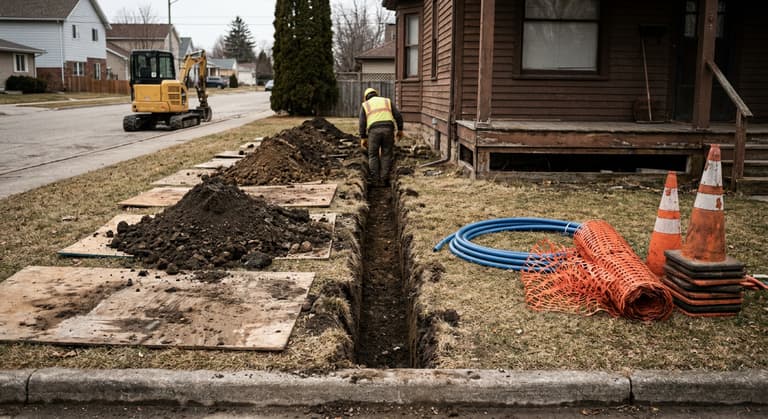
Lead pipe replacement in the ground: open cut or trenchless water line work
Two methods dominate. Open cut means a trench dug the length of the buried run, the old pipe cut free at the main and at the meter, and fresh copper or plastic laid in its place; copper is what Milwaukee Water Works writes into its standard. Where the path underground is clear, a trenchless pull spares most of that digging.
The pipe itself is the cheap part. Angi's 2026 water main figures land trenched work at $50-$200 per linear foot and a trenchless pull at $75-$150, while opening and refilling the trench alone accounts for $1,500-$13,000, before new sod, sidewalk repair or the rest of the yard put back.
Ready to talk to a licensed repipe pro?
Call (800) 555-0195No charge to call. A licensed repipe pro answers.Licensed repipe partners in your area- Every partner plumber is licensed and insured
- Calls routed around the clock
- Nothing billed for the call
- The plumber quotes you, and you say yes or no
The job from your side of the front door
- Confirm the material. EPA's quick check runs on two household objects: a coin or key to scratch with, and a magnet. Scratch a lead pipe and the dull gray surface opens to a bright silvery streak, while the magnet drops away; galvanized steel keeps a dull scratch and holds the magnet fast. Wear gloves, and EPA asks you to sweep up what the scratching leaves. Do this where the pipe comes through the basement wall, and our guide to identifying lead pipes shows the wiped joint.
- Check the inventory and the program. Locations of the lines your utility has classed as lead have to be published, and EPA's rule makes the system spell out how a customer challenges that classification and asks for tap sampling.
- Get itemized quotes if the private half is yours, then schedule both halves together. Permit, restoration and the tap connection belong on the page, not in a verbal estimate. One dig, one replacement.
- Flush and filter afterward. Fresh work stirs what the old pipe left behind, so EPA's holding measures still matter: flush the tap first, keep drinking, cooking and formula water on the cold side, clear the faucet aerator screen, and buy no filter lacking NSF/ANSI Standard 53 certification for lead reduction. Boiling is no shortcut; the metal stays in the glass.
What the replacement costs, source by source
Published lead service line replacement figures scatter more widely than any other number on this site. NYC DEP pins its range to how long the line is and what the site throws up, while the Chicago number shows what a dense city adds to identical work.
| Source | Range | Note |
|---|---|---|
| EPA 2019 analysis (Illinois EPA) | $1,852-$7,056 | In 2016 dollars |
| Illinois EPA advisory board (2023) | $4,275-$13,324 | Outside Chicago |
| Chicago DWM (2023) | $20,000-$26,000 | Phase 1, per unit |
Because the EPA band is stated in 2016 dollars, it reads low against a 2026 bid; the higher Illinois EPA band came out of replacement programs actually running in the state rather than out of a national model. Our replacement cost guide breaks the adders down.
Why stopping halfway is the wrong finish line
Pulling the utility's half and leaving yours in the ground is a partial replacement, and EPA hems it in: 40 CFR 141.84(g) allows the practice only where an emergency repair or scheduled infrastructure work forces it, and a system with access to the rest of the run must take that out too. Where a partial job does go ahead, a dielectric coupling is required.
Reviewing the evidence in 2011, EPA's Science Advisory Board found nothing to show that half a job dependably brings tap readings down over the short run, and reported the opposite effect turning up often: levels climb after the work for days to months, sometimes longer.
Looking for lead pipe replacement near you?
If your search was for someone to replace lead pipes near you, begin with the utility rather than a contractor: going private can forfeit a subsidy your city already funds. Whether you are changing lead pipes ahead of a sale or sitting in the municipal queue, confirm the material first.
Reach for the phone if pressure falls off after crews work your block, if a damp line shows in the grass above the buried run, or if morning water runs discolored.
Under contract on a house that predates the mid 1980s? The federal ban switched on 24 months after June 19, 1986, and several states got there first, as our page on when lead pipes were banned explains. Our guide to lead water pipe replacement covers the same removal from the pipe's side, including what a partial job leaves behind.
Grayfield publishes guides and does no plumbing work. When that half is yours, dial (800) 555-0195 at no cost: the partner network on the line hands you a local plumber, licensed and insured, to price your lead service line replacement. A qualifying call pays Grayfield a referral fee, never a change to the figure you are quoted.