
Orangeburg Pipe: What Is Under Your Front Lawn
The short version
- The Orangeburg Manufacturing Company closed in 1974 (APWA Minnesota chapter), so anything still buried in 2026 has outlived the 50 year life the material was advertised to have.
- Ann Arbor gives the early 1950s to the early 1970s as the usual install window, with contractor sightings as early as 1949.
- It seldom fails all at once: it flattens under earth pressure and roots open the joints, so drains back up again weeks after every cleaning.
- A camera inspection ($125-$500, HomeGuide 2026) is the only honest way to confirm what is under the lawn.
- Sewer replacement runs $50-$250 per linear foot, about $2,000-$10,000 for 40 feet (HomeGuide 2026).
If the house dates from the late 1940s to the early 1970s and the sewer backs up every few months, the material under the lawn deserves a name. Orangeburg pipe is bituminous fiber sewer pipe: fiber layers bound with coal tar pitch, sold as a light, cheap answer to clay and cast iron.
It rarely fails all at once. It deteriorates, goes oval, then blocks. Grayfield is an independent publisher, not a contractor: the number here connects you with a licensed local plumbing partner.
How to tell if you have Orangeburg pipe
No year built lookup settles this. The City of Ann Arbor calls the early 1950s to the early 1970s a reasonable assumption, cites contractor sightings as early as 1949, and says it turns up anywhere in town, street after street or one address at a time. A May 1970 ordinance struck it from the city's approved sewer materials.
The APWA Minnesota chapter dates Minnesota use from the 1940s to the 1970s, ending when the Orangeburg Manufacturing Company shut down in 1974.
The honest check is physical:
- Camera the line. The lens shows the oval cross section and root hair at the joints.
- Pull the municipal record. Ann Arbor has kept addresses of sewer replacements since the mid 1980s; ask your building department what it has on yours.
- Look at what comes out. Excavated pipe has a fiber wall and tapered butt joints, and other makers sold it as BERMICO or KYOVA.
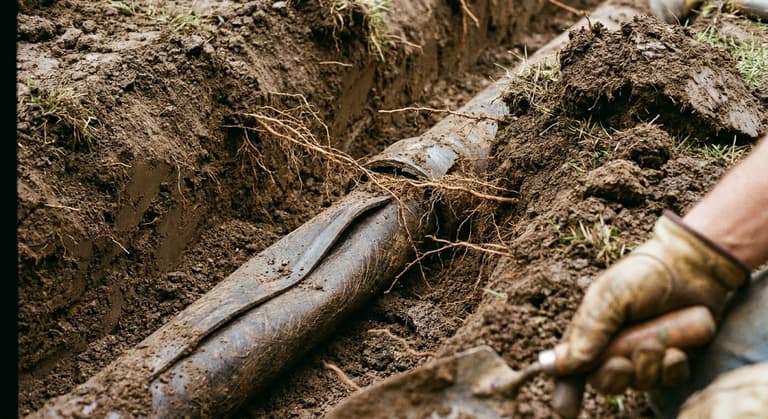
Orangeburg sewer pipe: how it actually fails
Ann Arbor describes the mechanism plainly: the material breaks down, earth pressure squeezes the wall out of round, and the rounded bottom that carried the flow is gone.
Roots do the rest. The APWA Minnesota chapter notes the tar pitch was once thought root proof, but as it dries, sewer moisture works through the wall and roots get in at the joints.
Because bitumen holds the fibers together, Ann Arbor warns that paint thinner, mineral spirits or adhesive cleaner poured down a drain attacks the wall from the inside. That is why two houses built the same year can differ by decades.
| What you notice | What it means | Next move |
|---|---|---|
| Backups return weeks after each cleaning | Deformation, not a one-off clog | Camera the pipe, do not re-rod it |
| Roots return on the cutter head | Open joints in a dried out wall | Ask for footage of the joints |
Orangeburg rarely announces itself: the oval creeps in, the joints open, and the collapse that finally stops the sewer pipe ends a slow sequence rather than a sudden one.
Ann Arbor's record shows numerous failures of bituminous fiber sewer pipes, and where Orangeburg is the material in the ground, the city concludes that removing and replacing all or part of the run may be the only fix.
How long does Orangeburg pipe last?
The APWA Minnesota chapter records the advertised service life as 50 years, and production ended in 1974, so every foot of this pipe still in the ground has outlived the number it was sold on.
HomeGuide's 2026 sewer data puts the material and clay in a 30-60 year band. It is not a countdown for your address: soil, roots, slope and what past owners poured down the drain all move it.
Ready to talk to a licensed repipe pro?
Call (800) 555-0195No charge to call. A licensed repipe pro answers.Licensed repipe partners in your area- Every partner plumber is licensed and insured
- Calls routed around the clock
- Nothing billed for the call
- The plumber quotes you, and you say yes or no
Repair or replace, honestly
Snaking is the reflex, and Ann Arbor is blunt about the tradeoff: a cutting head can damage the wall, and clearing the blockage helps only briefly because the failure mechanism resumes.
Trenchless, where the line allows
- Bursting pulls new pipe through the old run: $60-$200 per linear foot (HomeGuide 2026), $150-$190 per Angi
- Cured in place lining runs $90-$250 per linear foot (HomeGuide)
- Lawn and driveway mostly survive
Open cut, when it does not
- Lining needs a host that still holds its shape, which a deflected run often cannot
- Trench digging alone adds $5-$12 per linear foot (HomeGuide)
- Restoration is the hidden bill: resodding runs $1.50-$4.00 per square foot (HomeGuide)
Where the details live
- What this material is and how to identify it. Composition, the tapered butt joints, the ASTM standards it was built to, and the asbestos question that two public sources answer differently. Worth reading before a listing calls the sewer original but fine.
- What a replacement really costs. Pricing method by method, the restoration and permit money people forget to budget, and the questions that make three bids comparable instead of three different scopes of work quoted three different ways.
- Galvanized supply piping. Vintage houses often carry both problems: fiber under the yard, corroded steel in the walls.
- Lead service lines. The other buried line, on a federal replacement clock rather than a wear cycle, with the EPA penny and magnet checks.
- Start from the house age. Not sure which material you own? The home page sorts it by era.
Is there an Orangeburg pipe lawsuit?
The maker is long gone: the company closed in 1974. The class settlements people cite cover other materials, and both are closed. Cox v. Shell Oil created a $950 million polybutylene fund with claims filed only until 2009, per Shell's 1998 SEC filing. The Kitec fund of $125 million closed to claims on January 9, 2020.
Neither covers orangeburg sewer pipes, and whether a state law claim survives on your facts is a question for a lawyer.
When to stop researching and call
Red flags that skip the reading: a backup in the lowest drain in the house, a toilet gurgling when the washer drains, sewage in a floor drain, or a wet strip of lawn over the run.
If a camera has found Orangeburg under your yard, the next step is a quote from someone who can locate the run. Call (800) 555-0195. The call is free, a licensed local plumbing partner picks up, and you approve any work directly.