
What Is Orangeburg Pipe? A Homeowner Guide
The short version
- It is bituminous fiber sewer pipe: fiber layers bound with coal tar, sold under a brand name that stuck (City of Ann Arbor).
- The APWA Minnesota chapter dates Minnesota use from the 1940s to the 1970s and records the manufacturer closing in 1974.
- Ann Arbor describes cellulose and asbestos fibers; the APWA Minnesota chapter describes wood fiber and coal tar pitch. Composition is unresolved, so nobody should cut it open casually.
- Advertised useful life was 50 years (APWA Minnesota chapter), and production ended in 1974, so every buried foot is past that number.
- What settles it is a camera inspection ($125-$500 on average, HomeGuide 2026), not the year printed on the deed.
What is Orangeburg pipe? It is a sewer line made from bound fiber and coal tar rather than clay, iron or plastic, and the brand name ended up as the generic label. The City of Ann Arbor, Michigan gives that generic name as bituminous fiber pipe and names the maker as the Orangeburg Manufacturing Co., Inc. of Orangeburg, New York. Plumbers of the era called it no-corrode.
If the word landed on your inspection report, the useful question is whether the run under the lawn still holds a round shape.
Grayfield is a publication independent of the trade it covers, and it holds no plumbing contractor's license. The number here belongs to a partner network rather than to a writer: a licensed plumber near your address takes the call, the network pays Grayfield for the referral, and none of it lands on the invoice you sign.
What is Orangeburg pipe made of?
Two public bodies describe the recipe differently, and the gap matters before anyone cuts a section out.
Ann Arbor names two fiber types, cellulose and asbestos, saturated in a coal tar (bituminous) compound. The American Public Works Association Minnesota chapter writes it up more narrowly: ground wood fiber, pressed into layers, then soaked in coal tar pitch, with no asbestos named.
The construction is better documented. Ann Arbor records two wall types, homogeneous and multiple ply laminated, with tapered ends forming a butt joint. Two standards governed it, ASTM D-1861 for the homogeneous wall and ASTM D-1862 for the laminated one, setting the bar for crush and flattening strength, water absorption, permeability and chemical resistance.
Does Orangeburg pipe contain asbestos?
The public record is split, and Grayfield will not close a question the sources leave open. Treat it as unresolved: quote Ann Arbor's description to your contractor and building department, then let them decide on testing and handling.
When was Orangeburg pipe used?
Two dates bracket the history of Orangeburg pipe, and neither is a national cutoff.
| Date | What happened | Source |
|---|---|---|
| 1948 | The Fiber Conduit Company renames itself Orangeburg Manufacturing Company | APWA Minnesota chapter |
| 1949 | Contractors report the material in homes built this early | City of Ann Arbor |
| 1940s to 1970s | Common in Minnesota homes: sewer mains, service lines, vent piping | APWA Minnesota chapter |
| May 1970 | An ordinance removes bituminous fiber from approved sewer materials | City of Ann Arbor |
| 1974 | Orangeburg Manufacturing Company ceases operations | APWA Minnesota chapter |
When did they stop using Orangeburg pipe?
Locally, whenever the code said so: Ann Arbor's cutoff was that May 1970 ordinance. The brand itself ended in 1974, when Orangeburg Manufacturing shut down, per the Minnesota chapter of the APWA. Ann Arbor calls the early 1950s to the early 1970s a reasonable assumption for its own housing stock, yet its contractors report homes built as early as 1949, so the deed year is a hint and never a finding.
What does Orangeburg pipe look like?
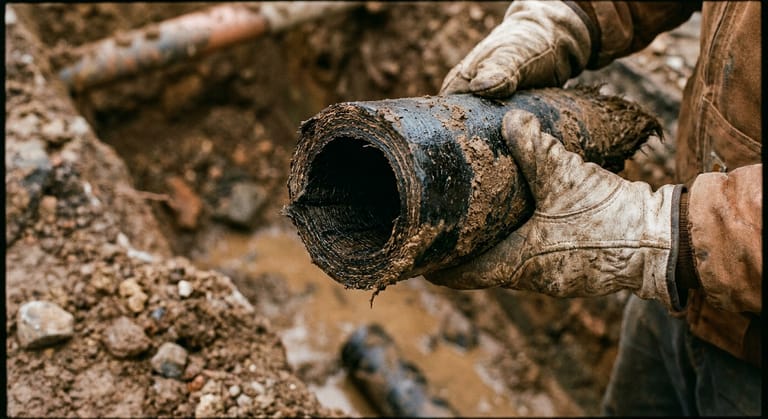
In the trench the wall gives it away: bound fiber layers rather than fired clay or cast iron, tapered ends butted together, and a tar bound surface.
On a camera monitor, shape is the tell. Ann Arbor describes a wall that decays and then squashes out of round under the soil load, so the picture is an oval with the rounded bottom gone, often with root hair at the joints.
Guessing from color settles nothing; the answer shows up on a camera screen, not in a listing.
Ready to talk to a licensed repipe pro?
Call (800) 555-0195No charge to call. A licensed repipe pro answers.Licensed repipe partners in your area- Every partner plumber is licensed and insured
- Calls routed around the clock
- Nothing billed for the call
- The plumber quotes you, and you say yes or no
How to identify Orangeburg pipe without guessing
- Screen by era. A house from the late 1940s through the early 1970s on its original lateral is a candidate. Ann Arbor keeps no list of affected houses: the material turns up anywhere in town, sometimes along a whole street, sometimes at one address between clean neighbors.
- Read the symptom pattern. A single clog clears and stays cleared. Deformation returns on a schedule, because the shape causing it never changed.
- Send a camera down the lateral. Footage of the line averages $125-$500 in HomeGuide's 2026 data, and $175-$750 where no cleanout exists.
- Ask for the municipal paperwork. Ann Arbor has logged the addresses of replaced sewer pipe since the mid 1980s, so your building department may already hold the answer.
Unsure what a house of that age hides? The material identification guide works down from build dates.
Why Orangeburg drain pipe fails
Four mechanisms recur in the public record, and in Orangeburg sewer pipes they compound.
- Deformation. Per Ann Arbor, the wall decays and the soil load presses it out of round. The curved invert that carried the flow stops existing.
- Roots at the joints. The APWA Minnesota chapter corrects an old assumption: the tar pitch was supposed to keep roots out, but it dries with age, sewer moisture seeps through the wall, and roots follow. Ann Arbor adds that they usually enter at joints, loosening sections and restricting flow.
- Bedding movement. Shifting bedding pushes lengths out of line and breaks them apart, again at the joints, per Ann Arbor.
- Solvents. Bitumen is the glue holding the fibers together, so Ann Arbor warns against tipping any solvent down a drain, thinner and mineral spirits and adhesive cleaner included. In laminated stock the softened bottom bows upward under the earth load.
That last one explains a puzzle: two houses on one block, same build year, decades apart in condition.
Orangeburg pipe life expectancy
Fifty years was the advertised number, and the APWA Minnesota chapter records it as the life the product was once expected to deliver. Manufacturing ended in 1974, so every foot still buried in 2026 has outlived it. HomeGuide's 2026 sewer data files it in a 30-60 year band alongside clay.
Nobody can quote a lifespan for the Orangeburg pipe under your own yard. Soil, slope, root pressure and whatever earlier owners poured down the drain move the outcome by decades.
Symptoms that should go straight to a licensed plumber
Call before the next cleaning, not after it, when any of this shows up:
- a backup that returns within weeks of a professional clearing
- slow drainage in two or more lowest floor fixtures at once
- gurgling from the toilet while a tub or washing machine empties
- a sewage odor across the yard, or a spongy dip in the lawn tracking the run
- water sitting in the cleanout
Where a camera confirms bituminous fiber, Ann Arbor's position is that removing the run and laying a new one, whole or in part, may be the only fix.
Sewer line replacement sits at $50-$250 per linear foot in HomeGuide's 2026 figures, or roughly $2,000-$10,000 across a 40 foot run. Our breakdown of Orangeburg replacement pricing covers costs method by method, permits and restoration, and the Orangeburg sewer pipe hub covers repair versus replace.
Want the run traced and the footage read by somebody who prices this work for a living? Call (800) 555-0195. Nobody is billed for a phone call, the plumber who answers holds a license, and the scope waits on your approval.