
Cost to Replace Orangeburg Pipe: The 2026 Math
The short version
- HomeGuide's 2026 sewer data prices replacement at $50-$250 per linear foot, or about $2,000-$10,000 for a 40 foot run. Everything else on this page explains where inside that band a job lands.
- Lining is frequently unavailable here: the process needs a host pipe that still holds its shape, and the City of Ann Arbor reports that soil pressure squashes this material until the bore stops being round.
- Trenchless pipe bursting runs $60-$200 per linear foot at HomeGuide and $150-$190 nationally at Angi, with Los Angeles quoted at $230-$300.
- Surface repair is the line people forget: resodding alone is $1.50-$4.00 per square foot (HomeGuide 2026), and Angi puts a trenchless sewer permit as high as $1,000.
- A camera inspection costs $125-$500, or $175-$750 with no cleanout (HomeGuide 2026), and no honest bid exists without that footage.
A sewer camera has found bituminous fiber under the front lawn, and the next question is money. In 2026 the cost to replace Orangeburg pipe is priced as an ordinary sewer line job rather than as a specialty: HomeGuide's 2026 sewer data puts replacement at $50-$250 per linear foot, or roughly $2,000-$10,000 for a 40 foot run.
That five to one spread is not vagueness. It is length, depth, access, method and whatever has to be rebuilt on the surface afterwards. Grayfield is an independent publishing operation and no kind of plumbing contractor, so nothing below is a quote. Treat it as budget math before bidding.
Orangeburg pipe replacement cost, line by line
| Line item | Typical 2026 range | Where the figure comes from |
|---|---|---|
| Sewer replacement, all methods | $50-$250 per foot, about $2,000-$10,000 for 40 feet | HomeGuide 2026 |
| Trench digging alone | $5-$12 per foot | HomeGuide 2026 (excavation only, not a finished job) |
| Pipe bursting | $60-$200 per foot | HomeGuide 2026 |
| Pipe bursting, quoted nationally | $150-$190 per foot | Angi 2026 |
| Cured in place lining | $90-$250 per foot; spin casting $80-$250 | HomeGuide 2026 |
| Boring a new path underground | $10-$30 per foot | HomeGuide 2026 |
| Camera inspection | $125-$500, or $175-$750 with no cleanout | HomeGuide 2026 |
| Trenchless sewer permit | up to $1,000 | Angi 2026 |
A published band becomes a real number only once a plumber stands over the run with a tape and a camera. Dial (800) 555-0195 and a licensed local plumber from the partner network takes the call, measures the lateral and prices the method. The call is not billed, a referral fee may reach Grayfield if work follows, and dollar figures are negotiated with the plumber.
The per foot arithmetic, worked
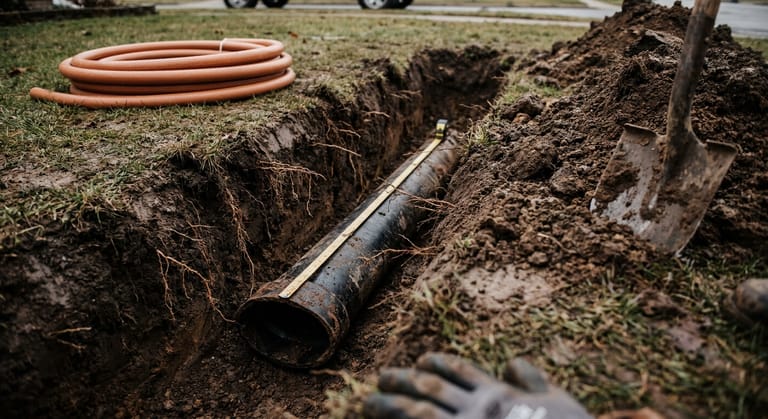
Rates only become budgets once you know how far the lateral travels. Measure from where the line leaves the house to the connection at the street, then multiply. Sixty feet at HomeGuide's $50-$250 band lands somewhere between $3,000 and $15,000 before a single square foot of lawn is replaced. The City of Ann Arbor calls the early 1950s to the early 1970s a reasonable assumption for Orangeburg sewer pipes in its own city, a local benchmark rather than a national one.
Depth does the rest of the work. A lateral below frost depth, tucked beneath a slab porch or passing under a driveway is dearer per foot to reach than the identical pipe two feet down in open turf. A serious bid answers two things before naming a price: the measured footage, and the depth at its deepest point.
Replacing Orangeburg sewer pipe: method by method
How the material fails picks the method, and it also sets this job apart from swapping out clay. Per Ann Arbor, bituminous fiber breaks down and is then squeezed flat by the weight of the soil, until the bore is no longer circular. Because a liner cures against a host that still holds its shape, a badly deflected run is often past lining whatever the budget.
Trenchless, where the run allows it
- Bursting pulls new pipe through the old path: $60-$200 per linear foot (HomeGuide), $150-$190 quoted nationally (Angi)
- Lining runs $90-$250 per foot (HomeGuide), but only over a pipe that is still round
- Lawn, drive and mature trees mostly survive, which is where the savings actually sit
Open cut, when it does not
- Collapsed or heavily deflected runs force a trench; digging alone adds $5-$12 per foot (HomeGuide)
- Full surface restoration comes back into the budget
- An open trench does let the plumber see and correct bad bedding and slope
How the job runs, step by step
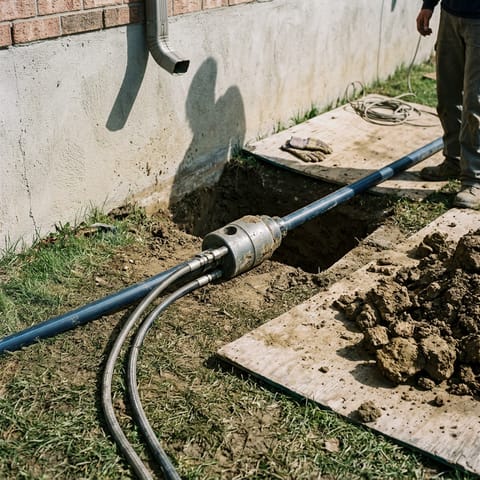
- Camera and locate. Footage confirms the material, the deformation and the exact depth. HomeGuide prices this at $125-$500, or $175-$750 where there is no cleanout to work through.
- Choose the method. The condition of the Orangeburg run, not a sales preference, decides between bursting, lining and open cut.
- Pull the permit. Municipal review and inspection are part of the price, and Angi puts a trenchless sewer permit as high as $1,000.
- Replace and tie in. Either a trench, or entry and exit pits at each end for a bursting head.
- Inspect, backfill, restore. The inspection is the milestone; the restoration is the invoice line most homeowners never saw coming.
Ready to talk to a licensed repipe pro?
Call (800) 555-0195No charge to call. A licensed repipe pro answers.Licensed repipe partners in your area- Every partner plumber is licensed and insured
- Calls routed around the clock
- Nothing billed for the call
- The plumber quotes you, and you say yes or no
The money that is not in the per foot rate
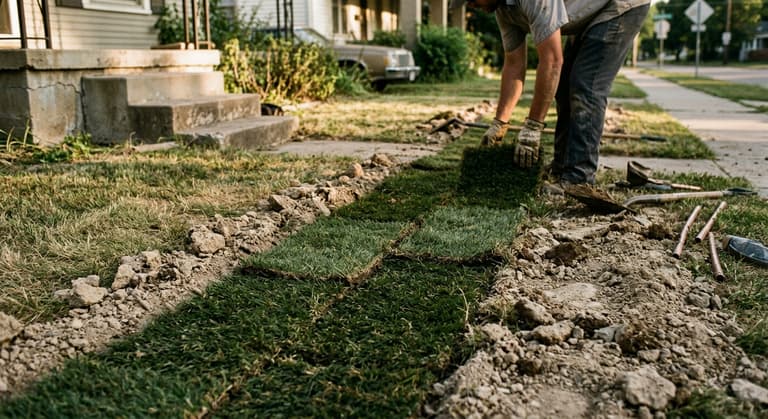
Ask every bidder to itemize the surface work, because an Orangeburg trench runs straight through the part of the property you look at each day. HomeGuide's 2026 lawn pages price resodding at $1.50-$4.00 per square foot, a rate expected to absorb stripping and hauling the old turf, light prep and the new sod. Regrading is quoted apart, at $0.40-$2.00 per square foot.
Sod as bare material is $0.30-$0.80 per square foot, or $130-$360 for a pallet, and laying it adds labor of $0.50-$1.00 per square foot, or $35-$80 an hour. Across a trench through a front lawn, those lines separate a bid that gives back a yard from one that gives back a ridge of clay.
Hardscape is the wildcard. No national aggregator range in our source set prices the replacement of a driveway apron, a patio or a public sidewalk cut, so treat any bid that stays silent on them as incomplete rather than cheap. Four restoration lines belong in writing next to the pipe scope:
- Turf. The square footage to be resodded, and whether hauling away the old sod is inside that number or billed on top of it.
- Grade. Regrading of the trench line once the backfill settles, which HomeGuide prices separately from the sod.
- Hardscape. Every driveway apron, patio and sidewalk cut, either priced item by item or written down as excluded.
- Paperwork. The permit and the final inspection, named in the bid rather than assumed into it.
Permits and the municipal paper trail
In code terms there is no choice about what goes back into the ground. An Ann Arbor ordinance effective May 1970 struck bituminous fiber off the approved sewer materials list and bars installing it new, so the replacement must be a currently approved material and must clear inspection before anyone backfills.
Regional spread: why the same 60 feet of Orangeburg doubles
The clearest published illustration comes from Angi's 2026 trenchless figures for the same method: pipe bursting at $150-$200 per linear foot in Dallas, $140-$180 in Indianapolis and $230-$300 in Los Angeles. Nothing about the pipe changes between those cities.
Labor rates, permit and inspection regimes, traffic control on a street cut, frost depth and how much restoration the municipality demands all do. That is why a national average is a sanity check on a bid rather than a substitute for one, and why bids from three local firms beat any figure on a website, including this one.
What you can do yourself, and where that stops
Almost none of this job is homeowner work, though part of the diagnosis can be: a rented sewer camera is $120-$225 a day at HomeGuide, which buys enough footage to spot an oval bore and roots at the joints. The false economy starts with clearing the line yourself. Ann Arbor cautions that a cutting head can harm the pipe as it works, and that the blockage it opens returns, because nothing has stopped the deformation behind it.
Digging beside a live sewer main, the tie in at the street, the permit and the inspection are all licensed contractor territory. Put this page down and phone one when the lowest drain floods first, when a toilet gurgles as the washing machine empties, when clogs return within weeks of every cleaning, or when a damp stripe traces the run across the lawn.
What to read before the bids come in
Read what this material is and how it is identified so the footage makes sense, and use the Orangeburg pipe hub for the failure pattern and the repair versus replace verdict. Houses of this era often carry a second bill indoors, which is why the galvanized supply pipe replacement cost guide sits next to this one, and the home page identification walkthrough sorts materials by the year the house went up.
Ready to put a real number on the cost to replace Orangeburg pipe under your own lawn? Call (800) 555-0195. Whoever digs will not be Grayfield, which only publishes: the number opens into a partner network whose licensed, insured plumbers cover your street. That introduction costs you nothing, may earn Grayfield a fee, and the plumber sets scope and price.