
Lead pipes: how to identify the line in your house
The short version
- Soft, flat silver gray, indifferent to magnets: a coin scratch comes up bright silver, and a magnet finds nothing to grip (EPA).
- Run the check where the buried line comes inside, in the basement or crawl space by the meter or the main shutoff (EPA).
- Roughly 9.2 million lead service lines nationwide is EPA's count in its 2023 needs survey, and plenty of utilities still file lines under unknown.
- Zero is where EPA puts the health goal for this contaminant in drinking water, and no safe level in children has been identified; CDC applies the same reasoning to blood levels.
- A full replacement lands at $1,852-$7,056 per line in EPA's 2016 dollar analysis and $4,275-$13,324 in Illinois program data, with the payer settled city by city.
Lead in pipes leaves no taste, no color, no smell, so identification comes first. This hub covers the two minute check that tells the soft gray metal from galvanized steel and copper, then risk, rules and 2026 replacement costs. Grayfield is an independent publisher, not a contractor: the number reaches a licensed, insured local plumbing partner, free of charge.
What does a lead pipe look like?
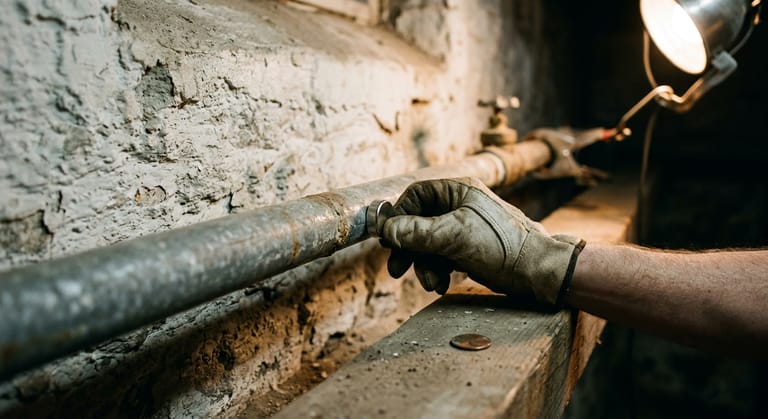
Two physical traits carry the test, both out of EPA's inventory guidance. Softness comes first: a coin or key leaves a mark. Second, the material ignores magnetism, so a magnet slides off. Color alone settles nothing, since dust makes galvanized steel and this metal look alike. EPA's consumer version needs only a magnet and a penny or key.
- Follow the buried run to where it enters through wall or floor. EPA points to the crawl space or basement, wherever meter and main shutoff sit.
- Choose a bare stretch between that entry and the inlet valve, then scrape it with a coin edge or key. EPA suggests gloves.
- Judge the mark, not the surface around it.
- Set a magnet on the same spot: it tells apart two materials dust leaves looking alike.
The City of Troy, New York sets the outcomes side by side:
| Scratch result | Magnet | Likely material |
|---|---|---|
| Mark turns bright silver, surrounding surface stays dull | Does not stick | Lead |
| Barely marks at all, no change of color | Sticks | Galvanized steel |
| Mark is bright and coppery | Does not stick | Copper |
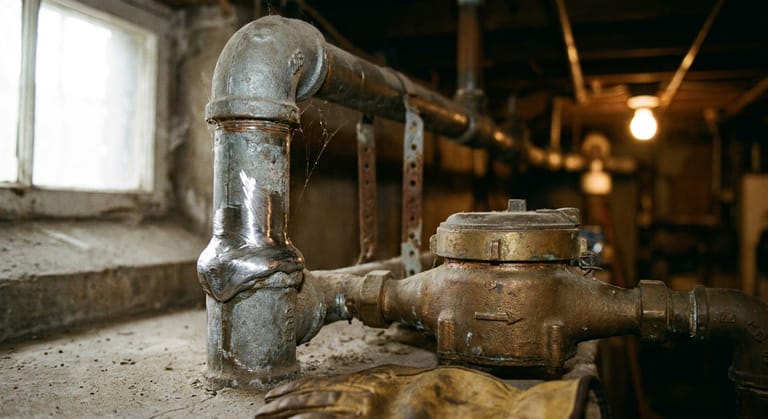
A third clue sits where two metals meet. Joints to another metal are frequently wiped joints, and the giveaway EPA describes is a rounded bulge at the seam, usually near the meter. Under paint, EPA notes an approved lead paint swab kit reads a pipe too.
Photograph what you find: it lets a plumber read the joint and supports a challenge to the utility's classification.
Which line is regulated, and when was it installed?
One name covers two things. A service line is the buried section from the water main to where household plumbing begins, and EPA singles it out as a major contamination source for drinking water. The same metal inside walls is far less common; HUD traces indoor use to the early 20th century. The buried section is the regulated one.
These lines went in until the mid 1980s, earlier in many cities. The 1986 Safe Drinking Water Act amendments made states enforce a prohibition on pipe, solder or flux failing the lead free definition, effective 24 months from June 19, 1986. EPA tells systems to check their own state's date, not one national cutoff. When lead pipes were banned has that timeline.
What that phrase actually meant
The 1986 definition was loose, EPA explains: solder and flux qualified at 0.2 percent or below, while lead in pipes could reach 8.0 percent. The Reduction of Lead in Drinking Water Act of 2011 reset pipes and fixtures to a weighted average of 0.25 percent across wetted surfaces for anything bought on or after January 4, 2014, leaving solder and flux at 0.2 percent. On older copper the joints therefore matter more than the tubing: solder joints in copper systems and the lead free solder options go into that.
For scale: EPA's 7th Drinking Water Infrastructure Needs Survey and Assessment (2023) puts the national count near 9.2 million lead service lines, with $60.2 billion needed to replace them.
The clock comes from two EPA rules. By October 16, 2024 the Lead and Copper Rule Revisions required each system to hold a public service line inventory, with four labels per run: non lead, lead, galvanized requiring replacement, or status unknown. The Improvements rule, finalized in October 2024, put a 10 year frame around finding and pulling those lines, from a compliance date of November 1, 2027, with full replacement owed no later than 10 program years after it. States may approve a deferred schedule where the burden is heaviest, so read your utility's plan.
How lead in pipes ends up in the water you drink
Release follows no schedule. The mechanism EPA gives is chemical: corrosion of plumbing that contains the metal puts it into drinking water, and corrosion runs harder in acidic water or water low in minerals. Utilities answer with corrosion control, usually a phosphate inhibitor. EPA's guidance walks through orthophosphate meeting the dissolved metal and forming solids that build a protective scale inside the line, and that scale keeps the water clean.
Two moments break the pattern:
- Treatment or supply changes. Flint moved to a different supply in April 2014, and inadequate treatment left many residents exposed; the EPA Office of Inspector General traced it to corrosion control the system failed to maintain. The plumbing had not changed; the chemistry had.
- Physical disturbance. Work on a service line can shake the metal loose, which EPA reports from field sampling and attributes to Del Toral et al. (2013), whose results above the 0.015 mg/L action level then in force came mostly from disturbed sites. A meter swap, a street dig, a half finished replacement: all qualify.
Do not relax about a gray pipe until galvanized steel is ruled in or out. EPA's caution: a galvanized line that sits, or once sat, downstream of a lead one can adsorb the metal and hand it back later. The galvanized pipe hub takes it from there.
What EPA and CDC say about the risk
Agency consensus is what the case against lead in pipes rests on. In drinking water the maximum contaminant level goal EPA has set for this metal is zero, a health target rather than a number anyone enforces; enforcement runs through the action level and treatment rules. No safe level in children has been identified, EPA states, and CDC frames blood levels the same way, noting that even low ones show up in a child's intelligence, attention and academic achievement. CDC's blood lead reference value, moved in October 2021 from 5.0 to 3.5 micrograms per deciliter, is a screening marker, not a safety line.
The documented effects
EPA sorts the documented effects by who is exposed.
- Children six and younger, who take up more of it than an adult: harm to a brain and nervous system still developing, slower growth, weaker attention and learning, lower IQ, hearing and speech trouble.
- Adults: higher blood pressure, effects on heart and kidneys, and reproductive problems including infertility.
- During pregnancy and breastfeeding: bone banks the metal the way it banks calcium, and the store can come back out, reaching the fetus or nursing infant.
Grayfield publishes no medical advice, and none of this interprets one household's exposure. Take health questions to your clinician, water questions to your utility and the state or local drinking water authority. Are lead pipes dangerous carries the longer answer.
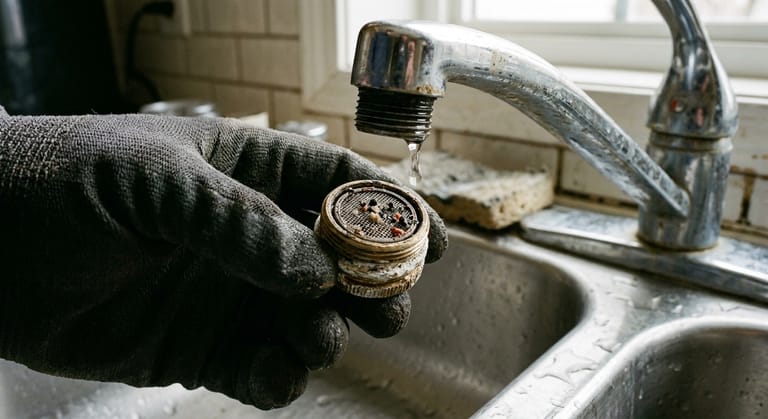
EPA's holding measures while the line is still in the ground. Take cold water only for drinking, cooking and infant formula, and do not count on boiling, which leaves the metal in the water. Flush standing water first, by running the tap or a shower or dishwasher cycle, then rinse the aerator screen, where particles collect.
Ready to talk to a licensed repipe pro?
Call (800) 555-0195No charge to call. A licensed repipe pro answers.Licensed repipe partners in your area- Every partner plumber is licensed and insured
- Calls routed around the clock
- Nothing billed for the call
- The plumber quotes you, and you say yes or no
Test the water first, then decide about the pipe
Sight, taste and smell tell you nothing here, so a lab result is the only measure of what lead in pipes is doing at your tap. Three moves, in order:
- Use a certified laboratory. EPA sends homeowners there, and your state or local drinking water authority holds the list. A search for a lead water test near me surfaces retail kits, but a five figure decision earns the certified route: lead water pipe testing covers collection and results.
- Filter in the meantime. Certification buys time, not a cure. EPA's advice: look for a mark and wording showing the unit was tested to NSF/ANSI Standard 53 with a lead reduction claim, plus Standard 42 (Class I) for particulates. A cartridge performs only while replaced on schedule, and the water filter guide compares the options.
- Hold the utility to its notice. Anyone served by a lead, galvanized requiring replacement, or unknown line gets annual notification under the Improvements rule, which must explain how to contest a wrong classification and request a tap sample.
Repair or replace? The verdict on a buried line
No repair makes this metal safe, and there is no service life to plan against. The buried run is a regulated source of contamination, not a component that wears out, and EPA rules put every line under a water system's control in line for full replacement. That leaves who does the work, when, and who pays for the private side.
Why partial replacement backfires
EPA's Science Advisory Board found a partial job often drives tap water lead up sharply for days or weeks, occasionally several months, and will not endorse it as a safe way to cut exposure short term. Federal rules agree. 40 CFR 141.84(g) bars partial replacement except during an emergency repair or coordinated infrastructure work, and any partial job that goes ahead must include a dielectric coupling. If a quote stops at the section inside your basement, raise that first.
Ranges, not quotes. EPA's economic analysis for the 2019 proposed rule priced full replacement between $1,852 and $7,056 per line in 2016 dollars, per the Illinois EPA advisory board report; program figures in that same 2023 report landed between $4,275 and $13,324 per line for Illinois outside Chicago, and Chicago reported $20,000 to $26,000 per unit in its first construction phase. NYC DEP puts a line between $5,000 and $10,000 by length. The [cost breakdown](/lead-service-line-replacement-cost/) sorts the drivers.
The payer is settled locally. Every service line has a public and a private side, and city programs split from there: Denver Water swaps customer owned lines for copper at no direct cost, while private ownership in New York City leaves DEP unable to compel replacement. Lead pipes by city follows programs and cost shares; lead service line replacement covers the work.
Where to go next
- Interior supply repiping: piping inside the walls, and how a repipe moves through finished rooms.
- Old lead pipes: pre 1940 stock, where the metal also shows up in drains, vents and odd fittings.
- Lead vs copper pipes: the two people confuse most, compared on color, weight and joints.
- Polybutylene pipe: gray plastic supply piping in a 1980s or newer house, worth ruling out next.
When to call a licensed plumber
A few findings earn a call the same day.
- The utility letter reads lead, galvanized requiring replacement, or unknown status, with no program date.
- A rounded gray lump sits where the buried line meets interior plumbing.
- Street digging or a meter change happened and the water ran discolored.
- A contractor offered to replace only the visible section.
- You are buying a pre 1986 house and the inspection leaves the material unknown.
Lead in pipes is a solvable problem, and the remedy is scheduled work, not an emergency. Dial (800) 555-0195, describe what the check turned up, and get a plumber's read. The call costs nothing, a licensed and insured local partner answers, and you agree scope and price.
Ready to talk to a licensed repipe pro?
Call (800) 555-0195No charge to call. A licensed repipe pro answers.Licensed repipe partners in your area- Every partner plumber is licensed and insured
- Calls routed around the clock
- Nothing billed for the call
- The plumber quotes you, and you say yes or no