
Are Lead Pipes Dangerous?
The short version
- The federal health goal for this metal at the tap is zero, and EPA has never identified a level in children it can call safe. CDC lands in the same place on blood.
- Nothing about the release is steady. Aggressive water chemistry, a switch in treatment, digging on the street and hours of standstill are the triggers EPA documents.
- November 1, 2027 moves the action level from 0.015 to 0.010 mg/L, and what it grades is a utility's 90th percentile, never one kitchen faucet.
- Sight, taste and smell settle nothing here, which is why EPA sends householders to a laboratory certified by the state drinking water authority.
- EPA's 2019 analysis priced a full line swap at $1,852-$7,056 in 2016 dollars; Illinois program figures land at $4,275-$13,324.
Yes, with the qualifier most pages drop. EPA's health goal for this metal at the tap, the maximum contaminant level goal, sits at zero, and the agency has never identified a level in children it can call safe. Federally, nothing is left to argue.
Nobody can call your own buried run from a distance: how much it gives up, and when. That moves with water chemistry, with disturbance, and with hours of standstill. So are lead pipes dangerous at your address? No photograph settles that, and no build year. Only a certified laboratory result.
The dangers of lead pipes, ranked by how often they bite
Lead pipes do not leach at a constant rate. A mineral crust, held in place by treatment chemistry, stands between metal and flow, and trouble starts when that truce breaks. EPA's corrosion control recommendations (EPA 816-B-16-003, March 2016) set out the mechanisms, ordered here by frequency.
| Trigger | What it does inside the line | Documented by |
|---|---|---|
| Aggressive water: acidic or too soft | Metal dissolves into the flow, unseen | EPA, lead in drinking water basics |
| A new disinfectant or treatment recipe | A pH shift rearranges the scale and frees what it held | EPA corrosion control recommendations |
| Street digging, a meter change, half a line swapped | Loose particles travel. In Del Toral et al. (2013), cited by EPA, most results over 0.015 mg/L came from disturbed sites | EPA, same |
| Hours of standstill in a lightly used house | Aging water drops pH and burns off chlorine residual, so the protective layer forms poorly | EPA, same |
Flint is that treatment row written city sized. EPA's Office of Inspector General found treatment after the April 2014 supply switch inadequate, leaving many residents exposed, and the corrosion control delay stretched it out. Nobody touched the pipes; the water changed.
Are lead pipes safe when the glass runs clear and tastes fine?
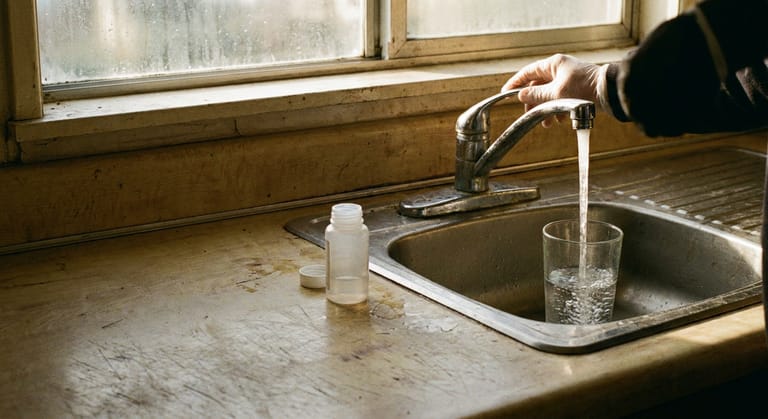
No. Dissolved in water this metal announces itself in no way at all, so EPA points householders at a laboratory holding state drinking water certification, not at their own senses. A clear glass speaks to sediment and iron, nothing further.
Two facts about lead pipes cost nothing. EPA's 2023 infrastructure needs survey puts roughly 9.2 million lead service lines still buried nationally, and every system had to inventory service line materials by October 16, 2024, so your address should already carry one. The third costs money: a sample from your kitchen faucet. Our guide to certified tap water testing says what to ask a laboratory for.
How much lead in drinking water is considered safe?
The rulebook gives two answers, and blurring them is how readers go wrong. Zero is a health goal and enforces nothing. What is enforceable is an action level, backed by treatment the system must run.
Under the Lead and Copper Rule Improvements of 2024 the old trigger level disappears and the action level drops to 0.010 mg/L from 0.015 mg/L, counting from the November 1, 2027 compliance date. Laboratory reports write it as 10 parts per billion.
What the number grades is a utility's 90th percentile, not your kitchen. Are lead pipes dangerous below it? Put it as how much lead in water is dangerous, and EPA names no safe amount: the health goal stays at zero.
Can lead pipes make you sick, and what counts as poisoning?
EPA publishes a list of associations, not a checklist for the kitchen table. For a child they gather on a nervous system still under construction: harm to the brain and nerves, growth and development falling behind, trouble with learning and behavior, a lower IQ, attention that will not hold, hearing and speech coming in poorly. Greatest risk goes to children six and younger, EPA says: a growing body absorbs more of the metal.
In grown ups it turns to organs: higher blood pressure with heart problems alongside, kidneys filtering less well, fertility problems in men and women both, and slippage in learning, memory and concentration.
CDC keeps a blood lead reference value, moved on October 28, 2021 from 5.0 to 3.5 micrograms per deciliter. Drawn from the 97.5th percentile among US children ages 1 to 5 in survey data, it singles out those reading higher than most: a screening line, never a line between safe and unsafe.
Poisoning is a clinical finding, out of blood work a clinician orders, and no symptom list read online stands in for it.
Ready to talk to a licensed repipe pro?
Call (800) 555-0195No charge to call. A licensed repipe pro answers.Licensed repipe partners in your area- Every partner plumber is licensed and insured
- Calls routed around the clock
- Nothing billed for the call
- The plumber quotes you, and you say yes or no
Worth doing this week, and what to keep your hands off
- Anything you swallow, draw it cold. EPA's flyer names drinking, cooking and baby formula, and kills the myth: boiling removes none of this metal.
- Move some water before the first glass. A shower, a wash cycle or a dishwasher load does it. EPA quotes no standard number of minutes: that rides on the plumbing in between.
- Rinse the faucet screen. Particles gather in the aerator, and EPA puts cleaning it on the interim list.
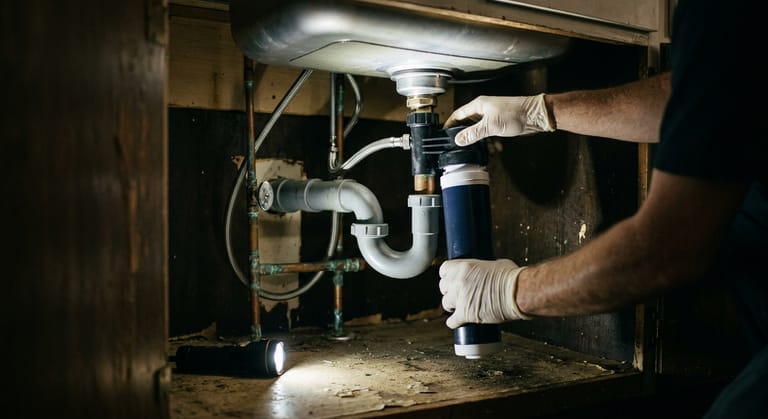
- Treat a certified filter as a stopgap. EPA tells shoppers to look for NSF/ANSI Standard 53 certification with a lead reduction claim, plus Standard 42 Class I for particulates.
- Keep off the pipe itself. Cutting or wrenching on it is the disturbance EPA's data links to elevated results.
Signals that move this onto today's list
- A utility letter filing your service line under lead, galvanized requiring replacement, or unknown.
- Recent excavation on the block, a meter change or a broken main.
- A first draw laboratory result with any detection.
- One stretch swapped, the rest left underground: a partial job.
- A pregnancy in the house, or a small child drinking at the tap.
Grayfield publishes this research and holds no plumbing license. Dialing (800) 555-0195 puts you through to a licensed and insured local plumbing partner, who can look at where the buried run enters the building and price the work with you.
What it costs to get lead pipes out
One clause protects both result and invoice. Under 40 CFR 141.84(g) a system may not do a partial replacement except during emergency repair or planned infrastructure work, and where it has access it must take the whole line.
The reason sits in EPA Science Advisory Board findings: after partial work, tap levels frequently climb for days or weeks, sometimes several months.
From there it is process: how a replacement gets scheduled, what swapping the pipe means indoors and what the closing bill reads with permits and restoration counted.
If the pipes turn out to be something else
The afternoon still paid for itself: one inspection answers the next question. Galvanized pipe that once sat downstream of a lead service line can hold adsorbed lead, EPA says, which is why utilities pull those lines too.
Our identification guide to lead pipes walks through the coin scratch and what a magnet will or will not grip where the buried run enters the basement. Start with your utility's classification, set a laboratory result beside it, let evidence fix the timetable.
Ready to talk to a licensed repipe pro?
Call (800) 555-0195No charge to call. A licensed repipe pro answers.Licensed repipe partners in your area- Every partner plumber is licensed and insured
- Calls routed around the clock
- Nothing billed for the call
- The plumber quotes you, and you say yes or no