
The short version
- Two household objects decide it at the basement wall: per EPA lead stays soft and holds no magnet, galvanized steel is hard and magnetic.
- Install dates do most of the sorting: lead service lines until the mid 1980s, polybutylene 1978 to mid 1995, Kitec 1995 to 2007, Orangeburg sewer laterals through the early 1970s.
- Every service line had to be catalogued by October 16, 2024, and EPA's 2024 rule improvements make replacement mandatory from November 1, 2027.
- Repiping a whole house costs $1,500-$15,000 in Angi's 2026 data, average close to $7,500.
A coin, a magnet, and the year on your deed settle most of this. EPA's quick check on a service line needs only a penny (or key) and a magnet, which sort the five legacy materials here: lead, galvanized steel, polybutylene, Kitec, and Orangeburg.
Ten minutes at the basement wall is usually enough to identify lead pipes yourself. What the material does to your water, or your floor, is the part that needs sources.
What the build date already tells you
Before anything gets scratched, the deed year rules out most of the list. New lead service lines stopped going into the ground around the mid 1980s, many cities earlier. EPA dates that cutoff to the 1986 Safe Drinking Water Act amendments: from June 19, 1986 states had 24 months to enforce a ban on pipe, solder and flux missing the lead free definition.
HUD puts the switch from galvanized steel to copper in the years after World War II, plastics from the 1970s.
| Installed | Likely material | Where it shows |
|---|---|---|
| Until the mid 1980s | Lead service line (EPA) | Entry point, main shutoff, meter |
| Before World War II | Galvanized steel supply pipe (HUD) | Threaded joints, upstairs fixtures |
| Early 1950s to early 1970s | Orangeburg sewer lateral (Ann Arbor) | Buried, seen on camera |
| 1978 to mid 1995 | Polybutylene supply pipe (InterNACHI) | Water heater, meter, stub outs |
| 1995 to 2007 | Kitec (InterNACHI) | Mechanical room, brass fittings |
"Lead free" was never free of it. The 1986 definition, EPA notes, still permitted 0.2 percent in solder and 8.0 percent in pipe.
How to identify lead pipes with a coin and a magnet
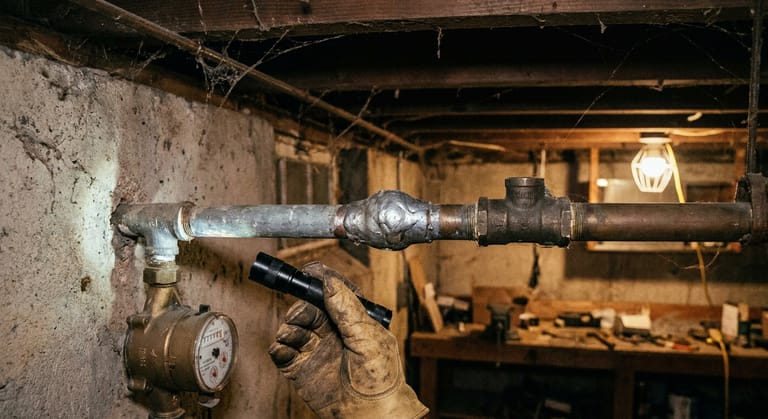
Only one stretch of pipe answers this, and EPA names it exactly: the incoming water line between the foundation penetration and the inlet valve, normally the bare metal standing beside the meter or basement shutoff.
Two things EPA asks first. Gloves go on before the coin comes out, and whatever the scratch knocks loose gets swept up. On a painted run, reach for an EPA approved lead paint swab kit rather than trusting your eye.
- Mark it with a coin. Light pressure is enough on the soft, dull silver gray metal EPA describes, and the streak comes up bright. The City of Troy, New York reads the result three ways: shiny silver means lead, dull gray means galvanized steel, copper colored means copper.
- Try a magnet. Per EPA the soft metal gives a magnet nothing to grab, while galvanized steel takes hold of one and keeps it.
- Look at the joint. EPA flags the old wiped joint where the run ties into another material, a rounded ball of lead. Short of a laboratory, nothing else at that wall carries more weight.
How to tell if you have lead pipes you cannot reach
Half the run sits under the yard, settled on paper rather than in your hand. Per EPA, the Lead and Copper Rule Revisions gave water systems until October 16, 2024 to catalogue every service line material and publish it.
The catalogue leaves no room for free text. A line gets filed as lead, galvanized requiring replacement, non lead, or lead status unknown, and that fourth heading is why so many utility letters answer nothing. EPA's 2024 improvements bolt on an annual notice, plus a route for contesting a classification and requesting tap sampling.
Begin with your utility, then compare what cities publish about their inventories with the lead pipe hub.
Ready to talk to a licensed repipe pro?
Call (800) 555-0195No charge to call. A licensed repipe pro answers.Licensed repipe partners in your area- Every partner plumber is licensed and insured
- Calls routed around the clock
- Nothing billed for the call
- The plumber quotes you, and you say yes or no
How to test for lead pipes, and the water they carry
Two questions get mixed up here. How to check for lead pipes is a question about metal, settled by the scratch, the magnet and the utility record. What the tap water carries is separate.
EPA does not hedge on the second one. The metal betrays itself with no color, no taste, no smell, so a certified laboratory is the only honest answer, and your state drinking water authority keeps the roster. Three interim habits from EPA fill the wait:
- Take drinking, cooking and formula water off the cold tap; boiling drives none of the metal out.
- Buy filtration only where the box reads NSF/ANSI Standard 53 with a lead reduction claim.
- Rinse the faucet aerator, the screen where loosened particles gather.
On health, this page repeats what the agencies say and stops there. EPA's maximum contaminant level goal for lead in drinking water is zero, a health target rather than an enforceable limit, and EPA and CDC both state that no safe level in children has been identified. Neither statement sizes up one household, so that question goes to a clinician and your local health department.
What each material risks, and what replacing it costs
Whether you identify lead pipes or clear the house of them, two questions follow: what does the material do, and what does removal cost?
Lead service lines. Corroding plumbing is how the metal reaches drinking water, per EPA, worst where the supply runs acidic or low in minerals, and street work shakes particles loose. EPA's 2024 rule improvements make replacement mandatory from November 1, 2027, and regulators want the full run gone, not half (see the FAQ). More on how a service line swap works.
Galvanized steel. HUD records corrosion and scale building inside the bore, worst in hot water runs, which strangles upstairs flow. Philadelphia Water adds a second problem: decades of corrosion let lead collect on the pipe walls. More in the galvanized steel hub.
Plastics and the sewer line
Polybutylene. InterNACHI blames oxidant in treated water, chlorine above all, reacting with the plastic and leaving scale, flaking and brittleness, fittings first. Its product standard, ASTM D3309, was withdrawn in 2010. The Cox v. Shell route is closed: Shell's SEC filing put the end of the claims window at 2009, and nothing has accepted a claim since. See the polybutylene hub.
Kitec. InterNACHI describes fittings cast in high zinc brass that corrode by dezincification, narrowing the flow and at worst letting the tube leak. IPEX rejects the claim that the systems are defective. This claim window is closed too: the administrator's deadline ran out in January 2020. See the Kitec hub.
Orangeburg. Soil pressure squashes the material until the bottom is no longer round, says Ann Arbor's building department, and roots find their way in at the joints. APWA Minnesota puts the advertised life at 50 years and 1974 as the last manufacturing year. See Orangeburg sewer pipe.
What the replacement costs
The 2026 spread. Angi's figures stretch a whole home repipe across $1,500-$15,000, averaging near $7,500, while HomeGuide prices sewer line replacement at $50-$250 per linear foot. Scope decides where you sit inside those ranges, so the [galvanized repipe cost breakdown](/galvanized-pipe-replacement-cost/) itemizes rather than averages.
Who writes this, and who answers the phone
Grayfield is an independent publication and sits on the writing side of this trade, not the contracting side. No crew, no truck, no plumbing license, no invented decade of field experience. Every figure travels with the document it came from, and every page begins as an AI draft read back against those documents before it goes live (editorial policy, about).
The number printed here does not ring an editor's desk. It routes into a partner network and puts a licensed and insured local plumber on the call. Where a call qualifies, Grayfield may be paid a referral fee, which never moves the price that plumber quotes you (how we make money).
When to call a licensed plumber
Some findings deserve a call this week.
- A coin mark that comes up bright silver.
- A utility letter that files your service line as lead, or as lead status unknown.
- Rust colored water in the morning's first draw.
- Upstairs fixtures that have gone weak.
- A gray plastic fitting that is weeping.
- A 1960s sewer lateral that backs up again after every cleaning.
On that last one, Ann Arbor cautions that snaking bituminous fiber conduit can damage the pipe, and the blockage returns once the failure mechanism picks up again.
Anyone who repipes houses weekly can identify lead pipes, galvanized steel and polybutylene by eye. If a quote needs checking, the number is (800) 555-0195. The call costs nothing, and scope and price are agreed with the licensed local plumber who answers.
Ready to talk to a licensed repipe pro?
Call (800) 555-0195No charge to call. A licensed repipe pro answers.Licensed repipe partners in your area- Every partner plumber is licensed and insured
- Calls routed around the clock
- Nothing billed for the call
- The plumber quotes you, and you say yes or no