
Galvanized Pipe Replacement: What It Costs and How It Goes
The short version
- HUD's Rehab Guide places this metal's peak in the decades before World War II, with copper taking the market afterward and plastics later still, so any run still carrying water has outlived its generation.
- Flow fades because the deposit grows toward the center of the bore, and nothing a repair can do restores that opening, which is why the answer is normally a whole-house repipe.
- HomeGuide 2026 brackets the installed job at $2,000 to $15,000, while Angi 2026 sets the national midpoint near $7,500.
- Budget for the wall as well: HomeGuide 2026 starts the drywall repair afterward at $300-$1,500 and moves up from there.
- Once a buried line is classed as galvanized requiring replacement, EPA rules hand the timetable to the water system, though who pays for the private side is settled locally.
Corrosion inside galvanized supply lines works toward the center of the bore, so the opening symptom is almost never a puddle. It is the upstairs shower sagging to a dribble the moment someone runs the kitchen tap. At that stage a galvanized pipe replacement usually means the whole system, not one tidy section.
Grayfield researches and publishes; it does not turn wrenches. Dial (800) 555-0195 and you reach a licensed local plumber who quotes the work.
Signs it is time to start replacing galvanized pipes
The HUD Rehab Guide (Volume 8) records the arc: this was the default house supply metal until World War II, copper displaced it once the war ended, and plastics finished the job from the 1970s onward. Whatever is left in the walls is late-life stock, and it gives out along a predictable path:
- Pressure that collapses when a second fixture opens. Deposits thicken along the inner wall of the pipe until the bore is a straw, and the fixture highest in the house is starved first.
- Brown or metallic water on the first draw that clears after a minute or so, worst on the hot side. HUD attributes the decay to unfavorable water conditions working together with heat, which is why hot runs give out ahead of cold ones. Our rusty water guide reads the color for you.
- Damp threaded joints. Fittings corrode before straight runs do, and a joint that has darkened twice will darken a third time.
- A magnet that stays put. EPA's service line inventory guidance has you scratch the outside: steel stays dull gray under the key and holds a magnet, while lead brightens to silver and lets it drop. That grip settles the lead question.
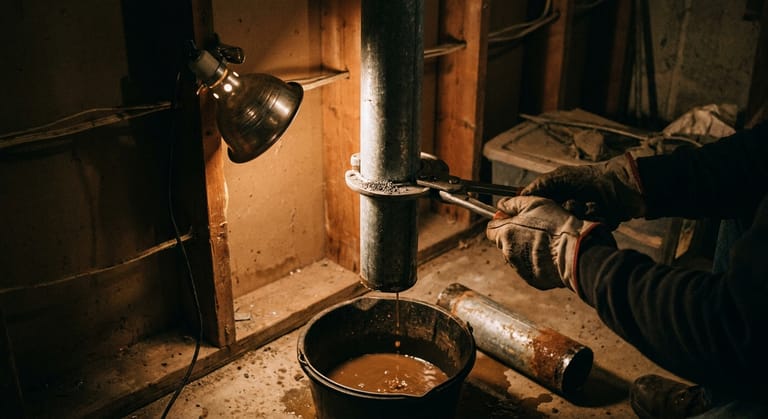
Why the corrosion matters past water pressure
A corroded interior is a rough one, and rough surfaces hold on to whatever drifts past. The Philadelphia Water Department makes the point plainly: over decades of use, lead released anywhere in a property's plumbing can lodge in the pitted walls of galvanized pipe. EPA's consumer flyer on lead in drinking water describes the second half of that cycle, where the deposit lets go again later and arrives at the tap as an elevated reading.
EPA sets the maximum contaminant level goal for lead at zero, and the only way to learn what your own tap delivers is a sample run by a state-certified laboratory. Three habits carry a household through the wait, and EPA recommends all three: reserve the cold tap for anything you drink, cook with or mix formula in; rinse the faucet screen so trapped grit is not left in the stream; and pour drinking water through a filter whose certification lists NSF/ANSI Standard 53 for lead. Boiling changes nothing, because heat does not take the metal out.
None of that is medical guidance. On exposure questions EPA and CDC point the same three directions: your water utility, the drinking water authority for your state or county, and your own clinician. Our page on whether galvanized piping carries lead walks through the mechanism itself.
The federal clock. "Galvanized requiring replacement" is the classification the Lead and Copper Rule Improvements created for a buried line that sits, or once sat, downstream of lead. Attach it to a line and the timetable belongs to the utility: 40 CFR 141.84 allows 10 program years from the compliance date, November 1, 2027. States may approve a longer run for the hardest hit systems, so your own utility's published plan is the document worth reading.
What the repipe actually involves
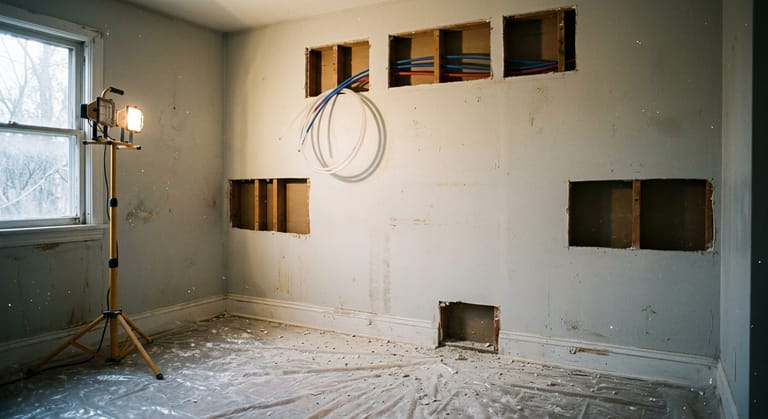
A repipe replaces the distribution itself: new runs leave the meter or pressure tank and reach every fixture, while the abandoned pipe stays where it is, dry and dead behind the finish. Access holes go in high on walls, next to stub-outs, and wherever a run crosses a ceiling. New line is pulled, connected and put under test pressure before anyone closes an opening.
A single story over a crawl space can mostly be worked from below, so the walls come through lightly. Two stories on a slab force the run up into the attic and back down inside partition walls, and that detour is where the labor hours vanish.
- Walkthrough and inventory. The plumber tallies fixtures, notes meter size, and checks what is reachable from a basement, crawl space or attic.
- Scope and price in writing. Material, number of fixtures, access holes, the permit, and whether paint is inside the number or outside it.
- Permit and calendar. A water line replacement permit averages $30-$500 in HomeGuide 2026, and the inspector's availability, not the crew's, sets the start date.
- Install. Water shuts off in stretches as runs are tied in, so ask how many working days the scope covers.
- Inspection and close-out. Test pressure, sign-off, then patching and paint by whichever party the contract names.
Replacing galvanized steel pipes: PEX, copper, or a mix
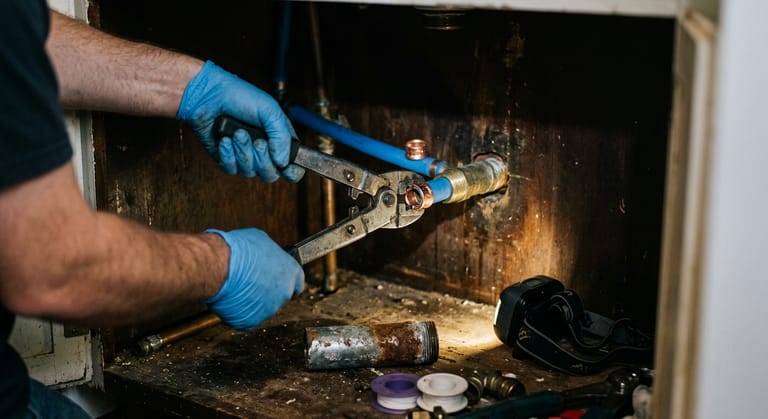
Two materials take nearly every job. PEX flexes, so it can be snaked through framing behind fewer cut openings, and it is the cheaper of the two: HomeGuide's 2026 figures put a 2,000 square foot house repiped in PEX at $2,000-$4,000.
Copper stays rigid, so more wall comes open and more hours get billed on site; the same dataset lands a whole-house copper job at $8,000-$16,000. The copper and galvanized comparison goes parameter by parameter.
PEX
- Fewer openings cut, so less patching later
- The cheaper installed price of the pair
Copper
- Stiff, serviceable, decades of track record
- Several times the installed cost
Ready to talk to a licensed repipe pro?
Call (800) 555-0195No charge to call. A licensed repipe pro answers.Licensed repipe partners in your area- Every partner plumber is licensed and insured
- Calls routed around the clock
- Nothing billed for the call
- The plumber quotes you, and you say yes or no
What a whole-house repipe costs in 2026
HomeGuide 2026 puts the installed spread at $2,000-$15,000, and the material going back in decides where inside it a given house lands. Angi's 2026 repipe figures settle the national midpoint near $7,500, then sort houses by how many bathrooms hang off the system:
| House | Installed (Angi 2026) | Driver |
|---|---|---|
| One bathroom | $4,000-$7,000 | One wet wall |
| Two bathrooms | $6,500-$11,000 | Longer branches |
| Three or more bathrooms | $10,000-$20,000 | Vertical routing |
Labor absorbs about 70 percent of a repipe bill (Angi 2026), so access difficulty swings a quote as hard as the choice of material. The galvanized pipe replacement cost breakdown covers per-foot and per-fixture pricing.
The line owners forget. Closing the wall back up is often a separate trade on a separate invoice. HomeGuide 2026 puts the drywall repair that follows at $300-$1,500 and upward. Ask in writing whether patching, texture and paint live inside the quote you signed or outside it.
Does a utility program pay for any of it?
Sometimes, but the funding tracks the buried service line and stops at the wall of the house. Because EPA's rules bundle requiring-replacement lines into the same workload as lead ones, a galvanized pipe replacement program and a lead program are usually one program at the utility level.
DC Water counts more than 42,000 lead or galvanized iron service lines in the District, and says every District owner with one is eligible. Its Block-by-Block, water main and assistance tracks cost the owner nothing on public or private ground; owners who move ahead of that schedule pay a private-side average of $2,500-$4,500 (DC Water FY2024 summary).
New York City DEP's 2025 plan tallies roughly 121,100 known lead or galvanized service lines. Each locality answers the private-side money question its own way, so call your own utility: ask how your line is classified and which program that unlocks.
Repair, partial repipe, or the whole house?
Do half a house and the old galvanized pipes still sit upstream of the new tubing, choking the very flow the new section was bought to restore. EPA states the buried-line version more sharply: swapping only part of a run can leave piping of other materials, this one among them, compromised, and 40 CFR 141.84(g) bars water systems from partial replacements outside emergency repairs and work coordinated with planned infrastructure.
After a partial lead service line replacement, EPA's Science Advisory Board documented tap lead running high for days to weeks, sometimes longer than that. Repiping galvanized pipes in one pass costs more on day one and returns the version that holds up.
A spot repair earns its place in two cases: one leak that has to hold while the budget comes together, and a single reachable run in a house whose other lines were already done. The one thing patching cannot deliver is pressure.
When to call a licensed pro
Some of this can wait for next spring's budget. The following cannot:
- A stain widening on a ceiling or along the base of a wall under a supply run
- A second pinhole leak in the same stretch within a single season
- Discoloration that refuses to clear however long the tap runs
- A utility letter filing your buried line under galvanized or unknown
Type repipe galvanized pipes near me into a search box and the same short list comes back, all working from wildly different pricing models, so collect two written scopes before signing either.
When you are ready, call (800) 555-0195. Grayfield publishes independently and takes no contracting work, so the call connects you with a licensed, insured partner plumber who prices your galvanized pipe replacement directly and starts only once you approve. Still unsure what is behind your walls? Start at the galvanized piping hub.
Ready to talk to a licensed repipe pro?
Call (800) 555-0195No charge to call. A licensed repipe pro answers.Licensed repipe partners in your area- Every partner plumber is licensed and insured
- Calls routed around the clock
- Nothing billed for the call
- The plumber quotes you, and you say yes or no