
Rusty Galvanized Pipes: Reading the Brown Water
The short version
- Zinc is a sacrificial layer, not armor. EPA describes the material as steel or iron sent through a zinc bath, and the metal underneath begins shedding as soon as that coating is used up.
- HUD's Rehab Guide put the worst of the corrosion and scale on hot water runs, with heat and unfavorable water making both move faster.
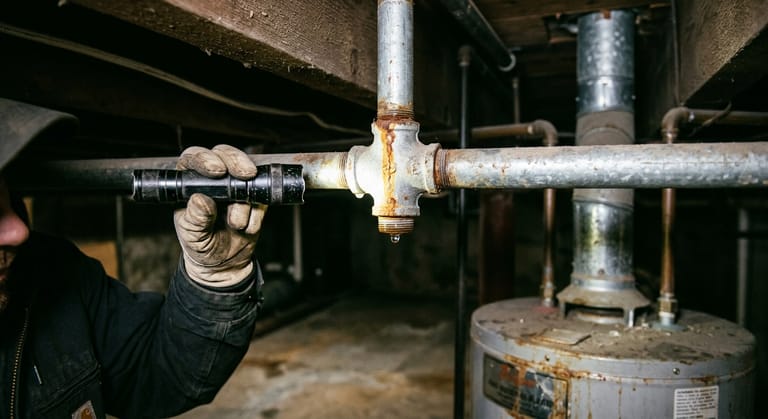
- Fittings surrender before straight pipe does, so the first weep or pinhole almost always shows at an elbow, a tee or a union.
- A corroded wall can hold lead as well. EPA has documented lead particles clinging to this steel and washing off into drinking water afterward, which makes a lab test, not a color check, the real answer.
- Plan the money in two parts: HomeGuide's 2026 repipe range of $2,000-$15,000, plus $300-$1,500 for the drywall that gets opened.
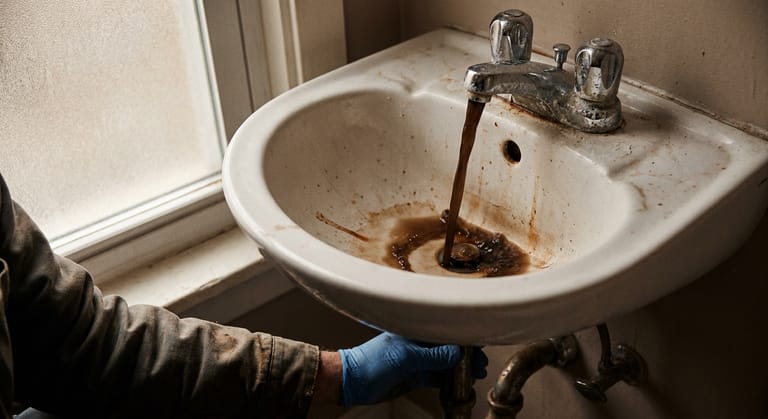
Turn on a tap that sat unused overnight and the first few seconds run brown before the water clears. The fixture is not the culprit; the supply line feeding it is. EPA puts the material plainly: steel or iron given a zinc coat so corrosion and rust have something else to chew through first. That coating is finite: it stands between water and steel only while it lasts, and then the water works on bare metal.
Rusty galvanized pipes are the result, iron oxide and hard scale piling up along the inner wall, breaking loose into the first draw, and squeezing the opening a little tighter every year.
What rusty galvanized pipes are doing inside the wall
HUD's Rehab Guide (Volume 8) is blunt about this material. In certain water types, it found, iron and steel piping took on both corrosion and scale build up, and hot water lines came off worst; heat and adverse water conditions, it adds, make the corrosion problems worse. EPA fills in the chemistry: acidic water, or water carrying few minerals, works on pipes and fixtures fastest.
The scale is lumpy and brittle rather than smooth, so it does two things at once. It narrows the bore, which is why the shower upstairs fades first, and it flakes, sending color and grit to whichever faucet opens after a pressure change.
Does galvanized pipe rust from the inside out?
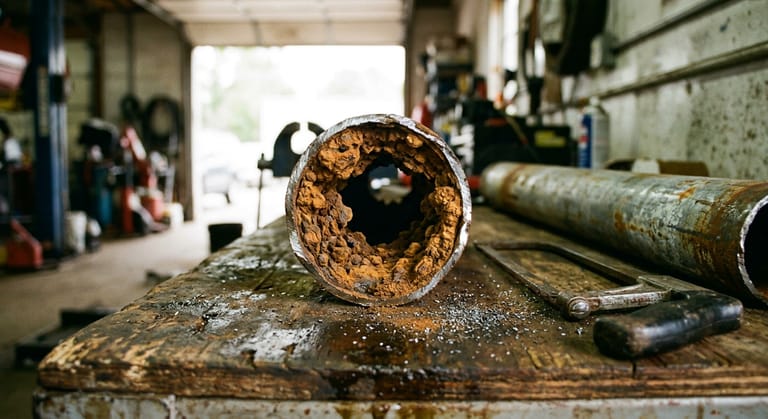
It does, and that is the trap: a run can look solid from the basement floor while the channel inside has nearly closed. Threads go first, since cutting a thread removes wall thickness and shaves off the coating in the same pass. Elbows, tees and unions all start life thinner than the pipe they join, so weeping and pinholes show up there long before mid run.
Which symptom points at which cause
| What you see | Most likely cause | How to separate it |
|---|---|---|
| Brown at every tap on the first draw | Corrosion inside the house supply piping | Time how long a cold tap takes to clear |
| Brown on the hot side only | The water heater tank or its steel nipples | Compare the cold tap at that fixture |
| Brown at one fixture only | That branch, or debris in the aerator | Test another fixture on the same floor |
| Sudden brown water across the street | Utility main work, a break or hydrant flushing | Call the water utility first |
| Grit and color after a pressure event | Loose scale scoured off the wall | EPA ties main breaks and the air behind them to scoured deposits reaching the tap |
Slow pressure loss belongs in that first row too: full flow downstairs with a weak shower above is what a closing bore looks like.
Putting an age on galvanized pipe corrosion
No honest source dates the plumbing in your particular house. HUD dates the era instead. The material was the standard choice before World War II, copper displaced it in the postwar years, and plastics took the market from the 1970s onward. Whatever still carries water is mostly pre 1960 stock, 65 years old or more in 2026.
A service life of 20 to 50 years for galvanized supply pipe comes from HomeGuide's 2026 cost data. No federal agency publishes an equivalent, so treat that span as an aggregator estimate, not a countdown. Water chemistry, temperature and use set the real number.
A ten minute check before you call anyone
- Confirm the material. EPA says two objects settle it: a coin and a magnet. Scratch the wall, then bring the magnet up. Flat gray, a scratch it shrugs off, a magnet that stays put: galvanized. The table from the City of Troy, New York, supplies the counterpart, the same scratch flashing bright silver reading as lead.
- Time the first draw, then compare floors. After an idle night, count the seconds a cold tap needs to run clear, then set upstairs flow against downstairs.
- Read the joints. Hunt for rust staining, mineral crust or damp threads at elbows and tees, especially near the water heater.
- Get your service line classification. The Lead and Copper Rule Revisions set October 16, 2024 as the deadline for each utility to open a service line inventory to the public, and every run in it wears one of four tags: lead, galvanized requiring replacement, non-lead, or lead status unknown. Ask which tag sits on your address.
Ready to talk to a licensed repipe pro?
Call (800) 555-0195No charge to call. A licensed repipe pro answers.Licensed repipe partners in your area- Every partner plumber is licensed and insured
- Calls routed around the clock
- Nothing billed for the call
- The plumber quotes you, and you say yes or no
How to fix galvanized pipes, and what to keep your hands off
The homeowner list is short: rinse the aerators, run a tap before drinking, photograph the joints for a plumber. What goes wrong is any attempt to clean the inside of a supply line, chemically or mechanically.
EPA's corrosion control work explains why. Sampling in the field showed that disturbing a lead service line during infrastructure work sets lead loose, and in the study EPA leans on, results above the action level then in force (0.015 mg/L) came mostly from disturbed sites. EPA also records that galvanized once fed by a lead line adsorbs lead into its scale, so shaking that scale free is a poor experiment for a drinking water line.
Sanding rust off the outside leaves the bore exactly as it was. For background, begin with what this material is and how to confirm it, then whether this steel carries lead.
How to repair galvanized pipes: what actually holds
Holds properly
- Cutting out the failed section together with the fittings on both sides
- Running the whole line again in PEX or copper, with a dielectric fitting anywhere dissimilar metals meet
Buys time only
- A repair clamp over a pinhole in straight pipe
- Epoxy putty or tape on a weeping thread, where the fitting has already thinned
A rusted galvanized pipe seldom fails only once. Treat the first pinhole as bad luck; a second break on the same run inside a year reports the condition of the whole line, and two patches billed separately is how households outspend a repipe. The repair options in detail compare each method, and how a repipe is sequenced shows the disruption.
Should galvanized pipes be replaced?
Sometimes the choice is not yours.
Outside that category, replacing rusty galvanized pipes is a money question: patch the failure in front of you, or take the corrosion out of the house for good.
Neither figure is a quote; both are national ranges. What a galvanized repipe costs line by line shows what drives a bid toward either end, and copper weighed against galvanized steel walks through the material choice.
The signals that mean call now, not next month
- Two failures on the same run within twelve months.
- A fitting whose threads sit damp and rust stained, worst of all with a finished ceiling below.
- Water that never runs clear, or stays tinted after a full minute.
- A trickle from the shower above while the ground floor still runs full.
- A classification letter tagging your service line galvanized requiring replacement, lead, or lead status unknown.
Grayfield runs a research desk, not a truck: no license, no crew, no repipe to sell. Dial (800) 555-0195 and the routing puts a licensed, insured plumber from the partner network on the line, someone who opens walls on rusty galvanized pipes most weeks. The call is free. A qualified referral may earn Grayfield a fee, which leaves your estimate alone, because scope and price are settled with the plumber.
When the symptoms point somewhere else
That is progress too. Brown at one fixture is a fixture problem, brown along a whole street is a utility problem, and brown on the first draw everywhere is a plumbing problem you now have the vocabulary for. Settle the material question with a coin and a magnet, and let that answer set your timing.
Ready to talk to a licensed repipe pro?
Call (800) 555-0195No charge to call. A licensed repipe pro answers.Licensed repipe partners in your area- Every partner plumber is licensed and insured
- Calls routed around the clock
- Nothing billed for the call
- The plumber quotes you, and you say yes or no