
Do Galvanized Pipes Contain Lead?
The short version
- In EPA's wording the pipe is iron or steel given a zinc bath, which leaves lead off the ingredient list.
- EPA documents the second route: particles cling to the pipe surface, then travel out with drinking water.
- A galvanized line that ever sat downstream of a lead one earns its own label, galvanized requiring replacement, and comes out in full.
- Between 1986 and 2014 the phrase lead free still permitted 8.0 percent inside pipe, according to EPA.
Two questions hide inside that one, with different answers. Is the metal itself a lead alloy? In EPA's telling a galvanized service line is iron or steel piping given a zinc bath against corrosion and rust, and the recipe stops there. Can the contaminant still reach a tap through this plumbing? Yes: EPA documents particles clinging to the surface of galvanized pipes and later riding the water out. So when a homeowner asks do galvanized pipes contain lead, the answer is no as an ingredient, yes as a passenger that rust lets settle inside the line.
What the pipe wall is made of
Volume 8 of HUD's Rehab Guide dates the material: zinc coated iron and steel piping dominated housing built before World War II, copper took over afterwards, plastics from the 1970s. The zinc is sacrificial, and once spent it leaves water against bare steel. HUD logs what follows as corrosion and scale build up, worst on hot runs and in aggressive water.
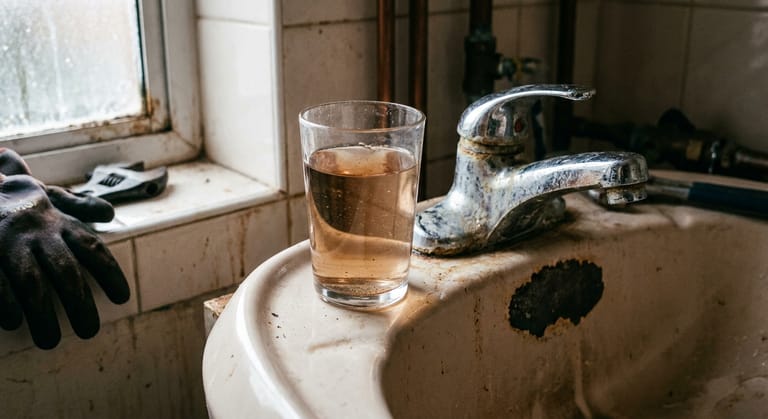
Everything follows from that flaking interior: the bore narrows, upstairs fixtures fade first, rust shows up in the first draw, and the rough wall gives stray particles somewhere to lodge.
Where the contamination actually comes from
The record points at three upstream sources. The pipe wall is not among them.
| Upstream source | What the record says | Who documents it |
|---|---|---|
| A buried lead service line feeding the house | Piping that sits, or once sat, downstream of one can take the metal up and pass it on | EPA service line inventory guidance |
| The property's own older plumbing | Whatever a building's own pipework sheds over decades settles into the corroded galvanized wall | Philadelphia Water Department |
| Fittings, valves, solder and faucets | Under the 1986 wording solder and flux could carry 0.2 percent, pipe 8.0 percent, and still comply | EPA lead free requirements |
Deposits gather slowly and let go at random, which is why one address tests high and the house next door reads clean.
Galvanized pipes for drinking water: how the rules treat them
Federal rules do not put every galvanized line in one bucket. EPA's inventory guidance carves out a class of its own, galvanized requiring replacement, for a service line sitting downstream of a lead line now or in the past, or of one nobody documented. A system that cannot show the line was never fed that way must assume the worst (40 CFR 141.84(a)(4)(ii)).
The 2023 infrastructure needs survey from EPA puts roughly 9.2 million lead service lines still buried nationally, and the Lead and Copper Rule Revisions gave systems until October 16, 2024 to publish an inventory filing every line under four headings: lead, galvanized requiring replacement, unknown, or none of those.
Lead pipes in old homes look almost identical
In a dim basement each reads as the same dull silver gray. The check EPA suggests needs only a coin or key and a magnet, and the City of Troy, New York prints the result table.
- Find where the line comes in. Basement or crawl space, near the meter or main shutoff, on a bare stretch ahead of the inlet valve.
- Scrape the surface. Soft metal brightening to shiny silver points one way. Hard metal keeping its dull gray is galvanized steel. Copper shows its own reddish tone.
- Hold a magnet against it. Galvanized steel grips it; the other two candidates will not.
- Read the joint. Near the shutoff, EPA counts a wiped joint as a strong tell: a bulge of metal rounded off by hand where the old pipe meets another material.
For painted pipe, or a scratch that tells you nothing, EPA points to approved lead paint swab kits. The longer walkthrough sits on the galvanized pipe identification guide.
Ready to talk to a licensed repipe pro?
Call (800) 555-0195No charge to call. A licensed repipe pro answers.Licensed repipe partners in your area- Every partner plumber is licensed and insured
- Calls routed around the clock
- Nothing billed for the call
- The plumber quotes you, and you say yes or no
The lead free label, and what changed in 2014
What to do next, in order
- Ask the utility how your service line is classified; annual notice is mandatory under the 2024 Lead and Copper Rule Improvements.
- Draw no conclusion until a certified laboratory has run the sample.
- Meanwhile take EPA's stopgap advice: cold water for drinking, cooking and formula, a cleaned aerator where particles collect, and no faith in boiling, which removes none of it.
- If the buried run is coming out, hold out for all of it: half measures often drive tap levels higher for weeks or more (EPA Science Advisory Board).
When to stop reading and call a licensed plumber
- A utility letter filing your service line under lead, galvanized requiring replacement, or unknown.
- Discolored water every morning, after the pipes stood quiet overnight.
- Weak pressure upstairs while ground floor taps behave normally.
- Two leaks on one run within twelve months, or a threaded joint damp to the touch.
- Any proposal that swaps out only part of the buried line.
Grayfield publishes independently and holds no plumbing license. Dial (800) 555-0195 and the call goes through to a licensed and insured plumbing partner nearby; you settle scope and price with the plumber.
If the answer is replacement
Those are national bands, not a quote. What swings a bid sits in the full replacement cost breakdown, the disruption in how a repipe is sequenced, the material choice in copper measured against galvanized.
Where that leaves the original question
So, do galvanized pipes contain lead by manufacture? No. Can an old one collect it and release it later? Yes, wherever such a source once sat upstream. Pull the classification, pay for one certified test, and let those answers set the timetable.
Ready to talk to a licensed repipe pro?
Call (800) 555-0195No charge to call. A licensed repipe pro answers.Licensed repipe partners in your area- Every partner plumber is licensed and insured
- Calls routed around the clock
- Nothing billed for the call
- The plumber quotes you, and you say yes or no