
Copper vs Galvanized Pipes: What Separates Them
The short version
- A coin and a magnet separate them: the City of Troy, New York reading table says a scratch that turns shiny and copper colored is copper, one that stays dull gray is steel, and EPA adds that only the steel is magnetic.
- Scale grows inward on steel and never reverses. HUD's Rehab Guide singles out hot water lines as the worst case.
- Money in 2026: Angi puts a whole house at $1,500-$15,000, averaging about $7,500, with roughly 70 percent of it labor. HomeGuide prices a full copper system at $8,000-$16,000.
- Only one side carries a lead story. EPA states that lead particles can attach to the surface of galvanized pipes and later enter the water, which is why federal rules put those lines on a replacement schedule.
- Where new metal meets old, a dielectric fitting goes in the joint. Copper against galvanized steel is a galvanic pair, so the adopted plumbing code and the fitting maker both call for that separation.
Almost nobody stands in a store choosing copper vs galvanized pipes. One is already in the walls of an older house; the other is what a plumber would run in its place.
HUD's Rehab Guide records galvanized steel as the popular choice before World War II, replaced by copper tubing after the war and by plastics from the 1970s. So the real decision is whether the steel you inherited is worth keeping, what a swap costs in 2026, and where PEX undercuts both.
Which metal is in your basement
Confirm the material before you spend anything on it. EPA's inventory guidance and the reading table from the City of Troy, New York describe the same two tool check.
- Pick the spot. EPA points you to the basement or crawl space where the buried line enters, near the main shutoff or meter.
- Scratch it with a coin. Troy's table reads the result: a scratch that turns shiny and copper colored is copper, one that stays dull gray is galvanized steel. EPA suggests gloves.
- Hold a magnet to it. EPA notes that galvanized steel is magnetic and copper is not, a distinction color alone cannot settle.
- Read the outside. Troy describes the steel exterior as dark gray or black, copper as brown and often greened.
A scratch that comes up shiny and silver is neither: that is lead, and it jumps the queue. See how lead reads against copper.
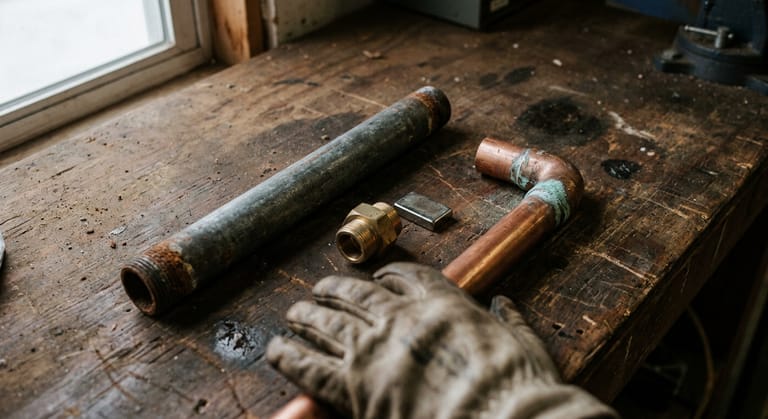
Copper vs galvanized pipes, line by line
| Measure | Galvanized steel | Copper | Source |
|---|---|---|---|
| Era installed | Popular before World War II | Took over after the war | HUD Rehab Guide |
| Exterior | Dark gray to black | Brown, often greened | Troy, NY |
| Scratch result | Stays dull gray | Shiny, copper colored | Troy, NY |
| Magnet | Sticks | Does not stick | EPA |
| Rated service life | 20-50 years | None published | HomeGuide 2026 |
| Corrosion | Scales inward, worst on hot runs | Not named in that finding | HUD Rehab Guide |
| Lead exposure | Corroded walls can hold lead particles | Solder joints before 1986 | EPA |
| Federal clock | Scheduled where it counts as GRR | None | 40 CFR 141.84 |
| Material price | Not priced as a repipe option | $2.00-$8.00 per linear foot | Angi 2026 |
| Whole house | $2,000-$15,000 to take it out | $8,000-$16,000 installed | HomeGuide 2026 |
| Utility practice | Pulled where lead sat upstream | What Denver Water puts back | EPA, Denver Water |
The bore that keeps closing
HUD is blunt about the failure: iron and steel supply piping suffered corrosion and scale build up in certain water types, especially in hot water lines, made worse by adverse water conditions and heat. Scale grows inward, so the opening narrows year after year and never recovers. Copper holds its bore.
That one difference explains the complaint most readers arrive with. The shower upstairs went weak, the kitchen tap runs rusty on the first draw, a threaded joint weeps behind the washing machine. HomeGuide's 2026 guide gives galvanized supply piping a 20 to 50 year service life, which puts pre 1960 steel decades past its rated span.
Flow that fades only upstairs, and only on the hot side, points inside the house rather than at the street. More on that pattern in rusty water and failing flow.
The lead question only one side carries
EPA's consumer flyer states that lead particles can attach to the surface of galvanized pipes and, over time, enter the water. The Philadelphia Water Department describes the same mechanism: over decades, lead from a property's plumbing accumulates on corroded steel walls.
That is why EPA's inventory guidance classes a line sitting downstream of lead, now or at any time in the past, as galvanized requiring replacement, and why 40 CFR 141.84 puts it on the federal replacement schedule.
Copper's weak point is the joint
Copper is not outside the topic, but the risk sits in the joint, not the wall. Congress prohibited pipe, solder and flux that were not lead free in 1986, and EPA records that era's definition as no more than 0.2 percent lead in solder and up to 8.0 percent in pipe. Anything soldered earlier is a testing question, not a demolition order.
Water carrying lead pours and tastes like water that is not, so EPA sends households to a certified laboratory, and to the lab list their state or local drinking water authority keeps. Its interim measures: draw only from the cold tap for drinking, cooking and formula, run a filter tested against NSF/ANSI Standard 53 with a lead reduction claim, and clean the faucet aerator regularly. Boiling does nothing to lead. EPA sets its health goal for lead in drinking water at zero, a goal rather than an enforceable limit, and states that no safe level of lead in children has been identified; CDC says the same of blood lead levels. Health questions belong with a clinician. More in what galvanized steel does with lead.
Ready to talk to a licensed repipe pro?
Call (800) 555-0195No charge to call. A licensed repipe pro answers.Licensed repipe partners in your area- Every partner plumber is licensed and insured
- Calls routed around the clock
- Nothing billed for the call
- The plumber quotes you, and you say yes or no
What the swap costs in 2026
Angi's 2026 repipe data puts a whole house at $1,500-$15,000, averaging about $7,500, with roughly 70 percent of the bill going to labor. By size, Angi gives $4,000-$7,000 for one bathroom, $6,500-$11,000 for two, and $10,000-$20,000 for three or more. HomeGuide's 2026 guide prices a full copper system at $8,000-$16,000, and puts the cost to replace galvanized pipe at $2,000-$15,000 depending on whether copper, PEX or something else goes back in.
The material gap is narrower than it sounds. Angi rates copper tube at $2.00-$8.00 per linear foot against $0.40-$2.00 for PEX, so 150 feet of supply run works out to $300-$1,200 in copper and $60-$300 in plastic. That premium of $240-$900 is what the metal itself costs, before a single hour of labor. Labor at $1.00-$4.00 per foot lands either way, because the hours go into opening walls.
Budget the finishing. HomeGuide puts patching the drywall a repipe opens at $300-$1,500, and a water line permit at $30-$500.
Staging the work rarely saves what people hope: Angi's average for repiping a single fixture is about $1,200, so three visits reach roughly $3,600, most of the way to a one bathroom house done once. Detail sits in the 2026 cost guide.
Can you connect copper to galvanized pipe?
Yes, and the fitting is the whole answer. The reaction between copper and galvanized pipe is galvanic: two dissimilar metals sharing one wet joint. A dielectric union belongs there so the two never touch directly.
Federal rules put it in stronger language. Under 40 CFR 141.84, a water system may not partially replace a lead or galvanized requiring replacement service line except as an emergency repair or alongside planned infrastructure work, and where it does, a dielectric coupling has to separate the old section from the new.
EPA discourages partial work on its own terms, noting that other materials, galvanized included, can be compromised when only part of a run is replaced. Its Science Advisory Board found in 2011 that the galvanic corrosion risk from such a joint may persist for at least several months.
Who should pick what
Four households, four answers on copper vs galvanized pipes.
Replace it now
- Pre 1960 house, weak flow upstairs, and you are staying: the steel is past the 20 to 50 year span HomeGuide gives it
- Your utility letter says galvanized requiring replacement: the federal schedule is already running on that line
Plan it instead
- Selling inside a year: take bids and disclose rather than spend $8,000-$16,000 for the next owner
- Cash is tight: HomeGuide's $2,000-$4,000 for a 2,000 square foot home in PEX beats another winter of waiting
Red flags that mean calling a licensed plumber
- Rusty water on the first draw after the house has sat overnight.
- A joint that weeps, or a damp ring on a basement ceiling under a run.
- Pressure dropping floor by floor over a season rather than all at once.
- A utility notice classifying your service line as galvanized requiring replacement, or as unknown.
(800) 555-0195 is answered around the clock and connects you with a licensed and insured local plumber from the Grayfield partner network. Grayfield publishes and holds no plumbing license, so scope and price are settled with that plumber directly. If you are searching for a galvanized pipe replacement near you, that call is the shortest route to an itemized bid you can hold against the ranges above.
The verdict on copper vs galvanized pipes is not close. Copper wins every measure that matters in a house still running on old steel, and PEX wins on price wherever the run can flex. Start with the galvanized pipes overview, then price the job in a full repipe.
Ready to talk to a licensed repipe pro?
Call (800) 555-0195No charge to call. A licensed repipe pro answers.Licensed repipe partners in your area- Every partner plumber is licensed and insured
- Calls routed around the clock
- Nothing billed for the call
- The plumber quotes you, and you say yes or no