
Lead vs Copper Pipes: Which Is in Your House?
The short version
- A penny is enough. Per EPA the softer metal marks easily and the fresh scratch comes up bright; Troy, New York supplies what each color means: silver for lead, a copper tone for copper, dull gray with no shine for galvanized steel.
- A magnet sorts nothing. EPA notes that neither metal holds one, which leaves galvanized steel as the only candidate it can rule out.
- This is not a choice anyone makes at a supply counter. EPA's 2023 needs survey counts roughly 9.2 million lead service lines still buried nationally, and Milwaukee Water Works alone has about 65,000 of them queued for copper.
- The 2026 math: $4,275-$13,324 for a single buried line under Illinois programs outside Chicago (Illinois EPA, 2023), and another $8,000-$16,000 for a copper repipe inside the house (HomeGuide, 2026).
- EPA sets the health goal for the older metal at zero, and 40 CFR 141.84(g) rules out half a replacement except in an emergency or alongside coordinated work.
Only one of these two metals sits on a federal removal schedule. Lead vs copper pipes sounds like a purchase to weigh up, and it has not been that since the 1980s: the national count in EPA's 2023 Drinking Water Infrastructure Needs Survey runs to about 9.2 million lead service lines still in use, and the crews digging them out drop copper into the same trench. Milwaukee Water Works alone has roughly 65,000 lines waiting for that swap. What matters at your house is which metal comes through the basement wall.
Lead pipe vs copper pipe: four checks at the wall
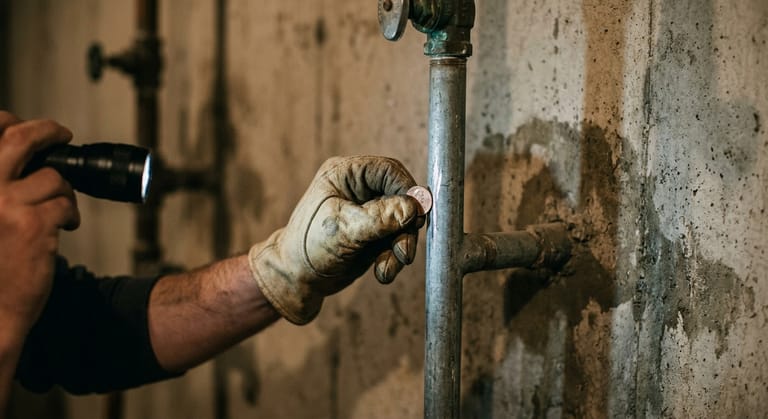
EPA's consumer guide needs almost nothing to run the check: a penny or a key, a magnet, and enough light on the spot where the buried line enters.
- Find where the line comes in. EPA sends readers to the basement or crawl space, near the water meter or the main shutoff; the length worth examining sits between that entry point and the inlet valve.
- Run a coin over it. The softer metal takes a mark and the exposed streak shines, EPA says. Troy, New York fills in the reading: silver points to lead, a copper tone to copper, and gray that will not brighten to galvanized steel.
- Then hold up a magnet. It sticks to neither of them, EPA notes, so its one job here is putting galvanized steel in or out of the running.
- Study the joints. At the point where the older metal was fastened to a different material, EPA describes a wiped joint bulging out into a rounded ball. A soldered connection never takes that shape.
Coated in paint, or still unsure of the result? The swab kits approved for lead paint can be used on plumbing as well, EPA says; the rest is in our walkthrough of what is in your walls.
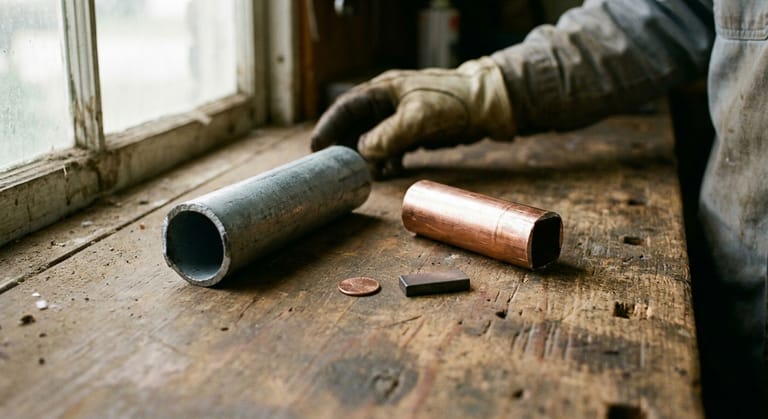
Lead vs copper pipes, eight measures side by side
Published national figures, not a quote for your address.
| Measure | Lead | Copper |
|---|---|---|
| Surface look | Dull silver gray, soft (EPA) | Brown, greening as it corrodes (Troy, NY) |
| Coin scratch | Shiny and silver (Troy, NY) | Shiny and copper colored (Troy, NY) |
| Magnet | Does not stick (EPA) | Does not stick either (EPA) |
| Federal standing in 2026 | Scheduled for removal (EPA, 2024 rule) | What utilities lay in its place (Milwaukee, Denver Water) |
| Tap action level | 0.010 mg/L from November 1, 2027 (EPA) | 1.3 mg/L, unchanged (EPA) |
| Health goal at the tap | Zero (EPA) | Not a zero goal |
| Material price | Not sold for drinking water | $2.00-$8.00 per linear foot (Angi 2026) |
| Whole house repipe | Not applicable | $8,000-$16,000 (HomeGuide 2026) |
Where the comparison stops being even
Set copper vs lead pipes beside each other and the rows above come close to a draw. Then health decides it. The maximum contaminant level goal EPA publishes for the older metal in drinking water is zero, and that number is a health target rather than a ceiling anyone enforces at a tap; for children, the agency says, no exposure level has been shown to be safe. CDC reads blood levels the same way, tying even low ones to how children learn, how long they hold attention, and how they do at school.
How much of it moves into the water depends on the water itself: supplies that run acidic or low in minerals eat at the metal, per EPA, and excavation in the street shakes particles loose.
You cannot taste it or see it. EPA accepts one kind of answer, a result from a certified laboratory, and the list of those laboratories sits with your state or local drinking water authority. Until the result lands: take cold water for drinking, cooking and formula, put it through a filter certified to NSF/ANSI Standard 53 for lead reduction, and clean the aerator. Heating the water removes nothing, so boiling is no workaround. Health questions belong with a clinician.
A search for lead water test near me should end at a state certified laboratory; what to ask them for is in our guide to testing tap water properly.
Does copper pipe contain lead?
Blame the joints, not the tube. Congress outlawed pipe, solder and flux that missed the lead free mark in 1986, and EPA's own account of what lead free meant back then is generous by current standards: up to 0.2 percent in solder and flux, and as much as 8.0 percent in the body of the pipe. Congress narrowed the definition again in 2011 through the Reduction of Lead in Drinking Water Act, which put the figure at a 0.25 percent weighted average over wetted surfaces and applied it to fixtures bought on or after January 4, 2014. So a house piped before 1986 can hold sound tube and leaded joints in the same wall, which makes it a question for a water sample rather than for a saw.
Ready to talk to a licensed repipe pro?
Call (800) 555-0195No charge to call. A licensed repipe pro answers.Licensed repipe partners in your area- Every partner plumber is licensed and insured
- Calls routed around the clock
- Nothing billed for the call
- The plumber quotes you, and you say yes or no
The lead pipe to copper connection
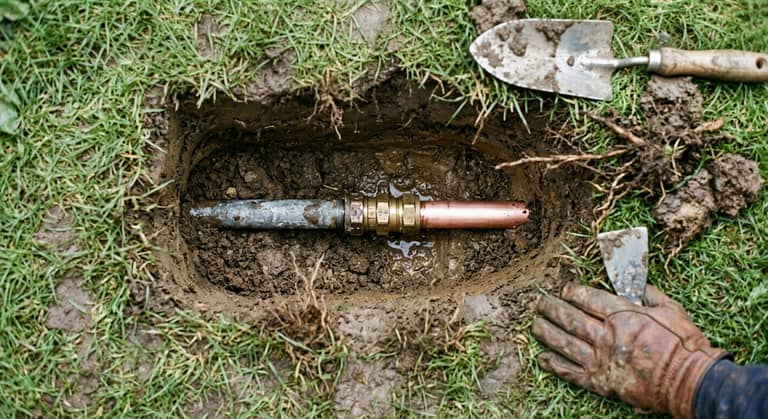
Plenty of houses already have one. The utility pulled its own portion, the homeowner's portion stayed put, and the two metals now meet at a fitting under the yard. Federally, that counts as a job left half finished.
What the rule says. 40 CFR 141.84(g) bars a water system from leaving half of a lead or galvanized requiring replacement service line in the ground, and it allows only two ways around that: an emergency repair, or work timed to a planned infrastructure project. Where the system can reach the full run, the full run comes out. If a partial job does proceed, a dielectric coupling has to sit between the old section and the new one. EPA's objection rests on the record of its own Science Advisory Board, which concluded in 2011 that halving a line often drives tap levels higher for days, weeks or even months afterward.
A finished job looks like lead service line replacement or replacing a buried water line.
What the swap costs in 2026
Different crews price the buried run and the indoor run, usually on different days, which is why a first bid reads worse than expected.
Published ranges, 2026. For one buried line, Illinois programs outside Chicago reported $4,275-$13,324 in 2023 through the Illinois EPA advisory board, a long way past the $1,852-$7,056 in 2016 dollars that EPA's 2019 economic analysis had penciled in; New York City's 2025 DEP plan budgets $5,000-$10,000 per line. Indoors the numbers change hands: HomeGuide puts a copper repipe at $8,000-$16,000 for 2026, while Angi prices the tube alone at $2.00-$8.00 per linear foot against $0.40-$2.00 for PEX. Labor accounts for something like 70 percent of the total.
Who pays is decided locally. Denver Water replaces customer owned lines with copper at no charge to the household and covers the work through rates and bonds; elsewhere the private side stays with the owner. Our service line cost guide itemizes it.
Who should do what
Lead vs copper pipes ends in one of four next steps, depending on what the coin turned up.
- The coin left a silver streak. Treat it as the regulated metal until a certified laboratory says otherwise, and ask the utility where your address falls in its schedule and how much of the bill is yours.
- Copper at the wall, house built before 1986. The visible part is answered; the buried part is not, because EPA treats a gooseneck of the older metal between the main and the service line as a connector in its own right. Request the utility's record, then sample the water, since the solder remains unresolved.
- Your inventory notice reads unknown, or galvanized requiring replacement. Systems have to clear unknowns by their deadline, EPA says, and to publish the route a customer takes to contest how a line was classified. Reply to the notice.
- You are buying the house. Write the buried run into the offer as a separate line item, and use the Illinois and New York figures above as planning ranges, not quotes.
The verdict
There is no honest tie to declare. Order copper and copper is what a plumber installs; the other metal is one the country is retiring under the timetable EPA issued in October 2024. Systems must have mandatory replacement under way by November 1, 2027, they get 10 program years for the lines they control, and a state is free to approve a deferred schedule that stretches past that. The date that governs is your utility's, not the national one.
When to call a licensed plumber
- A soft gray run, or a rounded wiped joint, at the point where the line enters the building.
- Grit or flakes caught in an aerator after street work, a meter swap or a main break.
- An offer to replace nothing but the portion sitting on your property.
- A laboratory result you do not know how to act on.
Grayfield publishes research and holds no plumbing license. Calling (800) 555-0195 reaches a licensed and insured local plumbing partner who works on service lines weekly; you agree scope and price with that plumber directly. Still unsure what you have? Start with the lead pipes overview.