
Lead Service Line Replacement Cost: From $1,852 to $26,000 a Pipe
The short version
- Published per line figures run from $1,852-$7,056 (EPA's 2019 analysis in 2016 dollars, quoted by the Illinois EPA advisory board) to $20,000-$26,000 per unit for Chicago Phase 1 work.
- Actual Illinois programs outside Chicago came in at $4,275-$13,324 a line, and NYC DEP prices its own work at $5,000-$10,000.
- In Denver, Washington DC and Flint the homeowner pays nothing under the main programs. Milwaukee bills the owner a five-year average of $3,454 for the private half.
- Budget outside the pipe too: HomeGuide puts the permit at $30-$500, the tap connection at $300-$500 and resodding at $1.50-$4.00 per square foot.
- Buying only the half you own is no discount. EPA hems partial work in at 40 CFR 141.84(g), and its Science Advisory Board recorded tap readings climbing for days to months after one.
Two homeowners can have the same buried pipe pulled out and see bills ten times apart. The Illinois EPA advisory board quotes EPA's 2019 economic analysis at $1,852 to $7,056 per full replacement, in 2016 dollars. In the same 2023 report, Chicago's water commissioner put the city's Phase 1 construction at $20,000 to $26,000 per unit.
Both are real. Lead service line replacement cost turns on who holds the contract, what sits above the trench, and whether a public program is paying.
Grayfield sells no plumbing work, so every figure below carries its source.
Lead service line replacement cost in one table
| Source and vintage | Published figure | What it covers |
|---|---|---|
| EPA 2019 analysis, via Illinois EPA (2023) | $1,852-$7,056 | Per full swap, 2016 dollars |
| Illinois EPA advisory board (2023) | $4,275-$13,324 | Real programs outside Chicago |
| Chicago Water Management (2023) | $20,000-$26,000 | Phase 1 construction, per unit |
| NYC DEP (2025) | $5,000-$10,000 | Varies with length and site |
| Milwaukee Water Works (2026) | $3,454 | Private half, five-year average |
| DC Water (FY2024) | $2,500-$4,500 | Private half, voluntary track only |
| Denver Water (2026) | No direct charge | Rate funded, customer side included |
A published range is not a quote. Call (800) 555-0195 and a licensed local plumbing partner will price your line at no charge.
Who ends up paying for replacing lead pipes?
Plenty of American households pay nothing at all: a public program is replacing the lead pipe and absorbing the cost. Denver Water swaps customer-owned pipe for copper at no direct charge, funded through rates, bonds and hydropower, and enrolls likely properties. Every District homeowner with a lead or galvanized iron line qualifies for a Lead Free DC track, DC Water reports, and only the voluntary one carries a charge.
At its 2026 budget hearing, Chicago's water department said four of five programs pay for both halves; only the Homeowner-Initiated track charges. Flint finished: the state announced the last known active line came out on July 31, 2026, free to residents.
Which is why the utility, not a plumber, takes the first call: pay privately and you can drop outside a subsidy that would have covered the trench. Our walkthrough of how a replacement actually runs sets out the queue.
Five variables behind any lead pipe replacement cost
- How far the run goes, and how deep. NYC DEP pins its own $5,000 to $10,000 spread on line length and site conditions, which is why neighbors hear different quotes.
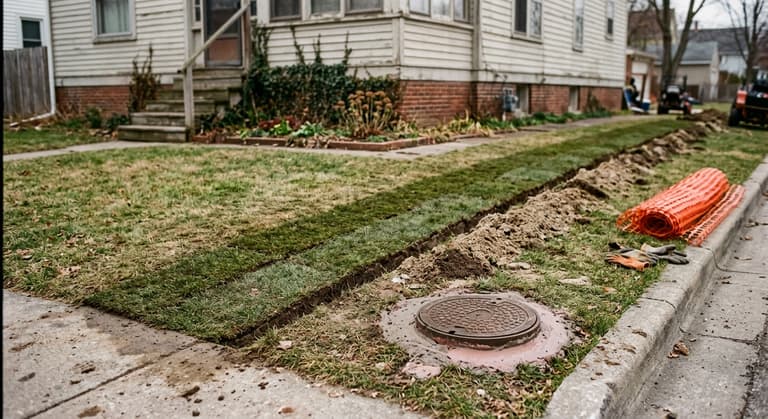
- The surface over the trench. Putting grass back is inexpensive. Driveways, sidewalks and established landscaping are not, and that money shows up on the restoration line.
- Who lets the contract. A municipal bid carries public procurement overhead, DEP's 25 to 50 percent premium noted above.
- The local market. Springfield, Illinois reported about $7,000 per unit in the same 2023 document where Chicago reported $20,000 to $26,000, which the Illinois report reads as a dense-city number rather than a national norm.
- The material going back in. Milwaukee Water Works standardizes on copper for its 65,000 remaining pipes, the pricier common choice.
Permits, meters and putting the yard back
| Line item | Published range | Source |
|---|---|---|
| Plumbing permit, water line replacement | $30-$500 | HomeGuide 2026 |
| Tap connection part and labor | $300-$500 | HomeGuide 2026 |
| New water meter | $300-$800 | HomeGuide 2026 |
| Trench digging and backfill | $1,500-$13,000 | Angi 2026 |
| Resodding the excavated yard | $1.50-$4.00 per sq ft | HomeGuide 2026 |
One municipal charge should stay off your paperwork. Denver Water's 2026 schedule prices the single-family System Development Charge, the tap fee, at $3,380 inside Denver from July 1, 2026, and applies it to new or enlarged service, not to swapping an existing pipe. See it on a bid and make the utility confirm it.
Ready to talk to a licensed repipe pro?
Call (800) 555-0195No charge to call. A licensed repipe pro answers.Licensed repipe partners in your area- Every partner plumber is licensed and insured
- Calls routed around the clock
- Nothing billed for the call
- The plumber quotes you, and you say yes or no
Cost to replace lead pipes in home plumbing, not just the buried run
Interior pipe is a separate project with its own arithmetic. HUD's research office dates indoor use of the metal to the early twentieth century, so it is rare inside a house. Galvanized steel downstream of an old service line is the common case, and EPA warns that particles lodge in those corroded walls and reach the tap later.
For a whole-home repipe, Angi's 2026 figures run $1,500 to $15,000, average near $7,500: one bathroom takes $4,000 to $7,000, two take $6,500 to $11,000, three or more take $10,000 to $20,000. Angi attributes about 70 percent to labor, and HomeGuide adds $300 to $1,500 for closing the drywall. Our guide to replacing interior lead water pipe covers that job.
Does waiting for the city save money?
Waiting costs least where a program is free and moving, and can mean a decade where the inventory is huge. Milwaukee Water Works admits only 200 properties a year to its voluntary Owner Request track, charges that owner the $3,454 average, and lets the sum ride 15 years as a special assessment on the tax bill at prime plus 1 percent. The same head start at DC Water runs $2,500 to $4,500 for the private half, against nothing for the scheduled job.
Is half a line ever half the price?
No, and federal rules mostly close that door. 40 CFR 141.84(g) leaves a water system two narrow openings for partial work, an emergency repair or planned infrastructure work that reaches the line anyway; given access to the whole run, it must take the whole run. Any partial that does go ahead needs a dielectric coupling.
Four free checks that change your number
- Confirm the material for free. EPA's quick check runs on a penny or key and a magnet: lead shows dull silver gray, brightens under a scratch and ignores the magnet, while galvanized steel stays dull and holds it. Our guide to identifying lead pipe shows the wiped joint.
- Read the inventory before you read a bid. Systems had until October 16, 2024 to publish what their service lines are made of, and EPA's rule obliges them to explain how you challenge that classification and ask for tap sampling. Unknowns often turn out to be something else: Flint dug up almost 32,000 properties and found roughly 11,600 to swap.
- Test rather than assume. Home samples go to a state certified laboratory under EPA's guidance; our page on testing a lead water pipe gives the order of operations.
- Get the scope itemized. Permit, restoration, meter and tap connection on paper, both halves in one dig.
Where this stops being a homeowner job
The rest is licensed plumber territory: excavation, the tap into the main, the joints on new pipe, the permit, the inspection. Reach for the phone if your utility letter reads lead or unknown, if a rounded ball of lead sits where the pipe meets the basement wall, or if crews have just worked the street or the meter nearby. EPA's research shows that disturbing an old run can release lead.
EPA's stopgap measures cost close to nothing: draw drinking and cooking water from the cold tap only, let it run before you fill anything, keep the aerator screen clean, and pick a filter certified to NSF/ANSI Standard 53 for lead reduction. Heating it on the stove removes none of the metal.
Turn a published range into a number for your address
Start with the lead pipe hub if the material is unconfirmed, or when these pipes were banned if you are dating a house. The federal text sits at 40 CFR 141.84.
Ready to turn a lead service line replacement cost range into a real figure? Call (800) 555-0195 and Grayfield will put you through to a licensed and insured local plumbing partner. Nothing is charged for the call, and the figure you agree to comes from that plumber.