
How to Fix Galvanized Pipe Before the Next Joint Goes
The short version
- A clamp hides the hole. The wall thickness that corroded away beneath it is still gone.
- In EPA's description the pipe is plain steel wearing a zinc coat, and when that coat is used up the steel rusts.
- Swapping to PEX or copper runs $2,000 to $15,000 installed in HomeGuide's figures; Angi's average for a whole home repipe lands near $7,500.
- Two leaks on one run inside a year stop being repair news and become replacement news.
- Once EPA's label reads galvanized requiring replacement, condition no longer matters: the whole line goes.
The decision opens with an orange bloom on gray steel and a drip returning whenever the water heater cycles. Three honest ways to fix galvanized pipe exist: strap a clamp across the weep, cut the failed inch out and bridge it with a coupling, or pull the whole run. What settles it is the condition of the metal either side of the wet spot, never the size of the hole. Water spraying right now? Shut the main, then reach a plumber at (800) 555-0195.
Shut it down first, then trace the leak to its origin
On a horizontal run water creeps along the underside of the metal and drops off at the low point, so a puddle rarely marks the hole that fed it.
- Shut the main, open the lowest fixture. Pressure bleeds away, the metal dries, and one weeping point shows itself.
- Prove what the metal is. Per EPA's service line inventory guidance, galvanized reads dull silver gray, resists a scratch and holds a magnet. Troy, New York adds the tiebreaker: scratched, galvanized keeps that dull gray tone, while lead flashes bright silver. Our guide to old steel plumbing covers the rest.
- Place the failure. A pinhole weeping mid span is the cheap version. Rust pushing from an elbow, tee or union is the costly one, since a fitting never had much wall to lose.
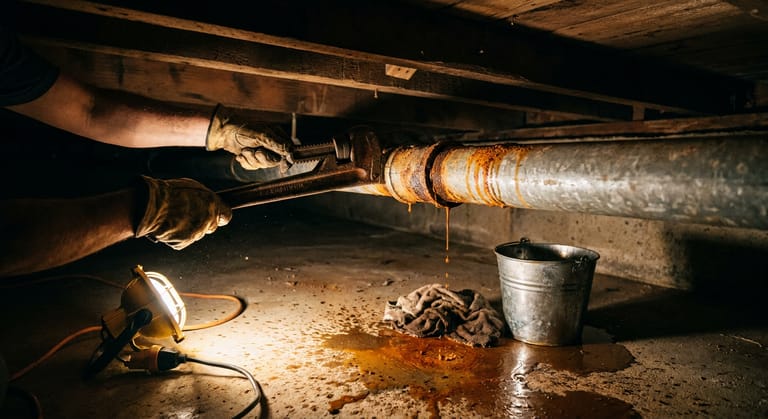
Galvanized steel pipe repair starts at the threads
By EPA's definition the line is iron or steel dipped in zinc to fight off corrosion and rust. That zinc is a jacket rather than the steel itself, and every thread a die cuts slices through it. With raw steel exposed at each connection, the first weep in a house usually appears at a fitting, not a plain length.
Failure on the inside runs quieter. HUD's Rehab Guide pins corrosion and a scale layer that shrinks the bore on this pipe, crediting both to water chemistry and heat, the reason the hot side surrenders first.
Three ways to repair galvanized pipe
| Method | Where it holds | Where it lets go |
|---|---|---|
| Clamp | One pinhole in sound, round wall | Next to a threaded fitting, or over flaking rust |
| Repair coupling | A short bad section removed and bridged | When the cut ends are pitted or oval |
| Cut and replace | Any leak at a joint, or a second failure on one run | Only against the budget and the drywall |
Will a galvanized steel pipe clamp hold?
Sold alone or inside a galvanized pipe repair kit, the stainless sleeve with a rubber gasket is the quickest of the three and the shortest lived. It holds pressure at the outer wall while rust keeps working within. As a bridge to a booked repipe it earns its place. As the answer, it does not.
Recutting threads on a corroded pipe seldom works, since a die has nothing solid to bite. Hence how to fix galvanized pipe without threads: a compression or dresser style repair coupling clamps onto two clean cut ends instead. Where the new stub is copper, a dielectric fitting has to sit at the junction, which our copper against galvanized comparison goes into.
Ready to talk to a licensed repipe pro?
Call (800) 555-0195No charge to call. A licensed repipe pro answers.Licensed repipe partners in your area- Every partner plumber is licensed and insured
- Calls routed around the clock
- Nothing billed for the call
- The plumber quotes you, and you say yes or no
What a galvanized pipe fix costs against a repipe
Published 2026 ranges, not quotes. For trading old supply lines for PEX or copper, HomeGuide lists $2,000 to $15,000 installed, plus $300 to $1,500 and up to close the drywall opened for access. Angi's spread on a whole home repipe is $1,500 to $15,000, averaging close to $7,500, with roughly 70 percent of that total going to labor.
Anything buried carries its own math. Angi's average for a main water line replacement is $1,704, quoted per linear foot at $50 to $150, while HomeGuide's permit line runs $30 to $500. An underground galvanized pipe repair also buys two trips with a shovel, one to fit the patch, one when it fails. Our cost breakdown takes these figures apart.
Patch it, or replace the run?
A patch is reasonable
- a first failure, in straight solid metal
- pressure upstairs still feels normal
- the morning first draw runs clear
- a replacement is already booked
Replace instead
- a second or third weep inside one year
- flow upstairs faded over the years
- rusty water at dawn, worst on the hot side
- a failure at a joint, in a wall or buried
Choosing to fix galvanized pipe at a single joint is a wager on every joint you cannot see, and age usually decides it. HUD places the material in houses built before World War II, copper tubing taking over afterward and plastics arriving in the 1970s, while HomeGuide gives galvanized steel supply lines 20 to 50 years of service. Piping original to a home built before 1960 has passed 65 years, well outside that window. Faded pressure is scale closing the bore, and scale sits where no clamp reaches, so that symptom argues for replacing the run instead.
Where lead changes the answer
Some lines cannot stay patched. Where a galvanized service line sits downstream of a lead line, or ever did, EPA files it under galvanized requiring replacement. For lines a water system controls, the Lead and Copper Rule Improvements fix a compliance date of November 1, 2027 and allow 10 program years from there to take them out whole. Partial work draws its own warning from EPA: renew part of a line and the galvanized left behind can end up compromised.
Test before assuming lead is not involved. Corroded galvanized wall can hold lead particles, EPA cautions, and those later wash loose into water headed for the tap, raising lead levels. EPA's maximum contaminant level goal puts it plainly: for lead in drinking water, zero. Neither EPA nor CDC identifies any level of lead in children as safe. Nothing in the water looks or tastes different, so only a certified laboratory answers it; your state or local drinking water authority keeps that list. Until the pipe is gone, EPA points to a filter certified to NSF/ANSI Standard 53 with a lead reduction claim. Anything medical belongs with your clinician.
Searching for galvanized pipe repair near me? Read this first
Three worries usually need settling first. A clamp is the cheapest item here and on one sound span it is money well used, but a third clamp on one run is not a plan. Nobody enjoys open drywall, so make the quote name access points and the patching allowance. And a do it yourself galvanized water pipe repair makes sense on exposed straight metal, never on a fitting that crumbles under a wrench.
Hand it over when:
- the main shutoff refuses to close
- the leak sits in a wall, ceiling, slab or near wiring
- the metal splits or flakes under a tool
- this run was patched once already
- the line is buried, or your utility has written about it
Grayfield publishes independently and takes no plumbing jobs. Dial the number and it reaches a licensed and insured local plumbing partner, able to price the patch and the full replacement side by side. Call (800) 555-0195, or start with what is actually in your walls.