
Lead solder on copper pipes: how to read your own joints
The short version
- Copper tube is no source of lead. The solder seam at each fitting is what an older house answers for.
- Lead solder left drinking water plumbing with the 1986 Safe Drinking Water Act amendments; EPA records the states enforcing from 24 months past June 19, 1986.
- Lead free never meant zero: in the 1986 definition EPA records, wire and flux could hold 0.2 percent.
- No visual check grades a joint, so EPA routes households to a certified laboratory.
- Michigan's first half 2026 Flint monitoring counted 13 of 61 validated sites as homes with copper plumbing and pre-1988 solder.
Copper tube is not a source of lead. The seam holding it together can be. Until the federal ban of the mid 1980s, lead solder on copper pipes was the ordinary way to assemble a supply line, and EPA records what ended it: the 1986 amendments to the Safe Drinking Water Act shut pipe, solder and flux failing the new lead free definition out of drinking water plumbing.
So the question in an older house is not whether copper is safe, but what sits in the fillet at every elbow and tee.
The tube is copper. The joint is an alloy.
Sweating a fitting is heat plus capillary action: molten wire is pulled into the gap between tube and cup, then freezes. Before the ban that wire was a tin and lead mix, easy to run and forgiving of rushed prep.
Copper either side of the seam stayed copper, so a house of bright tube can still test positive. Lead solder in copper pipes is a joint problem, not a pipe problem: one thin band of metal at every fitting, usually behind drywall.
The label promised less than shoppers assumed. EPA records the 1986 definition as up to 8.0 percent lead in pipe and 0.2 percent in the wire and the flux, so lead free never meant free of the metal. Enforcement sat with the states, due 24 months on from June 19, 1986. The 2011 Reduction of Lead in Drinking Water Act narrowed it: pipes, fittings and fixtures bought from January 4, 2014 must average no more than 0.25 percent across the surfaces water touches, while wire and flux stayed at 0.2 percent.
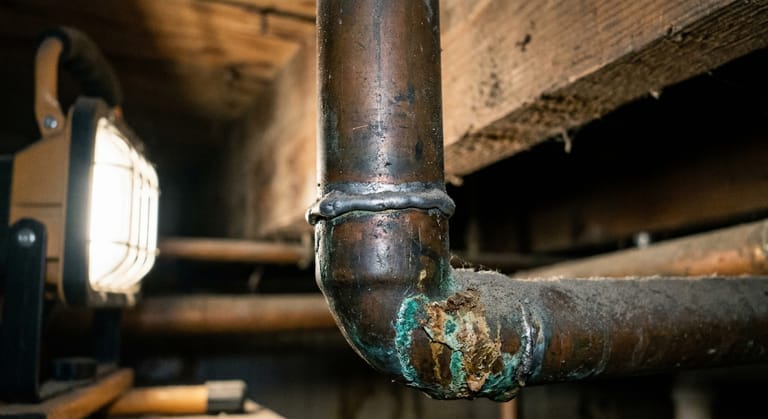
Do copper pipes have lead in them?
Not in the tube wall in any quantity worth chasing. Suspicion belongs on the seam at each joint, the brass inside valves, and whatever fixture ends the run. Hence EPA's flag on faucets bought before January 4, 2014.
How to check for lead solder on copper pipes
- Date the plumbing. A permit file or a date stamp from the same remodel fixes the year. In most states, work finished before 1988 falls on the wrong side of the ban.
- Look where tube is exposed. Basement, crawl space, heater connections and stub outs under sinks show joints without opening walls.
- Read the fillet, not the tube. At the cup edge a sweated joint leaves a narrow gray band, easily hidden by paint or oxidation. A hint, nothing more.
- Check the service entry. Where the buried line meets another material, EPA's inventory guidance points to the wiped joint, a rounded bulb of metal. Find one and it outranks every seam indoors.
- Test the water. Nothing about the metal reaches the senses, so EPA sends households to the certified laboratory list their state or local drinking water authority keeps.
Alongside the scratch and magnet routine, EPA allows approved paint swab kits on a pipe. A swab answers for a surface, not for what a joint sheds into a glass, so alone it decides nothing. Our guide to testing tap water for lead covers drawing the sample.
What moves the metal out of a joint
Corrosion does the work. On EPA's account the metal migrates out of the plumbing containing it as that plumbing corrodes, fastest where the supply is acidic or thin on minerals.
Utilities push back by dosing orthophosphate, which grows a mineral crust on the inside wall that EPA's corrosion control guidance credits with keeping the water clean.
Two things upset it. One is physical disturbance: EPA points to 2013 field sampling by Del Toral and colleagues, where readings above the 0.015 mg/L action level clustered at disturbed sites. The other is standing water, since age drops the pH and eats the chlorine residual the crust needs.
Zero is EPA's health goal for lead in drinking water, a target and not an enforced ceiling. EPA states that no safe level in children has been identified; CDC says the same of blood lead levels in children. Four holding measures fill the wait, all EPA's: move water through the house first, by tap, shower or laundry load; take cold water only for drinking, cooking and baby formula; rinse the aerator screen where particles gather; filter through a unit certified against NSF/ANSI Standard 53 with a lead reduction claim. Boiling accomplishes nothing. Water questions belong with your utility, health ones with a clinician.
Ready to talk to a licensed repipe pro?
Call (800) 555-0195No charge to call. A licensed repipe pro answers.Licensed repipe partners in your area- Every partner plumber is licensed and insured
- Calls routed around the clock
- Nothing billed for the call
- The plumber quotes you, and you say yes or no
What a regulator's own sampling shows
Michigan has Flint at ten years of compliance with state and federal standards: a 90th percentile of 3 parts per billion for the first half of 2026, from 61 validated sites.
Thirteen were single family homes on interior copper plumbing with pre-1988 solder, their own sampling tier under the 29 homes and 19 businesses on buried lines.
If the result comes back high
The buried side usually outranks the joints. 40 CFR 141.84 sets the clock: a mandatory service line replacement program has to run by the November 1, 2027 compliance date, and lines a system controls come out within 10 program years, unless the state approves a longer schedule as the fastest feasible.
Doing half the line is barred outside an emergency repair or scheduled work, on a finding of EPA's Science Advisory Board: a partial job is frequently followed by higher tap readings, for a stretch of days to several months.
See how a service line replacement runs and what replacing a lead water pipe involves, or our overview of lead pipes and joints.
Where homeowner checking stops
Reasonable to do yourself
- Dating the plumbing from permits and remodel paperwork
- Photographing exposed joints at the heater and the meter
- Ordering a certified laboratory kit
Work for a licensed plumber
- Opening walls or cutting into a live supply line
- Anything at the service entry or the meter
- Deciding which sections get replaced
What the work costs in 2026
Finding lead solder on copper pipes rarely triggers a repipe on its own. It counts when walls are open anyway, or when a high result and a buried line problem land together.
| Repipe scope | 2026 national range | Source |
|---|---|---|
| One bathroom | $4,000-$7,000 | Angi |
| Two bathrooms | $6,500-$11,000 | Angi |
| Three or more bathrooms | $10,000-$20,000 | Angi |
| Copper throughout the house | $8,000-$16,000 | HomeGuide |
Angi puts labor at roughly 70 percent of a 2026 repipe bill, so an open wall is the moment to remake every joint in reach. Buried side numbers live in what a service line replacement costs; the wire for a remade joint is in choosing lead free solder.
Red flags that mean a call rather than a project
- Grit, flakes or off color water in the first draw after street work or a meter swap.
- Joints that weep or wear a green crust on a run you cannot shut off alone.
- Your utility writes to say the inventory files your line under galvanized requiring replacement, lead or unknown.
- A laboratory number over the action level, or one you cannot read with confidence.
Any of those is a phone call, not a project. Dial (800) 555-0195 at any hour and the Grayfield partner network puts you through to a licensed and insured plumber nearby. Grayfield publishes research and holds no plumbing license, so you settle scope and price with that plumber.
Old joints are a testing question first, a plumbing question second. Get the number, then decide what to open.