
Lead Free Solder for Copper Pipes: What to Buy
The short version
- A drinking water joint has taken tin based wire and a matching paste since Congress rewrote the Safe Drinking Water Act in 1986, per EPA.
- The old benchmark allowed a trace rather than nothing: EPA puts the 1986 figure at 0.2 percent for the spool and for the tin.
- Choose the paste with the care you give the wire, because one statute and one number cover both.
- Certification became the price of entry for covered products on September 1, 2023, under EPA's Lead Free Rule.
- For seams sweated before the ban, guessing has no place: EPA sends households to a certified laboratory.
Anything carrying drinking water deserves one wire only, and that wire is lead free solder for copper pipes, bought with a paste held to the same number.
The date on the rule is 1986. That year's amendments to the Safe Drinking Water Act closed drinking water plumbing to any spool, tin or tube below the lead free standard, and the figure EPA sets down for that era is 0.2 percent, binding on wire and paste alike.
What the label promises, product by product
Four decades of amendments left every product class its own number, so what governs a spool is not what governs a faucet.
| Product | Federal ceiling | In force | Source |
|---|---|---|---|
| Solder and flux | No more than 0.2 percent | 1986 amendments, untouched by the 2011 Act | EPA |
| Pipe as first defined | No more than 8.0 percent | 1986 to 2013 | EPA |
| Pipes, fittings and fixtures | 0.25 percent, weighted across the wetted surfaces | Fixtures bought on or after January 4, 2014 | EPA |
| Fittings and fixtures in commerce | Non conforming products barred from introduction | 1996 amendments | EPA |
| Covered products entering commerce | Certified through one verification process | September 1, 2023, under the 2020 rule | EPA |
Two dates sit outside that table. Enforcement landed on the states 24 months after June 19, 1986, per EPA, though several acted sooner. And tube sold as compliant could still hold 8.0 percent, again per EPA, until the 2011 Act rewrote the definition, so a label from those years promised less than its buyer assumed.
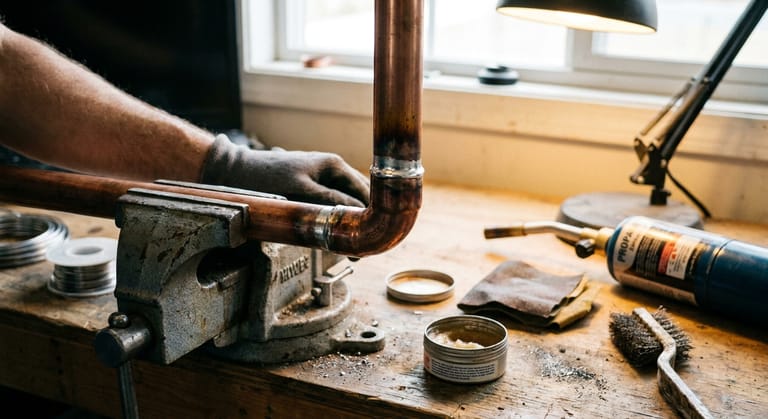
How to choose lead free solder for copper pipes
Buy in pairs. The best lead free solder for copper pipe is any spool carrying a third party certification mark and the words potable or drinking water, matched with a flux tin labeled the same way. The mark stands for a filing, not a slogan: EPA's Lead Free Rule has reached covered products entering commerce since September 1, 2023.
Tin based solder is the entire shelf now. Spools with silver flow more readily under the flame.
Three things must never touch a potable line: the tin and lead alloy the 1986 ban targeted, acid core wire for sheet metal, rosin core wire for electronics.
Sweating a joint that will hold
- Cut square, then ream the burr. An end left out of round will not seat, and that gap is where a weep begins.
- Take both surfaces down to bright metal. Emery cloth outside, a fitting brush inside the cup.
- Spread the flux thin, from the labeled tin. The statute names the paste beside the wire for good reason.
- Put the flame on the fitting, never on the spool. A hot cup draws solder in by capillary action.
- Move water through before anyone drinks. EPA's guidance is to run the line first, an open tap or a laundry cycle, then wipe the faucet screen.
The disadvantages of lead free solder
The trade offs land in technique, not health. Tin based solder forgives less than the alloy it displaced, so a joint left damp, greasy or half cleaned tells on itself at once. Preparation and heat control weigh more, and anyone learning the feel burns extra wire. Silver bearing spools cost more per foot. None of that argues for the old material, which has no legal home on a drinking water line.
Ready to talk to a licensed repipe pro?
Call (800) 555-0195No charge to call. A licensed repipe pro answers.Licensed repipe partners in your area- Every partner plumber is licensed and insured
- Calls routed around the clock
- Nothing billed for the call
- The plumber quotes you, and you say yes or no
Copper pipe with lead solder already in the joints
Copper installed before the ban was routinely sweated with the older alloy, and those houses still surface in utility sampling. Michigan's release on Flint monitoring for the first half of 2026 validated 61 sampling sites, 13 of them homes whose interior copper plumbing carries pre-1988 lead solder.
What an old seam gives up, if anything, depends on the water crossing it. EPA describes the mechanism as corrosion: the supply draws metal out of the materials it touches, and acidic or low mineral water draws harder. The sampling side is covered in our guide to testing tap water for lead, and the overview of lead pipes and joints frames the rest.
EPA's health goal for this metal in drinking water is zero, a target rather than an enforceable limit, and the agency states that no safe level in children has been identified; CDC says the same of blood levels in children. Neither taste nor smell gives it away, so EPA treats a laboratory result as the only honest answer and points households to the certified lab roster their state or local drinking water authority keeps. Until that result lands: draw cold water for drinking, cooking and baby formula; use a filter tested to NSF/ANSI Standard 53 with a reduction claim for the metal; clean aerators on a schedule. Boiling changes nothing here. Anything about health belongs with a clinician.
Can you solder a lead pipe?
Not in the sense this page has used the word. Soldering a lead pipe is not the modern repair: where a service line of that metal joins another material, the union is usually a wiped joint, which EPA describes as a lump of lead rounded over the point where the two meet. Today the run comes out instead of being patched.
Regulation pushes the same direction. Under 40 CFR 141.84, water systems have until the November 1, 2027 compliance date to open a mandatory replacement program, and 10 program years to finish the lines under their control, unless the state approves a longer schedule as the fastest feasible. Half a line is not an option outside emergency repair or planned street work, and EPA's Science Advisory Board explained why in 2011: partial work frequently pushes tap readings up significantly for days to weeks, or even several months. See lead service line replacement and replacing a lead water pipe for what the full job involves.
Red flags that mean a plumber, not a torch
- A seam that weeps, or green crust along a run you cannot shut off.
- A letter from the water system that has no material on record for your service line, or lists it as lead, or as galvanized requiring replacement.
- Grit or flakes at an aerator after street work or a meter swap.
- Any soldering that would sit close to a service line you suspect is lead.
- A laboratory result you cannot read with confidence.
Any one of those is worth a call before a flame. (800) 555-0195 is picked up at any hour and puts you through to a licensed and insured local plumber in the Grayfield partner network. Grayfield publishes research and holds no plumbing license, so scope and price get settled with that plumber directly.
What the wider job costs in 2026
| Scope | National range | Source |
|---|---|---|
| Whole house repipe | $1,500-$15,000, average near $7,500 | Angi, 2026 |
| Repiping one fixture | About $1,200 on average | Angi, 2026 |
| Copper throughout a house | $8,000-$16,000 | HomeGuide, 2026 |
Labor is roughly 70 percent of a 2026 repipe bill, per Angi, so an open wall is the moment to redo every connection within reach. Buried side figures sit in our guide to what a service line replacement costs.
Choosing the spool is the simple half. Knowing what the house already holds is the hard half, and that answer comes from a laboratory, not off a hardware store shelf.
Ready to talk to a licensed repipe pro?
Call (800) 555-0195No charge to call. A licensed repipe pro answers.Licensed repipe partners in your area- Every partner plumber is licensed and insured
- Calls routed around the clock
- Nothing billed for the call
- The plumber quotes you, and you say yes or no