
Old Lead Pipes: How to Tell What You Have
The short version
- Roughly 9.2 million lead service lines are still counted in the ground nationally by EPA's 2023 Drinking Water Infrastructure Needs Survey.
- No single national year clears a house. Instead of one federal cutoff, EPA has each water system apply the enforcement date its own state set for the 1986 rule.
- Five parts of an older house can hold the metal: the buried service line, galvanized steel sitting below it, solder at copper joints, brass fixtures bought before 2014, and interior supply piping.
- A coin and a magnet separate it from galvanized steel at the entry point. What the coin cannot settle is settled by the utility inventory record and a certified laboratory result.
- Full replacement ran $1,852-$7,056 per line in EPA's 2019 analysis (2016 dollars) and $4,275-$13,324 per line in Illinois program data.
A build year is a probability, not a diagnosis. EPA's 2023 Drinking Water Infrastructure Needs Survey puts the national count at roughly 9.2 million lead service lines, so old lead pipes are common enough to take seriously and scattered enough that a deed date neither convicts nor clears one address.
Two houses on the same 1930s block can hold different metals, since states and utilities quit the material on their own schedules. The decade tells you how hard to look; a coin, a magnet and your water system's inventory record tell you what is under the yard.
Do old houses have lead pipes?
Some do, plenty do not, and the boundary is blurrier than a listing suggests. Pipe, solder and flux failing the lead free definition were shut off by the 1986 amendments to the Safe Drinking Water Act, which, by EPA's account, states had to enforce 24 months after June 19, 1986.
Several states moved sooner, so EPA's inventory guidance sends each system to its own state date instead of one federal cutoff. Many utilities abandoned the metal long before either.
Read the year built as direction, not proof: a 1925 house went in six decades ahead of the ban, a 1994 build came after and rarely hides a buried run. Our page on when the federal ban took effect walks through the dates.
Five things an old pipe turns out to be
Old pipes lead to different answers depending on which stretch of the system you are looking at, roughly by frequency:
- The buried service line. The stretch carrying supply from the street main into the house. EPA names it a possible major source of contamination in tap water, and it is federally regulated.
- Galvanized steel downstream of it. A galvanized line that sits, or once sat, below a lead one is filed by EPA as "galvanized requiring replacement": the steel adsorbs the metal and keeps releasing it after the upstream pipe is gone (40 CFR 141.84(a)(4)(ii)). See galvanized supply piping.
- Solder at copper joints. Solder that was not lead free fell under the same 1986 ban, so copper tubing run before then can carry leaded joints while the tubing is blameless. See solder on copper.
- Brass fixtures bought before 2014. Between 1986 and 2013, EPA notes, "lead free" still allowed 0.2 percent in solder and flux and 8.0 percent in pipe. Congress tightened that in the 2011 Reduction of Lead in Drinking Water Act: a weighted average of 0.25 percent of wetted surfaces, for fixtures purchased on or after January 4, 2014.
- Interior supply piping of the metal itself. Rare, tied to very old stock: a 2018 HUD research office article notes it was run inside homes until the early twentieth century.
Old lead water pipes and galvanized steel look alike
Under basement dust both read as dull gray, so telling them apart is physical, not visual. Surfaces and magnet behavior below come from EPA's inventory guidance, the scratch colors from the City of Troy, New York result table.
| Material | Surface | Scratched with a coin | Magnet |
|---|---|---|---|
| Lead | Soft, dull silver gray | Bright and silver | Does not stick |
| Galvanized steel | Dark gray to black, hard to mark | Stays dull gray | Sticks |
| Copper | Brown, darkening with age | Shiny, copper colored | Does not stick |
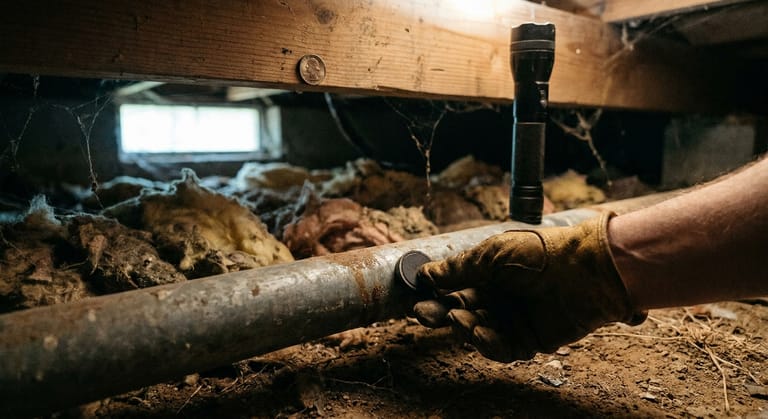
Gloves on first. Pick a spot between the wall entry and the inlet valve, scratch it with the coin, then test with a magnet. EPA adds a second tell: the wiped joint, a swollen rounded seam where an old lead pipe meets a different material.
Ready to talk to a licensed repipe pro?
Call (800) 555-0195No charge to call. A licensed repipe pro answers.Licensed repipe partners in your area- Every partner plumber is licensed and insured
- Calls routed around the clock
- Nothing billed for the call
- The plumber quotes you, and you say yes or no
Where the homeowner part has to stop
A coin settles one question at one spot, and says nothing about the buried run beyond the wall or what leaves the tap. Where paint hides the surface, EPA points to approved lead paint surface swab kits, which work on a pipe. Two records beat more poking.
The Lead and Copper Rule Revisions gave your water system until October 16, 2024 to build a service line inventory, sorting every line into four buckets: lead, galvanized requiring replacement, unknown, or non-lead. Undocumented is not the same as clean.
Record two is a laboratory result: EPA sends homeowners to a laboratory certified by the state or local drinking water authority, and certified tap testing turns suspicion into evidence.
What old lead pipes cost to replace, and who pays
Which share of the bill lands on the owner depends on the city. Chicago's water department draws the boundary at the curb stop: the main to that point is the public side, the rest into the building private.
Scheduling and digging a service line replacement is a different job from swapping the supply run inside the walls, and the finished invoice makes sense only with permits and yard restoration counted. The walkthrough by house age and the lead pipes reference cover the other legacy materials.
Red flags worth a call this week
Old lead pipes rarely announce themselves, so go by conditions you can observe, not by how the water looks or smells.
- The scratch turns bright silver and the magnet falls away.
- Your address sits in the utility inventory under any label except non-lead.
- Only part of the underground run was swapped out, the rest stayed buried.
- Street work, a main break or a meter swap on your block lately.
- Someone in the household is pregnant, or a small child drinks that tap water daily.
Grayfield researches and publishes; it holds no plumbing license. A call to (800) 555-0195 reaches a licensed, insured local plumbing partner who reads the entry point in person and prices the work.