
Lead pipes in NYC sit on private property, and that decides your bill
The short version
- About 121,100 New York service lines are recorded as lead or galvanized, and DEP says every known one belongs to the property owner (NYC DEP, December 2025).
- DEP replaces a line at no cost when City water main work disturbs it, and holds $72 million in federal and state grants for private property removals in parts of the Bronx, Brooklyn and Queens.
- DEP puts a full replacement at $5,000-$10,000 per line where the owner hires a contractor directly, and says City contracting runs 25-50 percent above private pricing.
- Installation stayed lawful in the city through 1961, and patching an existing line instead of pulling it remained permissible until 2009 (NYC DEP).
- Nothing in law compels participation, so the free replacement offer has an acceptance rate of 63 percent (NYC DEP).
New York City records roughly 121,100 service lines as known lead or galvanized, and the Department of Environmental Protection says every known one is privately owned, so it cannot order a replacement (NYC DEP, December 2025).
Ownership settles nearly every practical question about lead pipes in NYC. DEP orders nobody to act and opens its wallet on narrow triggers. An owner hiring a contractor directly should plan on $5,000 to $10,000 per line, shifting with length and site conditions.
Who is writing: Grayfield publishes this beat, fixes no pipe, holds no plumbing license, files nothing with DEP.
How many lead pipes in NYC are on record?
About 121,100 known lead or galvanized service lines, a tally from the DEP plan of December 18, 2025. They run through every borough and price band, weighted toward older one to four family houses.
A record is not an excavation. DEP notes that plenty of lines filed as lead proved otherwise once the trench was open, and an unknown is not reassurance.
Roughly 7,000 miles of aqueducts and mains carry about 1 billion gallons a day to nearly 10 million people, clean where DEP delivers it. Whatever the tap adds is collected downstream, on privately held pipe.
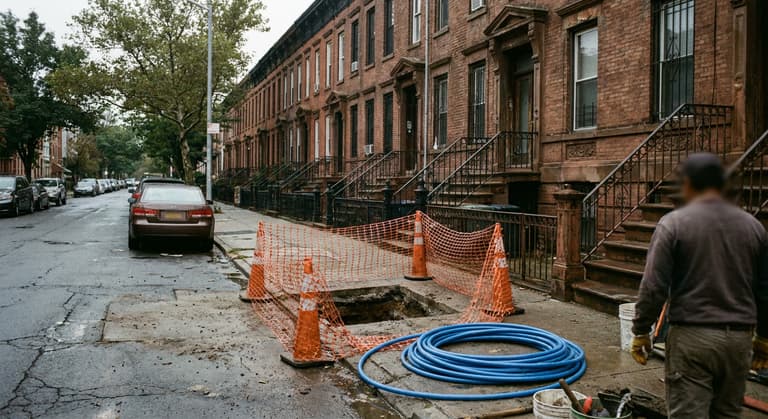
Is there a lead pipes NYC map?
No poster to print, an inventory instead. The Lead and Copper Rule Revisions set the date: by October 16, 2024 every public water system had to have one prepared, with the locations of its lead lines made public (EPA). The rule is federal, the filing is not: primacy belongs to the states, so the catalogue answers to the state agency, not to EPA.
New York's version sits at nyc.gov/leadpipe, where DEP keeps the eligibility check and signup form. The material column allows no freehand text: EPA fixes it at lead, galvanized requiring replacement, non lead, and lead status unknown. The fourth is an absence, not a finding, reserved for lines nobody has classified.
A federal schedule runs under the city program. Compliance falls due November 1, 2027, and a system then has 10 program years, averaging 10 percent a year, to retire the lead and galvanized requiring replacement lines it controls. Households on a line logged lead, galvanized or unknown get notice yearly, and the action level moves to 0.010 mg/L (EPA).
The cutoff years behind lead pipes in NYC: 1961 and 2009
The 2025 plan records both dates. Installation stayed lawful here through 1961, and patching an existing line instead of pulling it remained permissible until 2009 (NYC DEP). Of the two, 2009 lands harder: a pipe under a Brooklyn row house could have been legally patched inside living memory.
Washington moved later, and only on new material. Not until 1986 did Congress write a lead free requirement into the Safe Drinking Water Act, covering pipe, solder and flux, with enforcement a state duty 24 months after June 19, 1986. The wording slipped: a pipe holding as much as 8 percent of the metal still counted as compliant (EPA).
The Reduction of Lead in Drinking Water Act of 2011 pushed that ceiling to 0.25 percent, weighted across every surface the water runs over (EPA). The page on when these pipes were banned traces the cutoffs.
What the NYC DEP lead service line replacement program covers
DEP filed its federally required plan two years early. Because the pipe is private property, it runs on offers, not orders.
- City work triggers a free swap. If a City water main job disturbs a qualifying line, DEP pays.
- Targeted areas get funded removals. DEP holds $72 million of federal and state Bipartisan Infrastructure Law money for private property work in low income and environmental justice neighborhoods of the Bronx, Brooklyn and Queens. Another $48 million is anticipated, guaranteed by nobody.
- Everyone else is asked, not told: outreach invites owners to fund the work, with NYC Water Board financing such as loans or billed installments.
DEP's commissioner called the plan a floor, not a ceiling, then named the constraint: going further means higher water rates. How the replacement is done covers the sequence from shutoff to restoration.
Ready to talk to a licensed repipe pro?
Call (800) 555-0195No charge to call. A licensed repipe pro answers.Licensed repipe partners in your area- Every partner plumber is licensed and insured
- Calls routed around the clock
- Nothing billed for the call
- The plumber quotes you, and you say yes or no
Replacement pricing in New York City, band by band
| Figure | Amount | Source |
|---|---|---|
| Owner hires directly | $5,000-$10,000 per line | NYC DEP, 2025 plan |
| City contracting premium | 25-50 percent higher | NYC DEP, 2025 plan |
| National estimate, 2016 dollars | $1,852-$7,056 per line | EPA 2019 analysis, via Illinois EPA |
A band is not a quote. DEP ties its spread to line length and what the site turns up, then adds a variable few owners see priced: whose contract the job sits under, since City work runs 25 to 50 percent over a private firm's number for the same trench (NYC DEP). The full cost breakdown itemizes the rest.
Why a partial replacement is the wrong deal
Somebody eventually floats half a job: fresh pipe from the curb in, the buried remainder left in place. For water systems 40 CFR 141.84(g) forecloses that, allowing a partial only during emergency repair or planned infrastructure work; where the whole line is reachable, the whole line goes (EPA).
Metallurgy agrees. A cut and a rejoin shake particulate loose, and new metal bolted onto old sets up galvanic corrosion. EPA's Science Advisory Board found that partial work frequently drives tap lead up significantly for days to weeks, sometimes several months, and would not call it safe or effective against short term exposure.
Free NYC lead water test kits, and safer habits meanwhile
Sight and taste give nothing away, so EPA routes the question to a laboratory certified by the state drinking water authority. Residents can request a free NYC lead water test kit by calling 311 (NYC DEP), and certified water testing covers collection and results.
What EPA advises meanwhile:
- Anything swallowed comes off the cold side, a baby's formula included. Heat lifts none of the metal out.
- Move water that stood overnight before filling a glass; a laundry cycle or shower does as much as an open tap.
- Rinse the faucet screen periodically; loosened grit collects in that mesh.
- Read a filter box for two marks: NSF/ANSI Standard 53 with a lead reduction claim, and Standard 42 Class I for particulates.
Two agency statements follow, neither a diagnosis. No amount of lead has been identified as safe for children, EPA reports. CDC applies the same to blood lead levels, noting demonstrated effects on a child's intelligence and attention even at low ones. The federal health goal for this metal in drinking water is zero, a target and not an enforceable limit. Medicine sits outside what Grayfield does: exposure questions to a clinician, service line questions to DEP.
Buying or selling with a 63 percent consent rate
Free is not the same as accepted: with nothing in law forcing the issue, 63 percent of owners offered a free replacement have said yes (NYC DEP). DEP would back a law making the work mandatory at a sale, a major renovation, or a no cost offer.
For a buyer that is a diligence item with a price. Other cities differ:
- Flint's replacement record shows what a federal court settlement forces.
- Washington DC replacement runs mostly free on both sides, charging only owners who jump the queue.
- The city by city comparison sets six programs beside each other.
When to call a licensed plumber
Private ownership cuts both ways: nobody can order the work on you, and nobody is coming unbidden to do it. DEP's file cannot tell you the metal under your own property, or what a contractor you picked would charge to pull it.
Call when the record reads lead status unknown with no program date against your address, when an offer wants a private bid beside the City price, when the basement stub is the only length anyone has looked at, or when a sale has to document the material before closing.
Scheduling, not emergency. Have your inventory record in front of you when you dial (800) 555-0195, and put one question to whoever answers: what would the private side take? Answering is a licensed and insured plumber from the partner network, the call itself is never billed, and a qualifying referral can pay Grayfield a fee that touches no part of the quote you two settle on.
Ready to talk to a licensed repipe pro?
Call (800) 555-0195No charge to call. A licensed repipe pro answers.Licensed repipe partners in your area- Every partner plumber is licensed and insured
- Calls routed around the clock
- Nothing billed for the call
- The plumber quotes you, and you say yes or no