
Flint lead pipes are out of the ground, and the digging is the real lesson
The short version
- The last known active service line came out on July 31, 2026, closing the inventory the city had identified (State of Michigan).
- Crews excavated almost 32,000 properties to find roughly 11,600 lines worth replacing, at a program cost near $140 million (State of Michigan).
- Residents paid nothing for the work, which ran under a federal court settlement rather than a homeowner cost share (City of Flint).
- Sampling from January to June 2026 returned a 90th percentile of 3 ppb, against Michigan's 12 ppb standard and the federal 15 ppb (State of Michigan).
Flint removed its last known active service line on July 31, 2026, closing out the inventory the city had identified (State of Michigan). Getting there took almost 32,000 excavations to find roughly 11,600 lines worth replacing, near $140 million all in. So the short answer on Flint lead pipes: the identified inventory is gone.
Grayfield runs an independent research desk, not a plumbing company, and credits every figure below.
What the closing numbers on Flint lead pipes say
| What was measured | Figure | Source |
|---|---|---|
| Last known active line pulled | July 31, 2026 | State of Michigan, 2026 |
| Service lines replaced | About 11,600 | Same release |
| Properties excavated and checked | Almost 32,000 | Same release |
| Whole program cost | About $140 million | Same release |
| Tap result, January to June 2026 | 3 ppb, 90th percentile | Same release |
Roughly twenty thousand of those holes turned up something other than lead, with no paperwork sorting them beforehand. That is why inventories elsewhere carry addresses marked unknown.
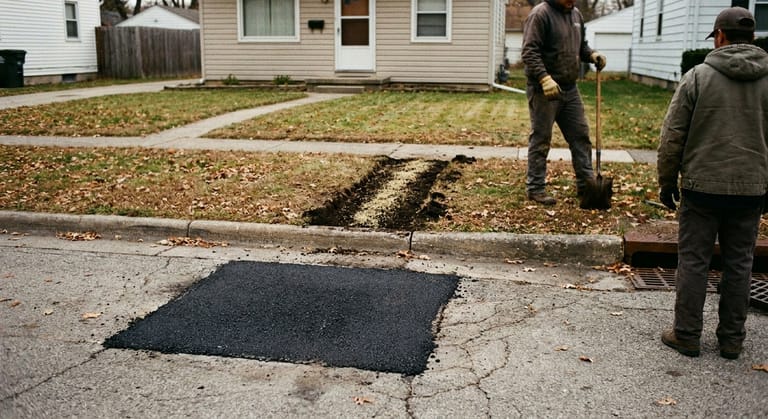
Flint lead pipe replacement ran on a court order
The work ran under the NRDC and Concerned Pastors Settlement Agreement, a federal court settlement covering more than 11,000 removals. Flint satisfied it in July 2025, then handled roughly 500 more lines found while closing out (State of Michigan). The local program is Get the Lead Out, also called FAST Start, hotline 810-410-1133.
That legal driver separates Flint from the programs in our city by city breakdown of replacement programs. Elsewhere the pace answers to budgets and grants. Here it answered to a judge.
What replacement day involved for the household
- The resident signs a consent form and stays present for the work.
- Water is off at the property for 4 to 24 hours.
- The contractor flushes the home 15 minutes once the new run is live.
- The resident flushes again, 15 minutes at full flow, which the city puts under 10 cents.
- Filters and cartridges are supplied for at least six months of use.
- Turf is seeded and mulched, pavement is replaced in kind, and the city does not take responsibility for trees or landscaping.
Residents paid nothing here, because a court settlement drove the work rather than a homeowner cost share. Treat that as the exception.
What the same job costs elsewhere: EPA's 2019 economic analysis put a full replacement at $1,852 to $7,056 per line in 2016 dollars, quoted by the Illinois EPA advisory board in 2023, while New York's DEP put a line at $5,000 to $10,000 in its 2025 replacement plan. Any quote should cover the whole line: partial swaps are restricted by rule and can push tap lead higher (EPA, below). Our walkthrough of how a full swap is sequenced covers shutoff to restoration.
Are there still lead pipes in Flint, Michigan?
Every known active one is gone, and the load bearing word is known. EPA's inventory rules give a system nothing to write but lead, galvanized requiring replacement, non lead, or lead status unknown, the last holding until a crew reaches the metal. Flint's unknown column is thin only because crews opened almost 32,000 holes to find out.
Interior plumbing is a separate question. Michigan's 2026 sampling pool deliberately included 13 homes with copper joined by pre-1988 lead solder, its own source behind the walls. So the accurate statement about Flint lead pipes in 2026 is narrower than the headlines: the buried item is finished, what sits inside a house answers to its own test.
Ready to talk to a licensed repipe pro?
Call (800) 555-0195No charge to call. A licensed repipe pro answers.Licensed repipe partners in your area- Every partner plumber is licensed and insured
- Calls routed around the clock
- Nothing billed for the call
- The plumber quotes you, and you say yes or no
Is Flint water safe to drink now?
The city has logged a decade of compliance with state and federal standards (State of Michigan). Sampling from January 1 to June 30, 2026 produced a 90th percentile of 3 parts per billion across 61 validated sites, 29 of them single family homes served by a lead service line. Results have stayed below action levels since July 2016.
| Benchmark | Value | When it applies |
|---|---|---|
| Federal action level | 15 ppb | In force now |
| Michigan action level | 12 ppb | Effective 2025 |
| Federal level, Improvements rule | 10 ppb | From November 1, 2027 |
Compliance is a regulatory status, not a health verdict. EPA's maximum contaminant level goal for lead in drinking water is zero, an aspiration rather than anything enforceable, and the agency has identified no safe level in children; CDC frames blood lead the same way: even low amounts have been shown to affect a child's intelligence, attention and academic achievement. Drinking, cooking and formula water comes off the cold tap; boiling leaves the metal where it was (EPA). Not medical advice: health questions to a clinician, water ones to your utility or state drinking water authority.
How much lead was in Flint water, and why it rose
Our sources carry no sample by sample record of the crisis years, so this page publishes none. The cause was audited federally. EPA's Office of Inspector General, in a final report announced July 19, 2018, found that after the April 2014 supply switch, inadequate treatment exposed many residents. Under state supervision the system failed two Lead and Copper Rule duties: keeping the service line inventory needed for sampling, and maintaining corrosion control. That delay, the report says, prolonged exposure.
Utilities dose orthophosphate, which reacts with dissolved metal to form compounds that stay solid rather than dissolve into water (EPA). The mineral crust on the inside wall, not the metal underneath, holds contamination back. Change the chemistry and the crust stops working. The buried plumbing under Flint did not change in 2014. The water sent through it did.
What that means for a house nowhere near Michigan
- Records are estimates until somebody digs. An inventory letter reading unknown is a real EPA classification, not a clerical shrug.
- Chemistry can undo good plumbing. EPA notes that infrastructure work and treatment changes lowering pH both release material that sat still for years.
- A partial job is restricted by rule, which changes how you read a cheap quote.
40 CFR 141.84(g) bars water systems from partial replacements except during emergency repair or coordinated infrastructure work, and requires a dielectric coupling wherever one happens anyway. EPA's Science Advisory Board found that partials often raise tap results significantly, sometimes for days, sometimes for months, with no demonstrated short term benefit.
Funding answers swing by city: in New York the bill sits with the owner by default, because every known line there is private property, while the District's program covers both halves for most households.
Red flags that justify calling a licensed plumber
None is an emergency, but all deserve a professional look.
- Your utility classifies the line at your address as unknown, with no replacement date offered.
- The pipe near your meter is dull gray, goes silver under a coin scratch, refuses a magnet (EPA).
- A rounded ball of metal, what EPA calls a wiped joint, sits where that run meets a different material.
- Water ran discolored after a main break, a meter swap or street work on your block.
- You are under contract on a house built before the mid 1980s, with no record of the buried run.
Nothing at a faucet gives lead away; only a state certified lab reports what leaves your tap. Our pages on certified sampling and filter certification cover collection, results and the NSF/ANSI marks to look for.
Talk it through with a licensed local plumber
Flint lead pipes came out under a federal court order and a $140 million invoice. Your street almost certainly has neither, so the timeline is yours to manage. Call (800) 555-0195, describe what your utility told you about your line, and ask what a full replacement would take. Grayfield publishes and does no plumbing. The number reaches a licensed, insured plumber near you from this site's partner roster; the call is unbilled, that plumber sets the price, and resulting work can pay Grayfield a referral fee.
Ready to talk to a licensed repipe pro?
Call (800) 555-0195No charge to call. A licensed repipe pro answers.Licensed repipe partners in your area- Every partner plumber is licensed and insured
- Calls routed around the clock
- Nothing billed for the call
- The plumber quotes you, and you say yes or no