
PEX or Copper Pipes: What Actually Decides It
The short version
- Repipe a 2,000 square foot house in PEX and HomeGuide's 2026 figures land on $2,000-$4,000. HomeGuide's whole-house range for copper runs $8,000-$16,000.
- You are not really buying tube. Angi assigns something like 70 percent of a repipe bill to labor, which is why the installed spread opens up so much wider than the per foot spread.
- Of these two materials, only the metal drags a lead history behind it, and the history sits in the solder. The federal ban arrived in 1986, and EPA puts the lead free ceiling of that era at 0.2 percent lead in solder.
- Copper answers to a rule of its own: an action level of 1.3 mg/L under EPA's Lead and Copper Rule Improvements. Nowhere in that rule does PEX appear.
- A tie goes to plastic when the supply is soft and acidic, since EPA blames corrosion on acidic water that carries few minerals.
Most homeowners arrive at the question of PEX or copper pipes at an awkward moment, with the old galvanized steel already coming out of the wall and a plumber waiting to hear what goes back in. The short answer is a money answer. Priced in HomeGuide's 2026 figures, a PEX repipe of a 2,000 square foot home comes to $2,000-$4,000, while a whole house replumbed in copper runs $8,000-$16,000, so the budget argument goes to plastic in most homes. Metal still earns its premium in certain houses, and what the utility sends through your meter decides more of this than brand preference.
What is better, PEX or copper pipes?
Neither material is defective, and in 2026 both are standard potable water plumbing, so ranking them in the abstract settles nothing. The useful question is narrower: which of the two suits the house you actually own.
Cost separates them first. By the linear foot, Angi's 2026 repipe data puts PEX tubing at $0.40-$2.00 and copper tube at $2.00-$8.00, and once installation is counted the two ranges drift much further apart, because rigid metal eats hours inside a finished house.
The metal never won on price. HUD's Rehab Guide traces the order of succession: galvanized steel first, copper tubing displacing it once World War II was over, plastics entering from the 1970s.
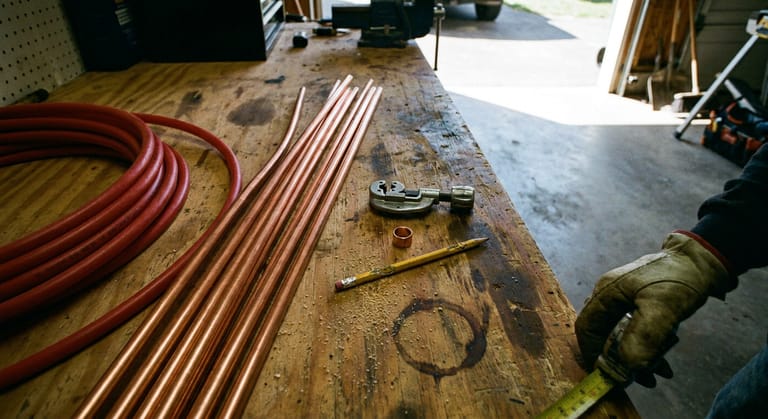
Nine measures side by side
| Measure | PEX | Copper | Source |
|---|---|---|---|
| What it is | Cross linked polyethylene tubing | Rigid copper tube | Material name |
| Material price | $0.40-$2.00 per foot | $2.00-$8.00 per foot | Angi |
| Whole house installed | $2,000-$4,000 for 2,000 sq ft | $8,000-$16,000 | HomeGuide |
| How it joins | Crimp or clamp fittings, no flame | Soldered joints | Field practice |
| Historic lead exposure | No solder, so no lead solder history | Solder predating the 1986 ban | EPA |
| In the Lead and Copper Rule | Not named | Action level 1.3 mg/L | EPA |
| Aggressive water | Not a corroding metal | Acid or thin minerals eat metal | EPA |
| Retrofit routing | Flexes through framing | Rigid, so more wall opens | Field practice |
| Rated service life | No figure in these sources | No figure in these sources | Not published |
Why the installed gap dwarfs the tube price
Run the material arithmetic by itself and the two barely separate. Angi's 2026 per foot ranges actually touch, since the top of the plastic and the bottom of the metal are the same $2.00. Installed, those same two materials finish thousands apart, which is the clearest sign that the tube is not the purchase.
Labor is. Angi files roughly 70 percent of a repipe bill under labor and prices the installation itself at $1.00-$4.00 per linear foot on top of whatever the material costs, while its polybutylene replacement page puts plumber time at $45-$200 per hour. Every copper joint gets cut, reamed, fitted and soldered by hand. PEX threads through framing in long uninterrupted runs, which leaves fewer joints behind it and fewer holes to patch.
One caveat belongs here: the two HomeGuide figures are not a like for like pair, since only the plastic one comes with a floor area attached.
Whichever material ends up in the wall, Angi's 2026 repipe data brackets a whole house at $1,500-$15,000, with the average near $7,500. Budget the finish work on its own line: HomeGuide prices the drywall repair a repipe creates at $300-$1,500 and up.
Where the joint changes the answer
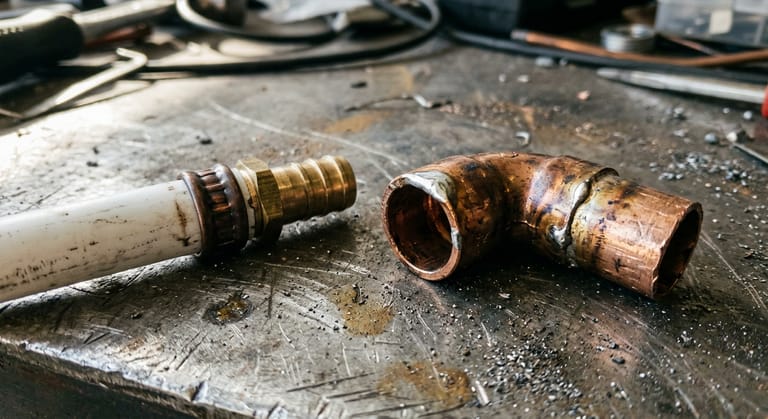
Copper is put together with solder, and solder is the route lead took into American plumbing in the first place. Congress closed the door in 1986 on pipe, solder and flux that failed the lead free test, and the limit EPA records for that era allowed 0.2 percent lead in solder and as much as 8.0 percent in the pipe body itself. A joint soldered before that year is a reason to test the water, not an order to open a wall, but no older metal system gets an automatic pass. New work goes together with lead free solder, a term what lead free solder means now unpacks in detail.
PEX inherits none of that history, since crimp and clamp fittings need no solder and keep open flame out of the wall cavity.
That first limit did not hold. The Reduction of Lead in Drinking Water Act of 2011 narrowed the definition a second time: EPA records the ceiling as 0.25 percent lead, worked out as a weighted average across the wetted surfaces of a fitting, and fixtures bought on or after January 4, 2014 answer to it. Anything assembled during the years between the two standards was held to the older, looser figure.
Ready to talk to a licensed repipe pro?
Call (800) 555-0195No charge to call. A licensed repipe pro answers.Licensed repipe partners in your area- Every partner plumber is licensed and insured
- Calls routed around the clock
- Nothing billed for the call
- The plumber quotes you, and you say yes or no
What your water does to the metal
Ask EPA how lead ends up at a faucet and the answer is corrosion. Anything in the plumbing that contains lead gives a share of it up to the water, quickest of all where what arrives at the house is acidic or thin on dissolved minerals. Supply that aggressive is not selective: whatever metal sits inside the wall takes the same treatment.
Copper comes with a number of its own. The Lead and Copper Rule Improvements hold the copper action level at its old value of 1.3 mg/L, and take the lead action level down to 0.010 mg/L from the compliance date of November 1, 2027. Search that same rule for PEX and nothing comes back.
EPA's corrosion control guidance explains what is going on underneath: utilities feed orthophosphate so a protective mineral layer forms along the pipe wall, and that layer, not the metal behind it, keeps contaminants out of the water. A water quality report that describes a soft, acidic supply, or that records an action level exceedance in past years, is therefore the local evidence that breaks a tie against metal.
A repipe estimate is not a water test, and the water volunteers nothing on its own, since lead arrives without color, without flavor and without odor. EPA treats one answer as trustworthy, a result from a certified laboratory, and the roster of qualifying laboratories sits with the state or local drinking water authority serving your address. Book that sample while bids are still coming in, and ask the utility which material its records assign to your service line.
EPA's holding measures cost almost nothing and do not wait on the material decision. Draw the cold side for drinking, for cooking and for mixing infant formula. Buy a filter only where the packaging documents testing against NSF/ANSI Standard 53 together with a lead reduction claim. Aerators deserve a routine of their own, so take one off the spout tip on a regular basis and clean the grit out of its screen. Boiling is wasted effort, because heat leaves the metal where it was. On how much is tolerable, neither agency offers a number: EPA has identified no safe level in children, and CDC says the same of blood lead levels. Where that leaves one household is a question for a clinician, not a plumber.
Coming out of galvanized steel
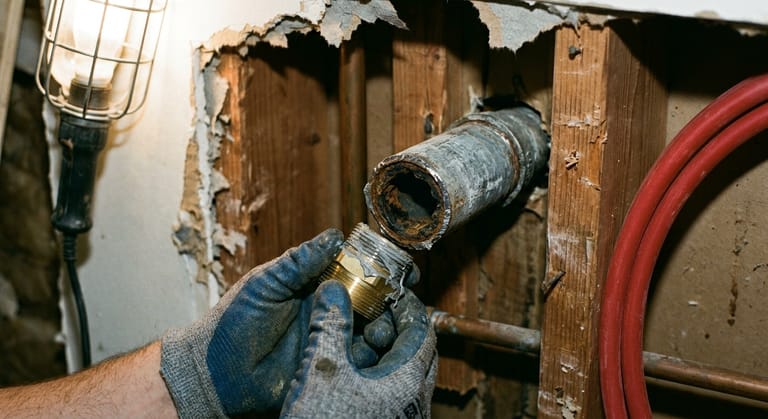
Most readers get here from an aging steel system, so pin the material down first with the identification walkthrough and the galvanized steel overview. The same HUD guide puts galvanized supply piping in the prewar decades and notes corrosion that unfriendly water and hot lines both speed up. HomeGuide gives the material a 20-50 year service life and prices the swap at $2,000-$15,000 depending on what goes in behind it, which leaves the cost to replace galvanized pipe with PEX near the bottom of that spread.
Work done in stages still needs a proper transition wherever the two systems touch. To connect PEX to galvanized pipe, a plumber begins at the threads, because galvanized steel is threaded and PEX is not. A galvanized pipe to PEX adapter carries that boundary across.
Where the adapter leaves dissimilar metals in contact, ordinary practice sets a dielectric union at the seam, so the galvanic couple does not go to work on the older steel. Inside the house that call belongs to the plumbing code your jurisdiction has adopted and to the fitting manufacturer's installation instructions, both of which the plumber pulling the permit reads before you do.
The buried line outside the wall answers to a separate rulebook. 40 CFR 141.84 puts a dielectric coupling between the section that stays and the section replaced whenever a water system takes out only part of a lead or galvanized requiring replacement line.
Half a job gets no blessing in those rules either. The same section clears partial replacement in two situations only, an emergency repair or work synchronized with a planned infrastructure project, and EPA argues against the practice, citing a 2011 Science Advisory Board evaluation in which lead at the tap climbed sharply for days to weeks and sometimes months afterward. The agency adds that a galvanized run left half done can be compromised the same way, which makes old steel feeding new tubing unfinished work.
Phasing the work rarely saves what owners expect it to save, because HomeGuide's $1,000-$5,000 for tearing out old plumbing is billed once, not once per visit. The sequence is mapped in a whole house galvanized repipe, priced in the 2026 galvanized repipe cost guide, and the warning signs are in rusty water and fading pressure.
Which material fits which house
Set PEX or copper pipes side by side and the house usually decides before the debate does.
Plastic is your answer
- Staying put in a 1950s house on failing steel and paying out of savings, where HomeGuide's plastic figure decides it
- Closed walls, plaster, tile or slab, where every extra opening turns into billable drywall
- Municipal water that runs soft or acidic, on the corrosion mechanism EPA describes
Metal earns its premium
- A gut renovation with framing already open, where labor hours converge and only the material gap is left
- Short exposed runs in a mechanical room or garage that take knocks
- A code or association rule naming the material, which your plumber will know before you do
Red flags that settle it before the material does
- Brown or gray water at the kitchen tap the first time anybody opens it in the morning.
- Flow thinning floor by floor across a single season, or paint darkening under a supply run where one joint has begun to seep.
- An inventory record from your water system that carries this address as galvanized requiring replacement, or that concedes lead status unknown.
One disclosure belongs beside a decision this expensive. Writing about problem piping is all Grayfield does: no wrench, no plumbing license, no crew working under the name. Ring (800) 555-0195 at whatever hour the wall comes open and a partner network hands the call to a plumber near you who holds a license and carries insurance, someone who can measure the runs and say whether PEX threads through this framing or the job wants copper. Where a call like that qualifies and turns into work, the network can pay Grayfield a referral fee for it, and nothing about that fee moves the figure you settle with the plumber.
So the choice of PEX or copper pipes comes down to one line: plastic for a lived in house with the walls already closed, metal for open framing, short exposed runs and any code that names it. Hold your bid up against the figures above, and against how copper stacks up beside the galvanized steel already in your wall.
Ready to talk to a licensed repipe pro?
Call (800) 555-0195No charge to call. A licensed repipe pro answers.Licensed repipe partners in your area- Every partner plumber is licensed and insured
- Calls routed around the clock
- Nothing billed for the call
- The plumber quotes you, and you say yes or no