
Galvanized Pipe Fittings: Where Old Joints Fail
The short version
- A cut thread strips zinc off the one spot where the steel wall was already thinnest, so connectors close up long before the tubing does.
- Iron and steel supply piping corrodes and silts up fastest on hot lines, HUD reports, and the water type in your area sets the speed.
- Zinc coated walls can hold on to loose lead, EPA's homeowner flyer warns, and what collects there shows up later at the tap.
- Parts bought before January 4, 2014 met a much looser lead free definition than anything on sale today, per EPA.
- Angi's 2026 data sets the cost of repiping a whole house between $1,500 and $15,000, with the middle of the spread near $7,500.
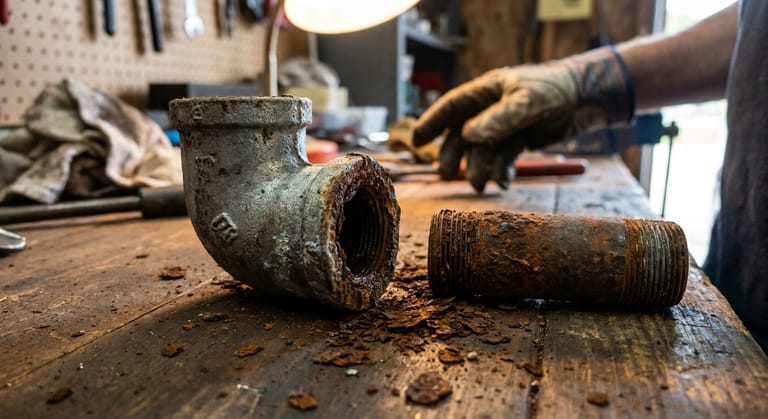
Unthread one elbow from the supply line of a pre war house and the diagnosis is done: rust has filled the threads solid, and the opening left down the middle is a fraction of what the factory bored. Galvanized pipe fittings are the threaded malleable iron connectors that tie a steel supply system together, and out of everything in that system they quit first.
The material itself is simple, in EPA's telling: iron or steel dipped in zinc, so what corrodes is the coating and not the bare metal beneath it. Cutting a thread takes that shield off exactly where the wall was thinned to make room for it. Hence joints that seep and silt up while the straight tubing between them still looks fit for service.
The parts list, and where each shape gives out
Five or six shapes cover an entire system, every one of them malleable iron cut with tapered pipe thread. Galvanized pipe fittings are still carried in the nominal sizes that match the old tubing, so a like for like swap is a counter purchase rather than a special order.
| Part | What it does | How it fails |
|---|---|---|
| Coupling | Joins two lengths | Rust bridges the threads and weeps |
| 90 degree elbow | Turns the run | Scale piles up inside the turn |
| Tee | Branches to a fixture | The branch closes first |
| Union | Unscrews without cutting | The seat corrodes and stops sealing |
| Nipple | A short all thread stub | No plain wall, perforates early |
Why the connector gives out before the tubing
Volume 8 of HUD's Rehab Guide traces the damage to two conditions no household gets to choose: what the incoming water carries, and how hot the line is asked to run. Under certain water types iron and steel supply piping corrodes and loads up with scale, HUD records, hot lines fare worse than cold, and water working against the metal drives it harder. Deposits grow inward. A connector starts life with the narrowest bore and the thinnest steel in the run, so a connector is where the passage shuts.
A house announces this two ways. Pressure sags at whichever taps sit farthest from the meter, upper floor before ground floor, and water drawn first thing each morning arrives tinted, the subject of our page on rusty galvanized plumbing. Not certain the metal is steel? Two checks out of EPA's inventory guidance settle it. Run a coin down the wall: on galvanized steel the mark stays dull gray instead of coming up bright. Then hold a magnet there, because a magnet holds fast on steel. Both results together point at galvanized, and our guide to galvanized supply piping picks up from there.
Galvanized pipes and fittings that once ran downstream of lead
Here a plumbing question turns into a water quality question. EPA's consumer flyer describes the mechanism this way: lead particles can lodge on the inner surface of galvanized pipe, then travel on into the water a household drinks, lifting the readings taken at the tap. Philadelphia's water department frames the same behavior as slow accumulation. Over decades, it says, whatever lead the rest of a property's plumbing sheds settles on corroded galvanized walls. Rough scale in a narrowed joint keeps a grip on what it collects.
The regulations carry a name for that history. A buried steel line sitting downstream of lead at any point in its working life belongs in the category EPA labels galvanized requiring replacement. Where the records leave the question open, the system has to treat the pipe upstream as lead until it can prove otherwise.
Where the federal rule lands. A clock runs under 40 CFR 141.84. Lead and galvanized requiring replacement service lines that a water system controls must be out of the ground inside 10 program years counted from the compliance date of November 1, 2027, and replacing half a line is barred unless an emergency repair or planned infrastructure work makes it unavoidable. Lead carries a maximum contaminant level goal of zero at EPA. Treat that as a target for health and not a legal ceiling; what a utility answers for is the action level and the treatment it sets in motion.
Measure it, do not guess. A glass of water hides lead completely: no color to see, no taste to catch, no odor. A laboratory result is the only way to know, and EPA points households to a certified lab, with the roster kept by the state or local drinking water program. Until that result lands, EPA's holding advice is short. Use the cold tap alone for what you drink, what you cook with and what goes into baby formula, since boiling will not drive lead out, and put a filter certified for lead reduction under NSF/ANSI Standard 53 on it.
Ready to talk to a licensed repipe pro?
Call (800) 555-0195No charge to call. A licensed repipe pro answers.Licensed repipe partners in your area- Every partner plumber is licensed and insured
- Calls routed around the clock
- Nothing billed for the call
- The plumber quotes you, and you say yes or no
Joining galvanized pipe to copper or PEX
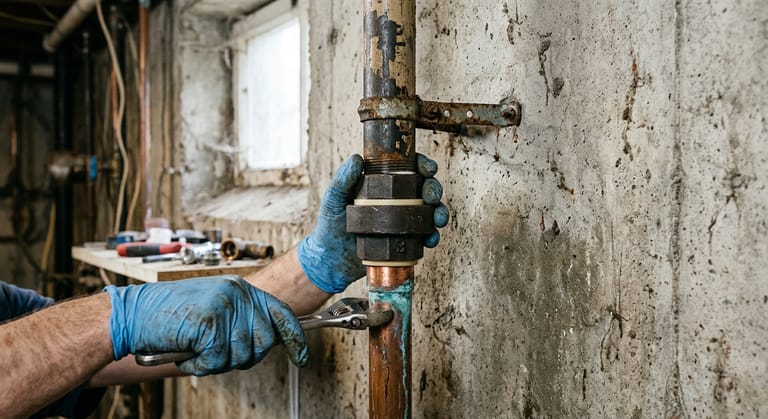
Fresh steel rarely meets old steel any more, so most repairs finish at a boundary between two unlike metals. Screw steel straight to copper and the pair share the same moving water, which drives decay at that seam quicker than either metal manages alone. A dielectric union is the standard remedy. Federal rulemaking reaches for the same part: in the narrow cases where a partial service line replacement may go ahead, 40 CFR 141.84 calls for a dielectric coupling between the section left in the ground and the new one.
That allowance is kept deliberately tight. Doing a service line by halves is something EPA argues against, citing its Science Advisory Board, which found tap lead frequently raised after partial work for a spell of days, weeks or several months, with no way to predict for a given house how high it climbs or when it settles. Where a system can reach the full line, the full line is expected to come out.
Above the floor the hardware is far simpler than the rulebook. A galvanized pipe to copper fitting and a PEX to galvanized pipe fitting are one idea aimed in two directions: a threaded adapter, sold in brass or in steel.
Whichever you buy, buy it certified lead free. That phrase was redefined by the Reduction of Lead in Drinking Water Act of 2011. On anything purchased from January 4, 2014 onward, EPA caps lead at 0.25 percent as a weighted average of the surfaces water touches, against the 8.0 percent the 1986 wording had allowed. If the run is leaving anyway, our comparison of copper against galvanized steel covers what should take its place.
Compression fittings and quick connects when the thread is gone
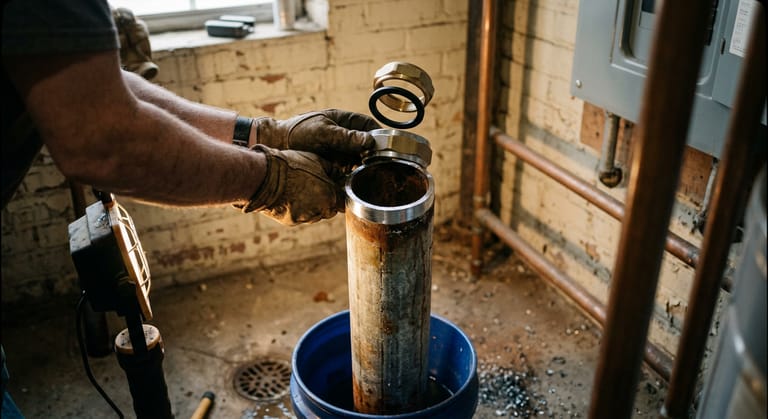
Sometimes nothing threadable survives. Galvanized pipe compression fittings and steel rated push to connect couplings exist for that moment, because neither asks for a die. A dresser style coupling grips the outer wall of the tubing; the push to connect type seals on that same wall with an O ring, backed by a grab ring. Both demand an end that is clean and genuinely round, which metal beside a failed thread rarely offers.
- Close the main and empty the line at the lowest fixture on the property.
- Take the cut back past the rust until the bore reads open, then square the end and knock the burr off.
- Seat the coupling to the insertion depth the maker prints, raise the pressure slowly, and watch the joint through a full cycle of hot water.
Where sound metal remains, a cut thread still makes the stronger joint, though cutting and threading steel pipe is a trade skill in itself.
Red flags that end the do it yourself version
- One joint weeping rust, and a second one starting the same way inside a year.
- Pressure upstairs that fell away at some point and never came back.
- Tinted water on the first morning draw, on days when no crew has been digging in the street.
- A notice from the water system that puts your line in the galvanized requiring replacement category, or records its lead status as unknown.
- Threads that powder as soon as a wrench takes hold, or a stop valve that has quit sealing.
Any single item on that list, and the useful phone call is not to a parts counter.
What the joints tell you about repair against replacement
One failed connector is a repair job. Several under a single roof describe a system reaching its end. HomeGuide puts the service life of galvanized supply pipe at 20-50 years, and HUD places the material's popularity before World War II, which leaves almost every surviving run past the far end of that span.
What the 2026 price pages publish. Angi puts a whole house repipe between $1,500 and $15,000, with the middle of its data near $7,500 and roughly 70 percent of any bill going to labor. HomeGuide quotes $2,000-$15,000 to swap out galvanized supply piping, then treats the drywall opened to reach it as a separate $300-$1,500 and up, with the water line permit at $30-$500.
Weigh that against patching one joint in a house where every other joint is the same age and sees the same water. Galvanized pipe fittings themselves cost little. Getting a wall open to reach them is the expensive half. Our page on what a repipe involves works through the job room by room, and the replacement cost guide itemizes the adders.
Grayfield is a publisher, not a contractor, and does no plumbing work itself. A call to (800) 555-0195 reaches a licensed and insured plumbing partner working nearby, who can price the patch and the repipe against each other. The call is free.