
How to Cut Galvanized Pipe Without Wrecking the Rest of the Run
The short version
- Old steel rarely unscrews, so the working method is two cuts and a union, not a fight with a seized elbow.
- EPA warns that lead particles settle on the inner walls of galvanized pipe, so flush the taps and clean the aerators once the work is done.
- Tapered threads seal metal against metal; compound only fills the spiral.
- HomeGuide puts galvanized supply piping at a 20 to 50 year service life, which is why some of these repairs are not worth making.
Old gray steel does not come apart the way new plumbing does. Threads seize, elbows round off, and the wrench that freed the first joint twists the next one in half. Subtraction is the method that works instead: cut galvanized pipe away as one section, then bridge the gap with fresh threaded ends and a union. Water already running across a floor while you read this? Shut the main valve, then call (800) 555-0195.
What you need on the bench first
Sizes depend on what is in your wall, so read this as a checklist rather than a shopping list. Add two wrenches, thread oil, a union and joint compound for the rebuild. Blades, oil and fittings are hardware store money; the die set is the item worth pricing before you buy one.
| Tool | What it does | Where it wins |
|---|---|---|
| Reciprocating saw, bi metal blade | Slices through the wall in place | Joist bays, overhead runs |
| Angle grinder, thin abrasive wheel | Fastest way through hard steel | Open runs, sparks controlled |
| Rotary cutter rated for steel | Rolls a square edge, no sparks | Near an appliance |
| Threading die, or a rented power threader | Cuts tapered threads on the stub | Rebuilding in steel |
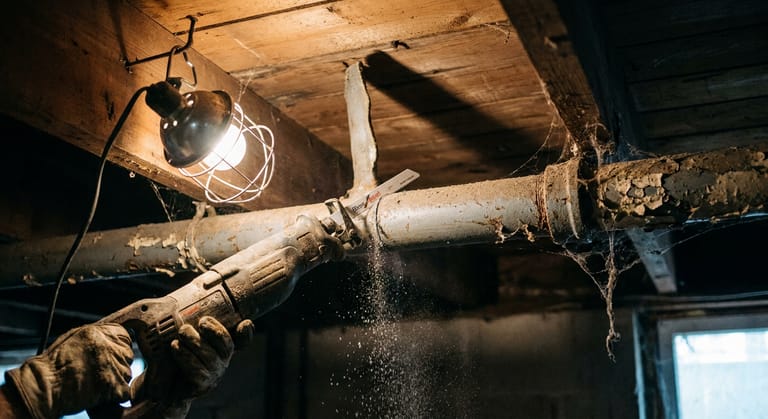
Safety work that comes before the blade
Not everything that has to be shut off here is water.
Before anything spins: close the main valve, then open the lowest faucet and let the run drain itself. Gray steel pipe overhead is no proof of water, so walk the length first and see what each end feeds. A run finishing at an appliance rather than a fixture can be fuel piping, which belongs to a licensed gas fitter. Should anyone catch the smell of gas, the job is over: tools down, every person out of the building, and both the 911 call and the gas utility call placed from outside. Steel supply lines carry electrical bonding in some houses, which makes a bonding clamp an electrician's question before it is yours. Eye and ear protection stay on throughout.
Keep the debris out of the water too. A blade stirs what the wall has collected, and EPA's consumer flyer on lead in drinking water warns that particles of lead can fasten onto the inner surface of galvanized pipe and drive levels up at the tap. Philadelphia Water Department tells it the same way: lead accumulating on corroded walls over decades.
So the job ends at the faucets, on EPA's interim steps. Run each tap a while before anybody drinks from it. Keep drinking, cooking and formula water on the cold side, since heat drives none of the metal out. Unscrew the aerators and rinse them, because that screen is where loosened particles finish up. What a tap actually delivers is a figure only a certified laboratory can produce, EPA holds, and your state or local drinking water authority lists the qualifying labs.
The best way to cut galvanized pipe
No single tool wins every time. The right one fits the space and keeps sparks off what surrounds it, and any of them will cut galvanized steel pipe in household sizes.
A reciprocating saw is the default, because it reaches into a joist bay and needs no clearance to rotate. A grinder is faster but throws sparks. A rotary cutter is quiet and sparkless, though it needs room to swing a full circle. Either way the edge matters more than the speed: a ragged end will not take a thread or seat in a coupling.
Make two cuts, not one. A length captive between two fittings cannot be unscrewed, because turning one end tightens the other. Two marks a few inches apart let the middle drop free, and the stubs left behind are what you thread or couple to.
Cut and thread the stub, step by step
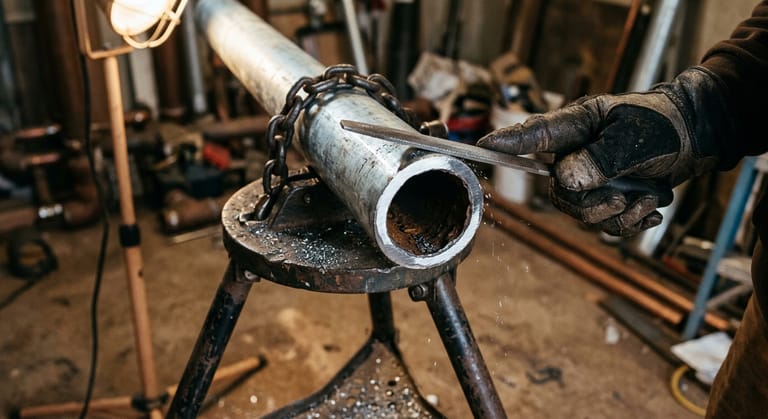
- Drain and dry the run. Water in the bore ruins a fresh thread and rusts the die.
- Strap both sides. Support the metal so nothing drops when the section lets go.
- Mark both lines. Leave enough sound wall on each stub to carry a full thread plus the depth the die needs to run out.
- Take the far mark first. The section stays captive until the second pass, so it cannot swing.
- Ream and file. Knock the burr off the inside and square the outside edge, because the die starts there.
- Read the ring. Bright metal at full thickness is workable; a dark flaky ring around a scaled bore is a replacement conversation.
Ready to talk to a licensed repipe pro?
Call (800) 555-0195No charge to call. A licensed repipe pro answers.Licensed repipe partners in your area- Every partner plumber is licensed and insured
- Calls routed around the clock
- Nothing billed for the call
- The plumber quotes you, and you say yes or no
How to thread galvanized pipe so the joint seals
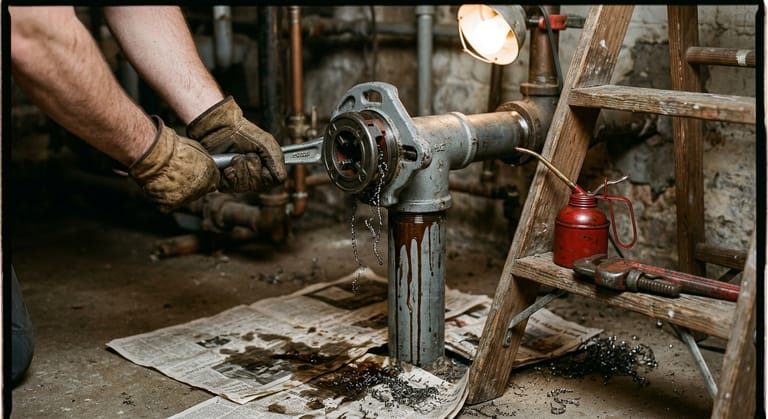
A galvanized pipe thread is not a bolt thread. It is tapered, so the two halves wedge together and seal metal against metal as they tighten, and compound only fills the spiral gap. Get the taper right and it holds for decades; force a shallow one and it weeps forever.
To thread galvanized pipe by hand, slide the die head over the squared end, hold the handle square to the run, and push inward until the teeth bite. After that it is oil and rhythm: keep the die flooded with cutting oil, work forward in short turns, and ease back often enough that the curl of swarf snaps off instead of packing the teeth.
The signal to stop is the end of the steel arriving level with the outer face of the die. That point gives the standard thread length, and it is the reason a galvanized pipe threader comes with a stop built into it. Let the fitting judge the work: hand tight to start, wrench tight to finish. One that spins all the way home under your fingers means the thread went too deep.
Compound goes on the male thread only. The last joint in a rebuilt section is a union, because a threaded length fixed at both ends cannot be spun into place.
How to connect galvanized pipe without threads
A saw leaves a plain end, so every job reaches the same fork: make a thread, or work around it.
- Cut a thread. The strongest route, and the only one a standard steel fitting screws onto directly.
- Fit a grip or transition coupling. A gasket and a grip ring rated for steel outside diameters clamp onto the bare end. Whether it may then be closed inside a wall depends on the manufacturer listing and on your inspector.
- Not a banded rubber coupling. Those belong on drain and vent work, never on pressurized supply.
- Not a push to connect fitting. They are sized for copper, PEX and CPVC rather than steel, so the route there is still a threaded end and an adapter.
Joining steel to PEX, PVC, copper or brass
Mixed metals is where a tidy repair quietly fails: steel touching copper in wet conditions corrodes at the joint.
| New material | How it joins the steel | Watch for |
|---|---|---|
| PEX | Threaded PEX adapter on the threaded end | Support the tubing; it cannot carry steel |
| PVC or CPVC | Male plastic adapter into a steel female fitting | Cement never bonds plastic to metal |
| Copper | Dielectric union, or a brass nipple in between | Corrosion where bare steel meets copper |
| Brass | Screws on directly to a good thread | Brass is the buffer inside dielectric assemblies |
On a plain end the order never changes: thread the steel first, then hang the PEX or PVC adapter off it.
When to stop and call a licensed plumber
Stop when the die will not start because the wall is too thin, when the metal flakes as the wrench bites, when the bore is more scale than opening, or when the same joint weeps after a second rebuild.
The buried run outside is not yours to cut anyway. It already carries a federal classification drawn from a set of four: lead, galvanized requiring replacement, non lead, or lead status unknown. Steel fed by lead now, or fed by it at any earlier point, answers to the second of those, and the Lead and Copper Rule Improvements settle such a line by pulling its whole length. Half measures find no backing at EPA: the agency cites the 2011 Science Advisory Board report and cautions that other materials, galvanized piping among them, can be left compromised where a line is renewed only in part.
Inside the house the arithmetic is simpler. HUD's Rehab Guide records galvanized iron and steel piping as the popular choice up to World War II, with copper taking the market after the war, while HomeGuide rates the service life of galvanized supply piping at 20 to 50 years.
By HomeGuide's numbers a repipe out of this material lands at $2,000 to $15,000 installed. Angi's 2026 figures for doing a whole home run $1,500 to $15,000, with the average close to $7,500.
Weigh that against a rented threader and a lost weekend. The numbers sit in our repipe cost guide, the job in what a full replacement involves, and the material choice in copper versus galvanized steel. Unsure what is behind the drywall? Start with the guide to galvanized piping or the identification walkthrough.
Searching for someone to cut galvanized pipe near you instead? Grayfield is an independent publisher rather than a plumbing contractor: no van, no threader, no license. The number here hands the work to a partner network, where a licensed and insured plumber near you picks up at any hour and prices the stubs, the union and the labor. A call that becomes work pays Grayfield a referral fee from the plumber's side, never added to yours. Call (800) 555-0195.
Ready to talk to a licensed repipe pro?
Call (800) 555-0195No charge to call. A licensed repipe pro answers.Licensed repipe partners in your area- Every partner plumber is licensed and insured
- Calls routed around the clock
- Nothing billed for the call
- The plumber quotes you, and you say yes or no