
Clogged Galvanized Pipes: Where the Flow Went
The short version
- The blockage is usually the pipe itself: HUD's Rehab Guide records corrosion and scale build up inside iron and steel piping, worst in hot water lines.
- Supply side and drain side fail differently, so timing and location tell you which one you have before anyone opens a wall.
- EPA warns that physically disturbing old lines can release lead, which is why acid flushing a water line is the wrong first move.
- HomeGuide's 2026 figures put a galvanized repipe at $2,000-$15,000 installed, with drywall repair a separate $300-$1,500.
- One slow fixture is a repair. Falling flow at every upstairs fixture is a replacement conversation.
The upstairs shower runs thin while the kitchen tap still hits hard. In pre 1960 plumbing that pattern rarely means something got flushed. Clogged galvanized pipes are blocked by their own corrosion: an iron scale that grows inward until the opening is a fraction of what was installed.
HUD's Rehab Guide (Volume 8) ties that build up to iron and steel pipe in certain water types, worst in hot water lines and pushed along by adverse water conditions and heat. Cleaning rarely holds against that, so the decision is about metal, not chemistry.
What is actually blocking the line
Two failures share one complaint. On the supply side, the zinc coating EPA credits for resisting rust wears through, water meets bare steel, and iron oxide builds inward, so pressure fails highest in the house.
On the waste side, galvanized drain pipe corrosion works with gravity: the rough interior catches grease and soap, the deposit hardens, and the line slows until one basin of dishwater backs up.
HUD dates this piping to before World War II, replaced by copper after the war and by plastics from the 1970s, so what survives in service is pre 1960 stock.
| What you notice | Likely cause | How to check |
|---|---|---|
| Thin upstairs, fine downstairs | Scale in the vertical risers | Compare floors at one hour |
| Hot weaker than cold | Hot lines, which HUD singles out | Time a jug on each tap |
| Basin drains slowly, gurgles | Sludge in a steel waste line | Fill it, release, watch the swirl |
| Grit after street work | Loose scale off the wall | EPA notes air after main breaks scours deposits |
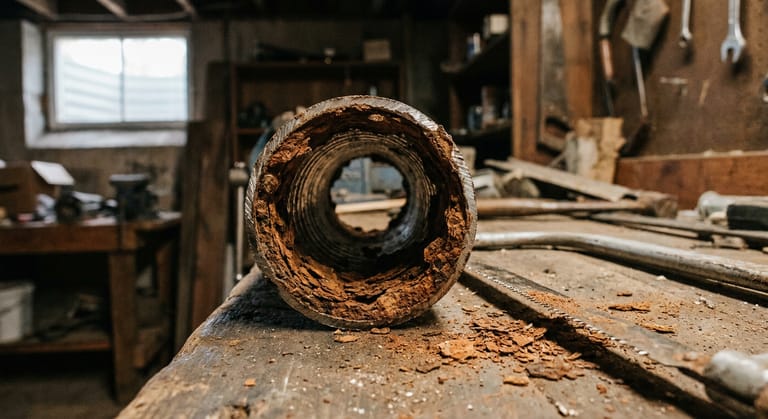
Clogged galvanized water pipes and slow drains are different problems
Clogged galvanized water pipes tell a pressure story: volume drops, the shower turns cold when a tap opens elsewhere, and the loss creeps in over years. A blocked waste line tells a speed story: water leaves the basin slowly, then stops.
That sets the budget: a steel waste line can often be cleared and left in place, while a scaled riser cannot be reopened for long.
How to unclog galvanized pipes without making it worse
- Confirm the material. EPA's quick check needs a coin and a magnet: this steel reads dull silver gray, resists scratching and holds a magnet. The City of Troy, New York publishes the tell: a scratch stays dull gray, not bright silver.
- Clean the aerator. EPA recommends cleaning the faucet screen regularly, where particles collect.
- Map the pattern. Test every fixture, hot against cold and upstairs against down. One slow fixture is a branch. A whole floor is the system.
- On a drain, work gently. Force is the risk: fittings are thinner than the pipe.
- Book a camera if a drain keeps returning. HomeGuide's 2026 figures put a sewer camera inspection at $125-$500 on average, or $175-$750 with no cleanout.
Blasting a supply line clear does not belong on that list. EPA's corrosion control work documents that disturbing old lines can release lead, citing field sampling where most results above the action level came from disturbed sites. Acid flushes and descaling tools are that disturbance.
Ready to talk to a licensed repipe pro?
Call (800) 555-0195No charge to call. A licensed repipe pro answers.Licensed repipe partners in your area- Every partner plumber is licensed and insured
- Calls routed around the clock
- Nothing billed for the call
- The plumber quotes you, and you say yes or no
How to clean galvanized pipes, and what cleaning cannot reach
Readers ask about vinegar, about the best drain cleaner for galvanized pipe, and about wire brushes. Here is the split between what helps and what only feels productive; cleaning methods in detail covers each.
Worth doing
- Rinsing aerators and washing machine inlet screens
- Clearing a soft drain blockage with a plunger or hand auger
- Photographing the fittings before a plumber visits
Does not reach the problem
- Acid or caustic products poured into a supply line
- Descaling a riser buried in a wall cavity
- Whole house filters bought to fix pressure
Surface work changes nothing about the bore: a run looks sound from the basement while the channel inside has closed to a straw. If the first draw runs brown, what discolored water signals comes next.
Why clogged galvanized pipes get replaced instead of cleaned
Should galvanized water pipes be replaced, or simply cleared again? Inside the walls that is a budget call. On the service line from the street main, federal rules decide.
Everywhere else it is arithmetic. HomeGuide's 2026 cost data gives galvanized supply pipe a 20 to 50 year service life, so pre 1960 runs are decades past it. Clogged galvanized pipes rarely stay a one branch problem: the same water and steel run through the whole house. Restoring one bathroom is a repair. Doing it three times is a repipe in installments.
Those are national ranges, never a quote. What moves a bid inside them is worth reading, how a repipe is sequenced shows how much gets opened, how copper compares with galvanized steel covers the material choice, and the galvanized pipe hub holds the identification basics.
Red flags that mean calling a licensed plumber now
- Sewage backing up into a tub or floor drain, a biohazard, not a wait and see.
- Flow that fell within weeks instead of years.
- A drain that slows again within a month of clearing.
- Damp or rust stained threads at a fitting above a finished ceiling.
- A utility letter classing your line as lead, galvanized requiring replacement, or unknown.
Any one of those is a phone call. Dial (800) 555-0195: a partner network hands the line to a local plumber, licensed and insured, who sees clogged galvanized pipes most weeks. Grayfield is an independent publisher, not a contracting business. The call costs nothing, and any referral fee reaching Grayfield leaves that plumber's quote untouched.
If none of this matches your house
You have still narrowed it. One slow fixture is a fixture problem, a whole floor losing pressure is a supply problem, and a drain that keeps closing is a camera job.