
How to Clean Galvanized Pipes Without Making Them Worse
Two different jobs hide behind the same search. One is cosmetic: orange bloom on an exposed run in the basement. The other is the bore, the shrinking channel inside a supply line installed before most of us were born. You can clean galvanized pipes on the outside in an afternoon with a wire brush and a can of primer. You cannot scrub the inside of a pressurized line back to full flow, and EPA has a specific warning about disturbing what has collected in there.
First, prove the pipe is galvanized steel
Identification comes before the brush. A coin and a magnet answer it, and the check comes out of EPA's service line inventory guidance. Drag the coin edge across the metal: galvanized steel barely takes the mark and keeps its dull silver gray face, while lead opens under light pressure into a bright silver streak. Then offer the magnet: it clamps onto steel and falls away from lead. The City of Troy, New York publishes a result table that reads the same way, down to the scratch that refuses to brighten.
| Field test | Galvanized steel | Lead |
|---|---|---|
| Magnet | Holds firmly | No pull at all |
| Coin scratch | Resists the edge, mark stays dull | Marks under light pressure, flashes silver |
| Outside surface | Dull silver gray, darker with age | Dull gray, soft looking surface |
Gloves belong on before the coin comes out, and EPA asks that the shavings be cleaned up after. A magnet that will not hold sends you back to the identification walkthrough first.
What cleaning galvanized pipes can and cannot reach
Failure begins on the wet side. HUD's Rehab Guide, taking stock of older residential plumbing, reports that certain water types left iron and steel pipes corroded and scaled on the inside, that hot water lines came off worst, and that heat together with aggressive water chemistry drives the damage on. The zinc goes first. Steel underneath it rusts, and the rust stays where it forms, building inward as a hard shelf. That shelf is the flow that went missing.
Cleaning genuinely fixes
- Surface rust on exposed runs
- Aerator screens and shower heads full of grit
- Grime hiding a joint you need to inspect
Cleaning never fixes
- A narrowed bore in a pressurized line
- Rusty first draw water, worst on the hot side
- A thread thinned to the point of weeping
The lead question before you scrub anything
Old steel manufactures no lead of its own; it collects what has passed through it. In EPA's consumer flyer on lead in drinking water, particles fasten onto the inner walls of galvanized pipes, later break away into what the household drinks, and push that household's readings upward. Philadelphia Water Department puts the same accumulation in slower terms: let lead travel through a property's plumbing for decades and corrosion hands it somewhere to settle.
Movement is what turns that deposit loose. EPA's technical recommendations on corrosion control treatment cite field sampling where service lines knocked about by infrastructure work afterwards gave up lead, and the report rests on Del Toral and colleagues in 2013: of the samples reading above the action level in force at the time, 0.015 mg/L, most were drawn from lines that had been disturbed rather than left alone.
After anything that rattles an old steel line: EPA starts by moving water through the plumbing before anybody fills a glass, and a long shower or a laundry cycle does that as well as an open tap. Whatever gets drunk, cooked with or stirred into baby formula comes off the cold side, and the kettle is no shortcut, because boiling leaves the lead behind. Unscrew the faucet aerator and rinse it, where loosened particles end their trip. The metal reaches none of the senses, no color, no taste, no smell, so the one proof EPA counts is a certified laboratory report on your own tap; whoever regulates drinking water in your state or town names the qualifying labs. While the sample is out, EPA's interim measure is a lead reduction filter certified under NSF/ANSI Standard 53, and certification is the whole test.
How to clean galvanized steel pipes on the outside
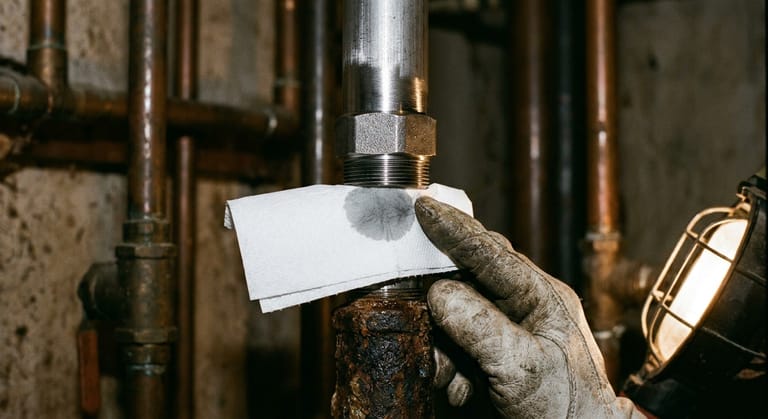
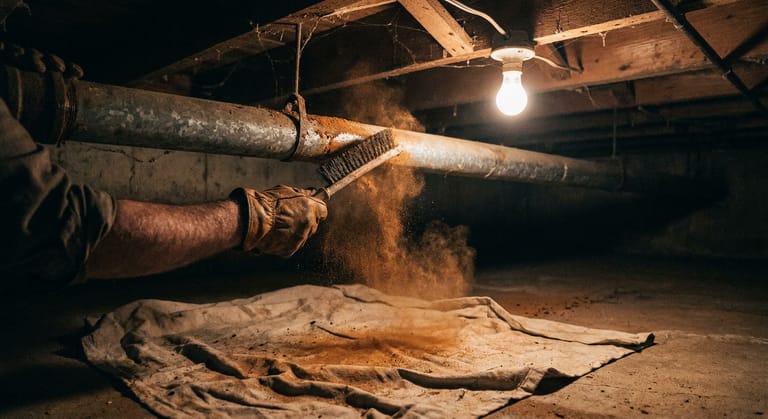
The safe way to clean galvanized pipes runs from the outside in, and an hour or two covers a twenty foot basement run. The shopping list is short: a stiff wire brush, gloves, eye protection, rags, and a metal primer rated for zinc coated surfaces. Hardware store money, not a project budget.
- Follow the run to both ends. Overhead steel in an old basement can just as easily be fuel piping. A length that finishes at an appliance instead of a fixture belongs to a licensed gas fitter and to nobody else. And if an odor of gas reaches anyone at any stage, the work is over: the house empties, and 911 and the gas utility are called once everybody is standing outside.
- Dry the metal and cover what sits underneath. Rust dust travels, and fresh moisture only shows itself against a dry surface.
- Brush along the run, never across the threads. Threads carry the thinnest wall on the line, so work them lightly and keep grinders away.
- Read what the brush takes off. Fine orange dust is surface rust and nothing worse. Dark flakes lifting off a damp patch mean the wall is weeping, and that is where the job ends.
- Come back an hour later and test the joints. Press a paper towel against each fitting. A stain means a leak, not leftover grime.
- Prime and paint, or leave the metal bare. Primer buys years on a dry run and conceals nothing you need to watch.
None of that changes the inside of the pipes. It buys appearance, a clean surface to inspect, and an early warning system.
Ready to talk to a licensed repipe pro?
Call (800) 555-0195No charge to call. A licensed repipe pro answers.Licensed repipe partners in your area- Every partner plumber is licensed and insured
- Calls routed around the clock
- Nothing billed for the call
- The plumber quotes you, and you say yes or no
Picking a drain cleaner for galvanized pipes
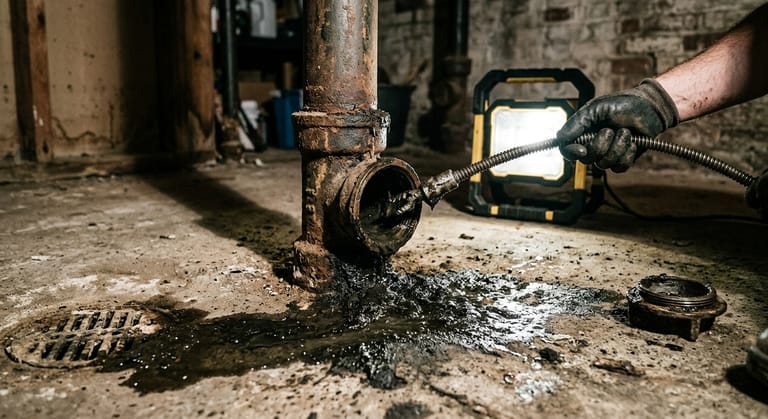
A house of this vintage often has steel waste lines too. No federal agency endorses a product for them: what EPA and HUD put on record is the state of the metal, and that record should make the decision. Caustic and acid drain cleaners sit against walls those same documents call corroded and scaled, and they sit longest at the blockage, which tends to be the low spot in the oldest run of pipes.
The route a plumber takes is mechanical and reversible. A cable with the right head cuts through the blockage, a camera reads the wall behind it, and any talk of jetting waits until somebody has seen how much metal is left. When the line closes again within weeks of every clearing, the clog stopped being the real problem a while ago.
When cleaning is the wrong tool
No attempt to clean galvanized pipes will restore a run that is finished, and more scrubbing only postpones the estimate. Call a licensed plumber when upstairs flow has faded year over year, when the first draw runs rusty and the hot side is worse, when a threaded joint weeps after a cleaning, when a drain backs up weeks after every clearing, or when brown water follows street work outside.
A federal clock runs behind all of this. Your water system has to file the pipe feeding the house under a label, and it is given four to choose from: lead, galvanized requiring replacement, non lead, or lead status unknown. Steel fed by a lead line today, or fed by one at any earlier point, takes the second of those, and the Lead and Copper Rule Improvements settle such lines by removing them whole, no later than 10 program years after the compliance date of November 1, 2027. Nowhere on that menu does scrubbing appear. EPA argues separately against taking out only part of a line, resting the objection on the Science Advisory Board evaluation from 2011.
What it costs when cleaning cannot save the run
Swapping the material out costs $2,000 to $15,000 installed in HomeGuide's 2026 figures, and what goes back in, PEX, copper or something else, drives most of that spread. Angi's 2026 numbers land alongside: $1,500 to $15,000 on a whole home repipe, a national average near $7,500, and roughly 70 percent of any bill charged as labor. Putting the house back together is its own line. HomeGuide opens drywall repair around the access holes at $300 to $1,500 and up.
Those numbers are broken down in our repipe cost guide, and the job itself, from access holes to the day the water returns, is in what a full replacement involves. If the new material is the open question, compare copper against galvanized steel. If the symptom is the water rather than the surface, start with rusty galvanized pipes, and the material as a whole sits in the guide to galvanized piping.
Searching for someone to clean galvanized pipes near you?
A brush and a free weekend cover the outside. What sits behind drywall, whether a thread that weeps after cleaning or a run your utility has already flagged, is work for somebody licensed to open a wall. Grayfield publishes and Grayfield does not plumb: no contractor's license sits behind this page. The line below is staffed at any hour, and it puts you through to a licensed, insured local plumber in the partner network: (800) 555-0195. A qualified call may earn Grayfield a referral fee, and it moves nothing about the price you settle with the plumber. Dial (800) 555-0195 and say what the wire brush turned up.