
Are Galvanized Water Pipes Dangerous?
The short version
- The health risk needs a lead source upstream. Without one, the trouble is mechanical: flow, rust and leaks.
- Where lead once sat upstream, EPA's flyer traces particles that cling inside the steel and surface at the tap much later.
- A line ever fed by lead becomes galvanized requiring replacement and comes out in full, on the utility's schedule.
- A 2026 whole home repipe runs $1,500-$15,000 in Angi's data, average near $7,500, labor taking about 70 percent.
A home inspector will not call galvanized water pipes dangerous on looks alone, and no federal rule condemns the material by name. Two checkable things decide it: what fed the line, and how far the steel has corroded.
If a lead service line ever sat upstream, EPA's drinking water flyer sets out the mechanism: particles of lead fasten onto the inner surface of galvanized pipe and reach the tap long afterwards.
If nothing leaded was ever upstream, the problem is mechanical, not medical: rust thins the wall and closes the bore until a threaded joint lets go, showing up as weak pressure upstairs and a damp elbow.
Two risks hiding in one gray line
EPA's replacement planning material describes the product in one clause: iron or steel pipe under a zinc coat meant to hold off corrosion and rust. Zinc in that role is sacrificial and finite. Once it goes, water sits against bare steel, and HUD's Rehab Guide (Volume 8) records the sequel: corrosion and scale that pile up under certain water chemistries, hot lines worst of all.
That roughened interior works against a house twice. It shrinks the channel flow squeezes through, which is why rust shows in the first draw and why the top floor weakens first. It also holds loose metal: as this steel corrodes over decades, Philadelphia Water Department reports, lead from a building's own plumbing can gather along the pitted walls.
| Pathway | What a homeowner notices | Documented by |
|---|---|---|
| Metal held in the corrosion layer | Nothing at all, which is the problem | EPA flyer; Philadelphia utility record |
| Scale closing down the bore | Upstairs pressure fading, brown first draw | HUD Rehab Guide, Volume 8 |
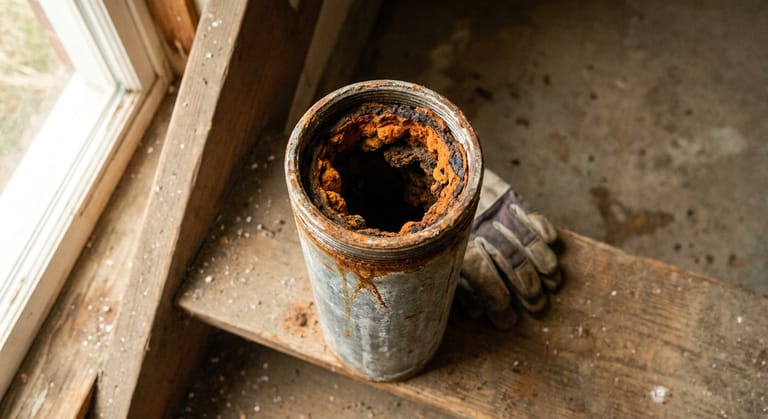
Are galvanized water pipes safe to drink from?
Everything hangs on the upstream history. EPA's inventory guidance is blunt about a run sitting downstream of a lead service line, now or earlier: it can take lead onto its walls and pass it to what people drink. Such runs carry a label of their own, galvanized requiring replacement. Where a clean upstream history cannot be shown, 40 CFR 141.84(a)(4)(ii) tells the utility to assume the worst.
So the visible pipe does not make the supply safe or unsafe to drink from; the upstream does, and leaded upstreams are hardly rare. EPA's seventh drinking water infrastructure needs survey counted about 9.2 million lead service lines nationally in 2023.
Until the laboratory reports back, EPA's interim measures apply. The drinking glass, the cooking pot and the bottle of formula get filled from the cold tap. Rinse the grit out of the aerator screen. EPA is clear that boiling leaves lead behind.
Do galvanized pipes need to be replaced?
Indoors this follows condition, not the calendar. Age on its own does not make galvanized water pipes dangerous, though HUD puts the material in the decades before World War II and hands copper the postwar job. HomeGuide's 2026 cost guide allows it a 20-50 year service life, leaving any original pre-1960 run past its rated span.
Leak history, pressure upstairs and what a cut section reveals decide when to replace galvanized plumbing.
Outdoors the logic changes. Once a utility classifies your service line as galvanized requiring replacement, removal becomes scheduled public work, not a choice you make.
One clause belongs in any bid for the buried section. Outside emergency repairs and planned infrastructure work, 40 CFR 141.84(g) bars taking those lines out halfway, and EPA's Science Advisory Board explains why: leaving half in place has repeatedly driven tap lead upward for days to weeks, sometimes several months.
Ready to talk to a licensed repipe pro?
Call (800) 555-0195No charge to call. A licensed repipe pro answers.Licensed repipe partners in your area- Every partner plumber is licensed and insured
- Calls routed around the clock
- Nothing billed for the call
- The plumber quotes you, and you say yes or no
Which of the two risks is actually yours
Neither risk yields to staring at the pipe, and each needs different evidence.
- Name the metal at the entry point. A coin scratch plus a magnet tells dull gray steel from dull gray lead. Our [guide to identifying galvanized pipes](/galvanized-pipes/) carries the procedure and the City of Troy, New York result table.
- Get the classification out of the utility. Your water system chose from a closed list of four: lead, galvanized requiring replacement, non lead, or lead status unknown. That choice, not the visible pipe, says whether the lead pathway is live.
- Test the supply rather than the metal. A classification describes the line, not what left your tap this morning. Closing that gap takes a laboratory certified through your state authority.
- Look inside the steel. Cutting a section at a threaded joint shows a plumber how much bore is left, the only direct read on the mechanical half.
Red flags that justify a call today
- Two leaks on one run inside twelve months.
- Metallic taste or brown color in the first draw after a quiet night.
- Upstairs pressure dropping while the ground floor holds steady.
- Damp around a threaded joint, elbow or union.
- A utility notice filing your line as galvanized requiring replacement, as lead, or as unknown.
Grayfield is an independent publisher, never a contractor. Dial (800) 555-0195: the call enters a partner network and routes to a licensed local plumber who carries insurance. Grayfield may earn a referral payment; your price stays the plumber's.
What replacement costs in 2026
Read all of that as a national range, never as a quote. The full cost of replacing galvanized pipes explains what pushes a bid up or down, how a repipe proceeds sets out the disruption, and copper measured against galvanized steel settles the material choice.
If none of this describes your house
Then time is on your side. Gather the classification, a certified lab result and a plumber's read on the interior while nothing is dripping. Otherwise a leak writes that schedule, and it never picks a convenient week.
Ready to talk to a licensed repipe pro?
Call (800) 555-0195No charge to call. A licensed repipe pro answers.Licensed repipe partners in your area- Every partner plumber is licensed and insured
- Calls routed around the clock
- Nothing billed for the call
- The plumber quotes you, and you say yes or no