
Should you buy a house with polybutylene pipe?
The short version
- This plastic is not a deal killer. It is a budget line you negotiate before the inspection contingency expires.
- InterNACHI dates manufacture to 1978 through mid 1995, so anything still carrying water in a listed home is at least 31 years old.
- Angi 2026 prices the conversion at $1,500-$2,500 for a one bathroom home and up to $15,000 above 2,000 square feet.
- Florida's Citizens will not write new business over 20 years old on this piping, one documented case of the binder, not the plumbing, holding up a closing.
- Shell's SEC filing describes class claims closing by 2009, so no settlement fund is waiting to reimburse you.
Usually yes, once the price reflects a repipe you will eventually fund. Grey tubing behind the drywall is a budget line, not grounds to walk from a contract. Whether to buy a house with polybutylene pipe rests on three answers you can collect before the inspection contingency dies: how much pipe is in the walls, whether any has leaked, and whether a carrier will bind your lender's policy at closing.
Grayfield is an independent publisher covering problem piping, not a plumbing contractor. The number here, (800) 555-0195, reaches a licensed local plumber who can inspect the house you are buying.
What you would be taking on
Per InterNACHI, polybutylene ran from 1978 into mid 1995, reached as many as 10 million American homes, and ended production in mid 1996. Whatever still holds pressure in a listed house has worked 31 years at minimum.
The mechanism is chemical, not age: InterNACHI names oxidants in treated municipal water, chlorine above all, reacting with the polybutylene until the wall scales, flakes and turns brittle. Fractures too small to see follow, and the pipe stops holding its rated pressure.
Fittings surrender ahead of straight runs. InterNACHI records leak and failure rates above normal here, clustered at the joints, metal and plastic alike, and HUD's Rehab Guide (Volume 8) goes further, listing the connectors and pipe of these water systems among components known to fail. See the fittings that fail first.
What you are pricing is property damage, not water quality. InterNACHI ties the end of production to allegations of burst lines wrecking houses: flooded rooms and ruined drywall, nothing dissolved in the tap water.
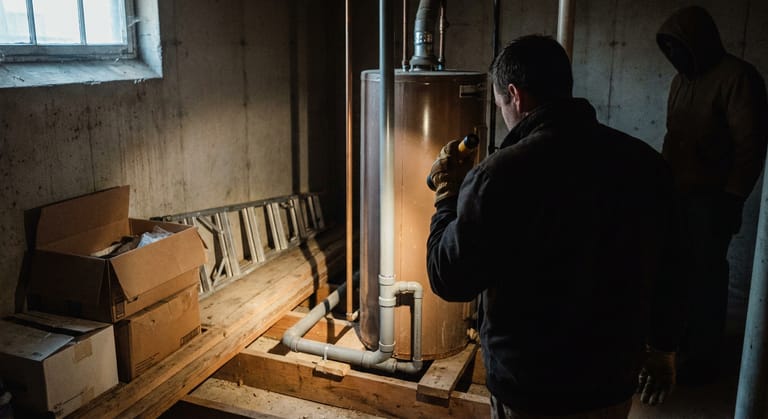
Walk the house yourself, before the inspector does
A flashlight, your phone camera, twenty minutes at a second showing, and most of it settles.
Eyes and camera only, hands off. Tubing that has held pressure for thirty odd years reacts badly to bending, and a joint you nudge in a stranger's house may be one you own by Friday. Nothing gets turned, valves included. A live drip, a soft cabinet floor or a ceiling stain goes to your agent in writing that day.
- Begin at the water heater. Supply runs are usually bare there, so you read the pipe instead of guessing.
- Trace that run back to the point of entry, near the meter and main shutoff. Many houses pair copper there with plastic in the walls above, so one tidy sightline proves nothing.
- Open the vanities and sink cabinets. Stub outs below basins and behind toilets are third.
- Read the print on the tubing. PB2110 is the old ASTM material designation code, running along the pipe wall. That stamp confirms it, not the color.
- Color proves nothing alone. Grey heads the InterNACHI list, which runs on to white, silver, blue and black, at 1/2 inch through 1 inch. Grey PEX sells today too.
- Ask for the paper trail: seller disclosure, plumbing permits pulled on the address, repair receipts. Partial repipes from years back turn up often and move the number.
No current standard covers a repair part
The specification this pipe was built to no longer exists: ASTM pulled D3309 in 2010, the document that once governed these systems, hot side and cold. Nothing on the books certifies a like for like piece, so a spot repair only buys time.
Price the repipe before you price the offer
Use the inspection window to get a quote in writing: a national average is a poor thing to negotiate against. The 2026 ranges below say whether it is sane.
| Scope | 2026 range | Published by |
|---|---|---|
| One bathroom home, converted to PVC | $1,500-$2,500 | Angi, 2026 |
| Two or more bathrooms, converted to PVC | $3,000-$7,000 | Angi, 2026 |
| Whole home, 2,000 sq ft or larger | up to $15,000 | Angi, 2026 |
| Whole home, any replacement material | $1,500-$15,000 | HomeGuide, 2026 |
| Drywall opened for access, then repaired | $300-$1,500 and up | HomeGuide, 2026 |
Hours worked, not parts bought, fills that invoice. Angi tracks plumbers at $45 to $200 an hour while materials peak near $8.00 per linear foot, which is why two houses of one size quote differently: you buy access, through an attic, crawl space or slab. The full cost breakdown for replacing polybutylene pipe lists every line item, and how a repipe actually runs covers the week itself.
Ready to talk to a licensed repipe pro?
Call (800) 555-0195No charge to call. A licensed repipe pro answers.Licensed repipe partners in your area- Every partner plumber is licensed and insured
- Calls routed around the clock
- Nothing billed for the call
- The plumber quotes you, and you say yes or no
Will homeowners insurance cover polybutylene pipe?
More purchases stall here than in the crawl space: your loan will not fund without a bound policy. The one openly published rule belongs to Citizens Property Insurance Corporation, the Florida entity the state created to carry what private carriers refuse. Under it a house of 20 years or newer stays eligible with this pipe in place, provided nothing leaks, no water damage sits unrepaired, and nothing reads as run down or hazardous. Past that 20 year line the answer reverses: as new business, the risk is not insurable on the Citizens HO-3, HO-8, DP-1, DP-3, MHO-3 or MDP-1 forms.
Take that as one state insurer's practice, nothing broader. Nor should you expect a policy to fund the repipe: homeowners forms carve out wear and tear, and a supply system installed before 1996 is the definition of it. Carriers get their own page.
Have your agent quote this exact address in writing while the contingency still protects you. No regulator bulletin and no carrier document setting nationwide practice turned up in our research pass, so a repiping company claiming one is advertising.
Selling it on later with polybutylene pipes in the walls
Yes, these houses trade every week, so nobody ends up stuck. The catch is symmetry: whoever buys this house from you walks the same twenty minutes and gets the same quote before they sell it on, so the polybutylene pipe left untouched comes off your price the way it comes off the seller's today. What you owe that next buyer in writing is fixed by your state's statute and its disclosure form, and no two states line up. Grayfield publishes research, not legal advice, so send that one to your agent.
No settlement money is waiting for you. Cox v. Shell Oil Company reached the Chancery Court for the Twenty-Seventh Judicial District of Tennessee on June 13, 1995, where Shell with Hoechst Celanese committed at least $950 million toward relief for the class. Shell's Form 10-Q for the quarter ended June 30, 1998 puts a fund of that size on the record, open to claims only as far as 2009. That horizon passed and nothing reopened it. See [what became of the class action](/polybutylene-pipe-lawsuit/).
Buy it, or walk away
Set what you found beside what fixing it costs. Two things decide: whether the quote fits a credit you can negotiate, and whether anybody will insure the house.
Reasons to proceed
- The system is dry, no leak history disclosed
- A written quote fits your negotiated credit
- An agent has a carrier willing to quote it
Reasons to keep looking
- Two or more repaired joints, on separate calls
- Ceiling or cabinet staining under a bathroom above
- No carrier will bind, so the loan cannot fund
When to stop and call a licensed plumber
A few findings end the do it yourself stage. Call a professional the same day for:
- Moisture at a fitting, or the mineral crust a joint leaves as it weeps and dries
- Staining on a ceiling or cabinet base beneath upstairs plumbing
- Exposed tubing at the heater gone chalky and stiff
- A disclosure listing two or more repairs in the same pipe system
Searching for polybutylene replacement near me is a sound move: the call costs nothing, and a plumber who has been in that crawl space turns vague worry into the figure your offer needs. To read up first, try our guide to polybutylene pipe or the comparison with modern PEX.
Grayfield connects callers with licensed, insured local plumbing partners who quote conversions like this one. Call (800) 555-0195 and get the pipe in that house looked at properly. The call is free, you approve the price with the plumber, and you learn what it costs to buy a house with polybutylene pipe before you sign.
Ready to talk to a licensed repipe pro?
Call (800) 555-0195No charge to call. A licensed repipe pro answers.Licensed repipe partners in your area- Every partner plumber is licensed and insured
- Calls routed around the clock
- Nothing billed for the call
- The plumber quotes you, and you say yes or no