
Polybutylene pipe replacement, from the first leak to the last patch
The short version
- InterNACHI dates production of this material to the 1978 through mid 1995 window, which makes any system still carrying water in 2026 at least 31 years old.
- Connectors let go before straight runs do, per InterNACHI and HUD's Rehab Guide, so a second joint leak usually ends the repair argument.
- ASTM pulled D3309, the product standard for this plumbing, in 2010, leaving no current specification behind a like for like repair part.
- Angi 2026 prices the PVC conversion from $1,500-$2,500 in a one bathroom house up to $15,000 once the home passes 2,000 square feet.
- No settlement money is left to wait on: Shell's SEC filing has claims closing by 2009, and nothing has reopened since.
Few of these jobs start with a flood. The trigger is usually a second weeping joint within a year, in a house whose supply lines fall in the 1978 to mid 1995 manufacturing window InterNACHI gives for this material. Open the same system twice and a polybutylene pipe replacement becomes the sober choice, not the extravagant one.
Grayfield publishes; it does not hold a wrench. The number here, (800) 555-0195, connects you with a licensed and insured plumber in the partner network who prices the job on your house.
Signs a patch will not hold much longer
The failure is chemical and starts on the wetted surface. InterNACHI's account: oxidants in public water, chlorine above all, react with the polymer, so the wall picks up scale, sheds flakes and stiffens, and the micro fractures that follow drain the strength from the run.
HUD's Rehab Guide, Volume 8, names the parts that let go: connectors as well as the pipe itself in a polybutylene water system. Joints surrender first, so the drip pattern below says more than the deed does.
- Two or more seeping fittings inside one season
- Weeping at a crimp or compression joint, not mid span
- Stiff, chalky tubing where the run is exposed at the water heater
- The code PB2110 printed on the pipe wall, the designation the retired ASTM scheme used
- Usually grey, though InterNACHI also logs white, silver, black and blue, in 1/2 inch through 1 inch sizes
Color proves nothing on its own, since grey PEX sits on every supply house shelf. The stamp confirms the material; fitting style is the backup check.
The product standard behind this pipe is dead. D3309, the ASTM specification for polybutylene tubing on hot and cold household supply, was withdrawn in 2010. It had rated the tubing and fittings for 100 psi at up to 180F. Nothing in force certifies a like for like repair part today.
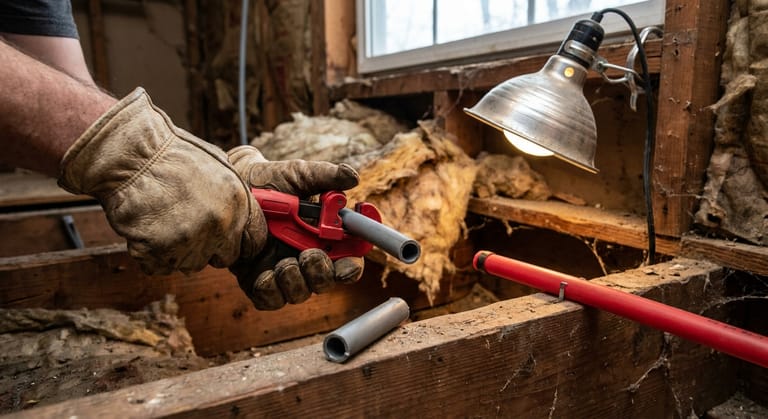
Replacing polybutylene pipes: what the crew actually does
A repipe is not a bigger patch. New supply lines run from the main shutoff to every fixture, the old tubing stays put, and openings are cut high on walls, at ceiling crossings and at each stub out.
Angle stops under sinks and behind toilets are usually changed on the same visit, so a polybutylene shut off valve replacement rarely needs its own trip.
Over a crawl space or basement, routing runs below the floor and the walls come through nearly untouched. The expensive geometry is two stories on a slab: lines climb to the attic and drop back down interior walls, and those hours are the invoice.
Replacing polybutylene pipes in a mobile home is an access question of its own. Ask who reaches the lines in the underbelly and who closes the insulation back up, since that swings the price more than the tubing choice.
How long does it take to replace polybutylene pipes?
No authority publishes an average duration. What you can nail down before signing is the sequence a polybutylene pipe replacement runs through, and which stretches shut the water off.
- Walkthrough. Fixtures counted, meter located, and whatever is reachable without opening drywall noted.
- Scope in writing. Material, fixture count, access openings, permit, and whether patch and paint are included.
- Permit. HomeGuide 2026 puts the average water line replacement permit at $30-$500, and the inspection slot fixes the calendar.
- Rough in. New runs are pulled and tied in. Supply is shut in blocks, so ask how many and how long.
- Pressure test and inspection. Nothing closes up until the system holds pressure and passes.
- Patch, texture, paint. Often a separate trade and bill.
Which new material: PEX, copper or PVC?
Angi's 2026 pricing assumes a conversion to PVC; PEX and copper carry their own numbers. By the linear foot, Angi 2026 shows PEX at $0.40-$2.00 next to $2.00-$8.00 for copper; on a 2,000 square foot home HomeGuide 2026 shows PEX at $2,000-$4,000 against $8,000-$16,000 in copper. Owners who replace polybutylene pipes with PEX do it for those numbers and the flexibility, though local code has the last word. The two are weighed in our PEX and polybutylene head to head.
What PEX saves you
- Bends through framing, so fewer openings to cut
- The lower material price per linear foot (Angi 2026)
What copper costs you
- Rigid lengths, so the route demands more openings
- A multiple of the PEX price per linear foot (Angi 2026)
Ready to talk to a licensed repipe pro?
Call (800) 555-0195No charge to call. A licensed repipe pro answers.Licensed repipe partners in your area- Every partner plumber is licensed and insured
- Calls routed around the clock
- Nothing billed for the call
- The plumber quotes you, and you say yes or no
What a polybutylene pipe replacement costs in 2026
Angi 2026 sorts the job by how much house the lines cross:
| Scope | Installed, converted to PVC (Angi 2026) | What drives it |
|---|---|---|
| One bathroom house | $1,500-$2,500 | One wet wall to work |
| Two or more bathrooms | $3,000-$7,000 | Branch runs get longer |
| Home of 2,000 sq ft or more | up to $15,000 | Climbing routes, more openings |
HomeGuide 2026 sits in the same territory, $1,500-$15,000 installed. Labor moves a bid inside those bands: Angi 2026 has plumbers at $45-$200 an hour, material topping out near $8.00 per linear foot. The 2026 cost breakdown splits it per fixture and per foot.
Find out where restoration sits in the number. HomeGuide 2026 prices the drywall work after a repipe from $300-$1,500 upward, the line owners meet after the fact. Tearing out the old plumbing runs $1,000-$5,000 by the same source, though that usually rides inside the repipe figure. Make the bidder name which of the two the quote covers.
Patch the fitting, or pull the system?
Against a repipe one repair looks cheap. Angi 2026 puts a single fixture at $70-$1,000, and the headline polybutylene band of $150-$5,100 is wide because it blends small call outs with whole house work.
What a patch leaves untouched is the odds on every joint nobody has opened, and no standard in force covers the part going in. The fittings guide and the repair options page set out what a spot fix buys.
Two facts end the debate. First, no outside money is coming. In a 1998 SEC filing Shell described the class settlements as creating a $950 million fund whose claims could be filed only until 2009. That window is closed and nothing has reopened it.
Second, eligibility. Citizens Property Insurance Corporation, the residual market carrier Florida created, sets its cutoff at 20 years: a dwelling at or under that age with this plastic stays writable while nothing leaks and no water damage sits unrepaired. Anything older arriving as new business falls outside its main homeowner and dwelling forms.
One carrier in one state is not an industry rule, yet every polybutylene house passed 20 years long ago.
Searching for polybutylene pipe replacement near me?
Those results mix contractors who price in very different ways, so read the first quote as a data point, not the price. Hold every bid to one list: material, cost per foot or per fixture, how many openings, who paints them, permit. Two written scopes beat one confident number by phone.
When the call cannot wait
Some of this can sit until next year's budget. These cannot:
- A stain spreading on a ceiling or wall base under a supply run
- A second leaking fitting in the same system inside a year
- Tubing that splits or crumbles as a fitting is backed off
- A renewal questionnaire or buyer's inspection that flags the plumbing
If a line is losing water now, close the main, then call. (800) 555-0195 reaches a licensed and insured plumber in the partner network who quotes the work directly; scope and price are agreed with that plumber, not with Grayfield. Unsure what runs behind your walls? Start at the polybutylene material hub.