
Polybutylene pipe repair: what a patch really holds
The short version
- One joint gets fixed. Every other foot of that run has carried the same water for just as long.
- Manufacture ran from 1978 to mid 1995 by InterNACHI's account, so a system still working in 2026 has 31 years on it at minimum.
- D3309, the ASTM specification written for these systems, was withdrawn in 2010, which leaves like for like parts outside any live standard.
- For 2026 Angi lists $70-$1,000 on a single fixture and as much as $15,000 to swap a whole home.
- Claims under Cox v. Shell had to be filed by 2009, so no settlement money covers a bill dated today.
A brown ring overhead, a faint hiss behind drywall, a fitting seeping at the water heater. Most polybutylene pipe repair begins with one of those, and a single patch only buys time on a system whose failure record is documented.
Per InterNACHI, plants turned this plastic out from 1978 through the middle of 1995, and as many as 10 million US homes received it. ASTM retired D3309, the specification that once covered these systems, in 2010. The run you are about to patch has 31 years on it at minimum and answers to no current standard. A line throwing water into the house? Kill the main, then dial (800) 555-0195.
Why the leak showed up at a fitting
Joints surrender before pipe does. Leak and failure rates on polybutylene run above normal in InterNACHI's account, concentrated where sections meet, plastic fittings and metal alike. HUD says the same in Volume 8 of its Rehab Guide, listing connectors and pipe in these water systems among parts with a known record of failing.
Blame chemistry, not the installer. InterNACHI's explanation puts oxidants in treated public supplies, chlorine among them, at work on the material from the bore outward. Scale builds, the surface flakes, the plastic stiffens, and hairline fractures follow that leave the wall weaker than it began. The joint that gave way was the first tired spot on that run, not the only one.
Signs worth acting on before a rupture:
- Drywall that stays damp, or a stain that returns after drying
- A meter that creeps while every tap is shut
- Grit or pale flakes in aerators after street work
- Two failures on one run inside twelve months
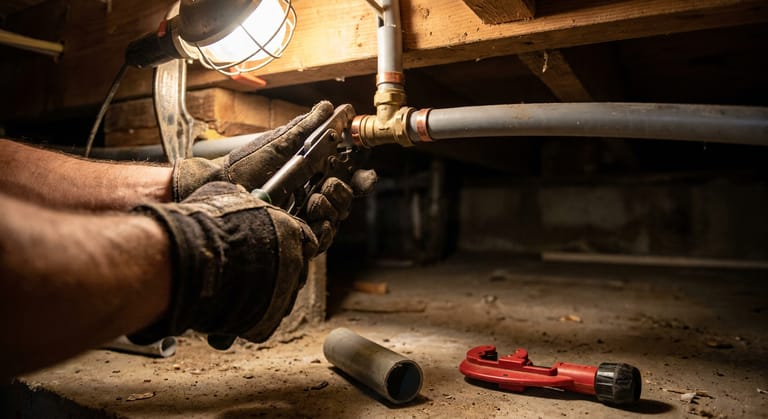
Is that gray polybutylene pipe, or something else?
Gray is what most people picture, and InterNACHI does call it the common color, though the same source records white, silver, black and blue too, in household sizes of roughly 1/2 inch to 1 inch. Color decides nothing by itself, since PEX now sells in gray.
What settles the question is the stamp. Under ASTM D3309 this plastic carries the designation code PB2110, printed along the pipe wall. Check wherever supply lines run in the open: near the shutoff and meter where the main enters, at the water heater, and at stub outs beneath sinks. Our guide to polybutylene piping walks through identification, and the side by side with PEX covers the gray on gray confusion.
How to repair polybutylene pipe without making it worse
Three legitimate moves, cheapest first.
- Swap the failed fitting. Out comes the joint, in goes a compatible coupling, and sound pipe is reconnected either side. Suits a first failure on a reachable run. Our page on polybutylene repair fittings covers what mates with it.
- Cut out and splice the damaged length. Where the plastic is scored, kinked or crazed, the bad section comes away and new pipe bridges the gap, usually with a PEX transition at both ends.
- Abandon the run. Once a branch has failed twice, replacing it costs less than a third call out and the drywall behind it.
Keep solvent cement and any flame away from this plastic, and overtightening a compression nut on brittle pipe ruins it just as quickly.
What a polybutylene pipe repair kit actually buys you
Inside a polybutylene pipe repair kit sit a coupling, inserts sized to the outside diameter, crimp rings or clamps, and often a PEX transition at one end. Those contents do one job cheaply and well, putting a single joint back in service. None of it helps the runs either side, and with D3309 off the ASTM books since 2010, no live specification stands behind a like for like rebuild.
Ready to talk to a licensed repipe pro?
Call (800) 555-0195No charge to call. A licensed repipe pro answers.Licensed repipe partners in your area- Every partner plumber is licensed and insured
- Calls routed around the clock
- Nothing billed for the call
- The plumber quotes you, and you say yes or no
How the repair visit tends to unfold
- Finding the source. Water tracks along the outside of a horizontal line, so soaked drywall rarely sits beneath the hole.
- Opening access, with a price attached. One clean cut beats three exploratory ones. Get the fix, the parts and the restoration in writing, plus who patches the wall.
- Judging the rest. Back under pressure, ask how the exposed pipe looked. That opinion is the most valuable part of the visit.
What polybutylene plumbing repair costs in 2026
Ranges are what aggregators publish; a quote comes from a plumber. The Angi figures below, all 2026, cover replacement work on polybutylene, one fixture to a whole house.
| Scope of work | 2026 range | Published by |
|---|---|---|
| Single fixture | $70-$1,000 | Angi, 2026 |
| All projects, partial work included | $150-$5,100 | Angi, 2026 |
| One bathroom house, swapped to PVC | $1,500-$2,500 | Angi, 2026 |
| Two or more bathrooms, to PVC | $3,000-$7,000 | Angi, 2026 |
| Whole home, 2,000 sq ft or larger | up to $15,000 | Angi, 2026 |
| Plumber labor | $45-$200 per hour | Angi, 2026 |
Patch the fitting, or repipe the house?
Patch it
- First failure, on a run you can reach
- Pipe either side looks sound and unstressed
- The house is staying as it is for now
Replace it
- A second failure in the house inside a year
- A leak inside a finished ceiling or under a slab
- A sale, a refinance or an insurance question ahead
The first column is where a polybutylene pipe repair belongs, and nowhere past it. Sometimes the insurer ends the argument: in Florida, Citizens Property Insurance Corporation treats a new business dwelling older than 20 years with this piping as not insurable under its main forms, one published example rather than a national rule.
Whatever money once softened this decision has run out. Shell's 1998 filing with the Securities and Exchange Commission puts the Cox v. Shell fund at $950 million and limits claims to 2009. That window never reopened, so today's invoice is yours alone. Our replacement walkthrough covers the bigger job.
When to call a licensed plumber
Stop patching and call if any of this fits:
- Water in a ceiling, under a slab, or behind finished surfaces
- A joint fixed once already, weeping again
- Pipe that feels stiff, chalky or crazed when flexed by hand
- Pressure that fell across the whole house, not at one tap
Grayfield publishes on this plastic and performs none of the work it describes. Dial (800) 555-0195 free, and the partner network routes the call to a local plumber who is licensed and insured. Where a call qualifies, Grayfield earns a referral fee from that partner, never from you, and your quote stays where the plumber set it.