
PEX pipe vs polybutylene: the difference that sets your budget
The short version
- PB2110 printed on the tubing wall is the proof. InterNACHI dates that material to 1978 through mid 1995, while PEX is still a current product.
- ASTM withdrew D3309, the polybutylene specification, in 2010, so no live standard covers repair parts for it.
- InterNACHI ties the failures to oxidants such as chlorine, and the leaks usually begin at fittings rather than mid run.
- Repiping a 2,000 square foot house in PEX runs $2,000-$4,000 (HomeGuide 2026), before drywall patching and the permit.
- The Cox v. Shell fund took claims only until 2009 (Shell SEC filing), so no settlement money is waiting.
Grey plastic in a wall cavity settles nothing. Both materials flex, both are joined with rings and barbed connectors, and nobody staring at a stub out under a sink can tell them apart by colour. The PEX pipe vs polybutylene question matters because one is a current plumbing product and the other left the market in the 1990s, then lost its governing standard in 2010. Read the stamp on the tubing wall first. PB2110 is the material designation code for polybutylene under the withdrawn ASTM D3309 specification, and finding it printed there is as close to proof as an owner gets.
Is polybutylene pipe the same as PEX?
No. Different polymers, different eras, and the trade treats them differently for sound reasons.
Polybutylene, written PB on inspection reports and poly B in conversation, was made between 1978 and mid 1995 and went into up to 10 million US homes, according to InterNACHI, the association of certified home inspectors. Production ceased in mid 1996, and ASTM D3309, the specification covering PB hot and cold water systems, was withdrawn in 2010. PEX is cross linked polyethylene, still manufactured and installed today. That single difference drives everything below.
Colour is the trap. InterNACHI records PB in grey most often, and also in white, silver, black and blue. Modern PEX is sold in grey too, so the shade in your basement proves nothing. Sizes overlap as well, roughly 1/2 inch to 1 inch in houses.
No live standard. ASTM withdrew D3309 in 2010 and put nothing in its place, so anyone patching PB in 2026 works outside an active product specification. The Grayfield guide to polybutylene fittings and what still fits them covers what remains obtainable.
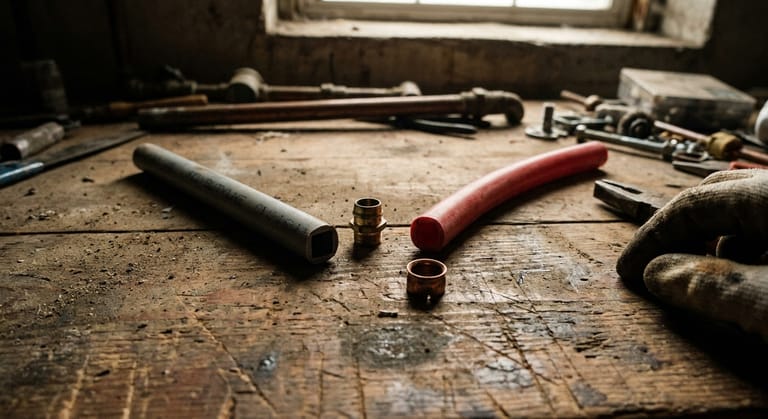
PEX pipe vs polybutylene, parameter by parameter
No page in the current top results lays these two side by side, so here they are.
| Parameter | Polybutylene (PB) | PEX |
|---|---|---|
| Years installed | 1978 to mid 1995, ending mid 1996 (InterNACHI) | Current product, sold in 2026 |
| Product standard | ASTM D3309, withdrawn 2010 | Current ASTM specifications |
| Printed stamp | PB2110, the code under the withdrawn spec | Brand plus a live standard |
| Colours seen | Grey mostly, also white, silver, black, blue (InterNACHI) | Red, blue, white and grey |
| Failure mode | Oxidants such as chlorine believed to cause flaking, brittleness, micro fractures (InterNACHI) | No class wide failure record here |
| Where it lets go | Usually at connectors, plastic and metal alike (InterNACHI, HUD) | No systemic weak point documented here |
| Material price | Not sold new | $0.40-$2.00 per linear foot (Angi 2026) |
| Whole home swap | $1,500-$2,500 one bathroom to PVC, $3,000-$7,000 for two or more baths, up to $15,000 at 2,000 square feet (Angi 2026) | $2,000-$4,000 at 2,000 square feet (HomeGuide 2026) |
| Insurer eligibility | Florida's Citizens declines new business over 20 years old with it | No comparable published rule located |
Why one material fails and the other has no such record
InterNACHI describes the mechanism as chemical, not mechanical. Oxidants in public water supplies, chlorine above all, are believed to react with the polymer, producing scaling, flaking, brittleness and micro fractures that cut into the structural integrity of the system. So it does not wear out on a schedule. It degrades from the inside at whatever pace the local water dictates, which is why two identical houses on one street can be decades apart in when they let go.
Connectors usually give out first. InterNACHI reports leaks and line failures above the plumbing norm, often at the joints, plastic and metal both, and HUD's rehab guidance states plainly that certain connectors and pipe in polybutylene water systems are known to fail. Manufacture ended, InterNACHI notes, after scores of allegations that these lines ruptured and caused property damage.
Hold that last phrase. This is a property damage story, not a health story. Nothing in the EPA record treats the material as a drinking water contamination source the way it treats lead service lines. You are pricing a burst line behind drywall, not the tap.
Ready to talk to a licensed repipe pro?
Call (800) 555-0195No charge to call. A licensed repipe pro answers.Licensed repipe partners in your area- Every partner plumber is licensed and insured
- Calls routed around the clock
- Nothing billed for the call
- The plumber quotes you, and you say yes or no
Which is better for plumbing, PEX pipe or polybutylene pipe?
For new work the question is moot, because the older material has not been sold for three decades. The PEX pipe vs polybutylene comparison only bites in an existing house, where the choice is keeping what you have or paying to change it.
PEX wins on availability, price and paper trail. Angi's 2026 figures put it at $0.40 to $2.00 per linear foot against $2.00 to $8.00 for copper, cheapest of the replacement materials. The older one wins a single point, and it is real: doing nothing costs nothing.
Reasons to convert now
- No current standard covers PB repair parts
- Failures arrive as ruptures, not slow drips
- Finished work clears the inspection line that spooks buyers
Reasons to wait a season
- No rule or code deadline forces the swap
- A dry system with no leak history buys time to budget
In practice the polybutylene plumbing vs PEX decision turns on leak history. One repaired failure is bad luck. Two in a few years is a pattern, and the full replacement walkthrough is the next read.
Three houses, three answers
The 1988 ranch that has never leaked
One bathroom, PB2110 on the tubing, dry for as long as this owner has held the deed. Angi's 2026 range for a one bathroom conversion is $1,500 to $2,500, small enough to schedule rather than dread. Book it for the year the interior gets repainted, when patches vanish into budgeted work.
The 1992 two story going on the market
Buyers' inspectors name this material in their reports. Angi puts two or more bathrooms at $3,000 to $7,000. Firm quotes before listing beat negotiating against a figure a buyer's contractor invents on the spot.
The condo that has already had one failure
One repair done, stains still on the ceiling below. A targeted polybutylene repair earns its keep only as a stopgap while a full quote comes together. Angi's range runs from $150 for small partial jobs up to $5,100, which is why a number quoted over the phone tells you nothing.
What it costs to replace polybutylene pipes with PEX in 2026
Take the middle case, a 2,000 square foot house. HomeGuide's 2026 data puts a PEX repipe of that size at $2,000 to $4,000. Add the two lines owners forget: drywall repair after repipe access at $300 to $1,500 and up, and an average water line plumbing permit at $30 to $500, both HomeGuide 2026. The realistic all in band is $2,330 to $6,000.
Across ten years of ownership that is $233 to $600 a year. The arithmetic is the honest case for moving early, because the job costs the same after a rupture, plus whatever the water ruined.
Labor is where the money goes. Angi puts it near 70 percent of a repipe bill, with plumbers billing $45 to $200 an hour while materials top out around $8.00 per linear foot. The scope by scope cost breakdown has the rest.
What a quote must itemise. Tubing and connectors, labor hours, access openings and patching, the permit, and who repaints. With labor near 70 percent of the bill per Angi, two honest bids can differ by thousands on hours alone.
When to call a licensed plumber
Reading the stamp is free. Everything past it wants licensed eyes on site.
- Any active weep at a joint. The joint is the documented weak point here, and a damp fitting is the last warning before it opens.
- A second failure within a few years. One is bad luck. Two is the pattern InterNACHI describes.
- Fresh ceiling stains below a bathroom. Water tracks along joists, so the mark rarely sits under the break.
- A sale under contract. Quotes in hand beat a credit negotiated blind at closing.
Grayfield is an independent publisher, not a contractor. The number here routes to a licensed and insured partner network, so the call connects you with a licensed local plumber who does this work every week, and you approve scope and price with that plumber directly. If you are searching for polybutylene replacement near you, that call is the shortest route to a real figure.
Two photos before you spend a dollar. Shoot the printed stamp on a clean length of tubing, then the joint style beside it. Those answer most of what a plumber asks on the phone.
So the PEX pipe vs polybutylene verdict commits. If the stamp reads PB2110, you own the material with the withdrawn standard and the documented joint failures, and the only question left is when you convert. Call (800) 555-0195 to price it, or start at the polybutylene material hub if you are still confirming what is in the wall.