
Polybutylene pipe fittings: the joint that goes first
The short version
- InterNACHI reports leaks and line failures above the plumbing norm in these systems, and the fittings are where they show up, metal ones included.
- HUD's rehab guidance puts connectors on the known to fail list for these water systems, alongside the pipe itself.
- ASTM withdrew D3309 in 2010, so no live product standard covers this tubing or the parts made for it.
- PB2110 printed on the tubing wall is the material code that settles what you own before you buy a part.
- Angi puts a single fixture repipe at $70-$1,000 in 2026 and plumber labor at $45-$200 per hour.
When grey plastic supply tubing lets go, the connector is the usual culprit rather than the run between connectors. InterNACHI, the home inspector association, puts leaks and failures in these systems above what plumbing generally shows, concentrated at the fittings, plastic ones and metal ones alike. HUD's Rehab Guide is blunter: in polybutylene water systems, it says, certain connectors as well as the pipe are known to fail.
So the short answer on fittings for polybutylene pipe: the joint is the weak spot, spare parts sit outside any live product standard, and a patch buys a night rather than a fix.
What fittings work with polybutylene?
Sort the fittings for polybutylene pipe by how they grip and you get four families, plus one part that arrived later. ASTM D3309, the withdrawn specification for polybutylene hot and cold water distribution, covered the tubing and four fitting types with it: socket fusion, compression, mechanical, and plastic to metal transition, all rated to 100 psi up to 180 F. ASTM withdrew the specification in 2010, so no current standard covers a like for like repair part.
| Family | How it holds | Where you meet it |
|---|---|---|
| Mechanical, insert and ring | A barbed body inside the tubing, a ring squeezed around the outside | Tees, manifolds, stub outs behind walls |
| Compression | A ring pressed onto the outside wall under a threaded nut | Stops, meters, water heater connections |
| Plastic to metal transition | Plastic on one end, thread on the other | Heaters, hose bibbs, valve groups |
| Socket fusion | A heat welded joint, specialist work | Rare in houses, more so in larger buildings |
| Push to connect coupling | Grips a cut end without tools | Modern repairs on old runs |
Adapters, compression fittings and connectors
Polybutylene pipe adapters are the transition parts, plastic on one side and thread on the other, sitting wherever the plastic meets a valve, a heater or copper. Polybutylene pipe compression fittings clamp the outside wall rather than relying on a barb inside, which is why they survive in repair work. Polybutylene pipe connectors is the umbrella word for the hardware itself: couplings joining two lengths, tees splitting a run, elbows turning a corner, each built on one of the grips above.
Why the joint surrenders first
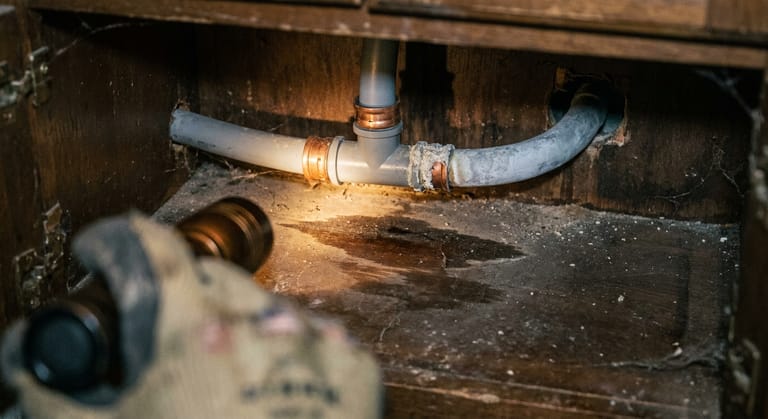
InterNACHI's account of the failure is chemical, and openly hedged. Chlorine and other oxidants in public water are believed to attack the plastic, leaving the wall scaled, flaky and brittle until micro fractures open and the tubing loses its built in strength. That damage spreads through the whole installation, but it surfaces first where the plastic is worked hardest: stretched over a barb, squeezed under a ring, or bent into a joint.
The production history says it louder. InterNACHI records that manufacture stopped once scores of allegations piled up over these lines splitting open and ruining property. The event behind that record is a burst and a wrecked ceiling, not a drip under a sink. Compensation, though, is no longer part of the story: the Cox v. Shell class settlement stopped accepting polybutylene claims by 2009 on the wording of Shell's own SEC filing, and nothing has replaced it.
A soaked ceiling is an electrical and structural problem before it is a plumbing one. Close the main shutoff, stay out of rooms where water runs near light fixtures or a panel, and photograph the failed joint before it is removed, because an insurer may want to see which part let go.
Can you use SharkBite fittings on polybutylene pipe?
Sometimes, and only where the maker says so. Push to connect couplings are the late arrival among fittings for polybutylene pipe, and they ship with charts naming the materials and outside diameters each part accepts. Match the part to that chart, never to what looks the same width in the aisle. The same test settles a PEX to polybutylene transition fitting: the chart either names both materials or it does not.
One caution rides along. Brittleness is the documented mechanism here, so an aged end can split as a new coupling grips it, which is why a plumber cuts back to sound material first.
Carry the failed part and a photo of the printed stamp to the counter. Under the withdrawn ASTM D3309 system, PB2110 is the code printed along the wall of polybutylene tubing, so the stamp settles what you own before anyone sells you anything.
Ready to talk to a licensed repipe pro?
Call (800) 555-0195No charge to call. A licensed repipe pro answers.Licensed repipe partners in your area- Every partner plumber is licensed and insured
- Calls routed around the clock
- Nothing billed for the call
- The plumber quotes you, and you say yes or no
Sizes: 3/8 polybutylene pipe fittings and the rest
Measure before ordering. InterNACHI puts residential runs of this plastic at roughly 1/2 inch to 1 inch. People shopping for 3/8 polybutylene pipe fittings are usually standing at a sink or toilet, where the short riser and its stop valve are narrower than the branch feeding them, so the part may not belong to the grey run at all. Measure at the point of repair, then buy for that number.
What a repair fitting actually buys you
- Kill the water. Close the main, then open a low tap to drain the branch.
- Document first. Photograph the joint in place, for the claim file.
- Cut back to sound material on both sides if the plastic flakes.
- Land a coupling the maker lists for this material, or transition into new tubing.
- Repressurize slowly and watch the repair and its neighbors before closing up.
Polybutylene pipe repair fittings restore water, which is worth real money on a weeknight. They change nothing elsewhere in the house, because every remaining joint shares the age and the water chemistry that took out the first one. Spot repair and emergency options covers what a plumber can honestly promise on a patch.
Red flags: stop buying parts and call a licensed plumber
- A second failure elsewhere in the house within the year.
- A joint that weeps, dries and weeps again above a finished ceiling.
- Tubing that flakes or splits as a connector comes off.
- Ceiling discoloration widening where no fixture sits overhead.
- A pending sale or an insurance renewal where the piping material comes up.
Any of those earns a call rather than another trip to the parts counter. Dial (800) 555-0195 and the partner network answers with a licensed, insured local plumber, someone who handles grey tubing weekly. Grayfield publishes and nothing more: independent, with no plumbing contractor's license behind the name. Calls cost nothing, the network may pay Grayfield a referral fee, and price stays with that plumber.
What this work costs in 2026
| Scope | National range | Source |
|---|---|---|
| Single fixture repipe | $70-$1,000 | Angi, 2026 |
| Plumber labor | $45-$200 per hour | Angi, 2026 |
| One bathroom home, redone in PVC | $1,500-$2,500 | Angi, 2026 |
| Two or more bathrooms, redone in PVC | $3,000-$7,000 | Angi, 2026 |
| Drywall opened for access, then repaired | $300-$1,500 and up | HomeGuide, 2026 |
Angi's 2026 data tops materials out near $8.00 per linear foot, so labor drives the invoice. An hour of opening a cavity costs more than the part it reaches, so do the neighboring joints while the wall is open. The replacement cost breakdown splits those ranges by home size and material.
One failure is a repair. A third in the same year is a decision, and it reads the same whether the parts were plastic or metal: keep buying fittings for polybutylene pipe, or take the system out. Start with the polybutylene overview for identification and dating, read whole house replacement for how the work actually proceeds, and weigh materials with how PEX compares with polybutylene.
Ready to talk to a licensed repipe pro?
Call (800) 555-0195No charge to call. A licensed repipe pro answers.Licensed repipe partners in your area- Every partner plumber is licensed and insured
- Calls routed around the clock
- Nothing billed for the call
- The plumber quotes you, and you say yes or no