
White polybutylene pipe: the ten minute test that settles it
Somebody looked at the white plastic supply tubing in this house and said polybutylene. Confirm it before that word turns into a repipe quote, because confirming is cheap.
InterNACHI, the association of certified home inspectors, records that the material was most commonly gray and was also produced in white, silver, black and blue, so white polybutylene pipe is a real thing.
Color decides nothing on its own: those shades sit on plastics still sold today. The line of print along the tubing wall decides it, and reaching it costs ten minutes and a flashlight.
White is on the factory color list
Because that list is so broad, a white run is consistent with polybutylene and equally consistent with the plastic tubing on a supply house shelf this week.
Dates narrow the field faster than color does. Manufacture ran from 1978 to mid 1995 and production ceased in mid 1996, per InterNACHI, so houses finished after that window rarely hold any.
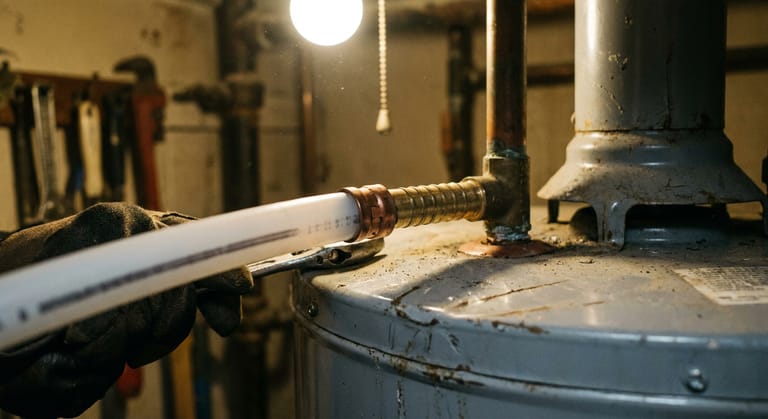
What the print on the tubing wall says
Plastic supply tubing carries a material designation, a standard number and a pressure rating printed along its length.
For polybutylene the code is PB2110, issued under ASTM D3309, the specification covering hot and cold water distribution at 100 psi up to 180 F. PB2110 on a white run closes the question, and any other code names a different material.
Polybutylene pipe sizes and what the diameter adds
Residential runs measure typically 1/2 inch to 1 inch in diameter, per InterNACHI, ordinary branch and trunk sizing for a house. Polybutylene pipe sizes therefore rule almost nothing in or out.
Diameter still matters twice: anything fatter is unlikely to be residential polybutylene, and the size you measure is what a plumber prices material against.
A ten minute check, in order
- Start at the water heater, where supply lines are exposed, clean and near eye level.
- Move to the meter and the main shutoff, where EPA's service line inventory guidance sends people precisely because the piping there sits in the open.
- Check the stub outs behind toilets and inside vanity cabinets, then photograph the print with the flash on and zoom in.
- Touch no joints. Brittle tubing gives way at the connector first, so twisting one for a better look is how a dry house becomes wet.
Ready to talk to a licensed repipe pro?
Call (800) 555-0195No charge to call. A licensed repipe pro answers.Licensed repipe partners in your area- Every partner plumber is licensed and insured
- Calls routed around the clock
- Nothing billed for the call
- The plumber quotes you, and you say yes or no
White plastic that is not PB
The official Kitec settlement site puts that system in blue on the cold lines and orange on the hot, and red, gray and black turn up on its list as well. White does not.
Kitec announces itself in brass anyway, since the settlement's own photo gallery shows brass crimp and compression fittings. A white run with no brass rings is unlikely to be Kitec.
| What you can see | What it means for a white run |
|---|---|
| PB2110 in the printed line | Polybutylene confirmed, pigment irrelevant |
| Brass crimp or compression rings | Points toward Kitec instead |
| Diameter above 1 inch | Outside the usual residential range |
| House completed after 1996 | Outside the manufacturing window |
How this tubing actually fails
Nothing on the record ties the failure of white polybutylene pipe to its shade. The water does that damage. Oxidants in treated supply, chlorine the main one, attack the resin, on InterNACHI's reading: the wall roughens with scale, sheds flakes, goes stiff, and micro fractures take the strength out of the run.
Joints fail before tubing does. InterNACHI puts the leak rate on these systems above normal and most of it at the fittings, and HUD's Rehab Guide lists certain polybutylene connectors and pipe among parts known to give way. Manufacture ended in mid 1995, so anything still carrying water in 2026 has served at least 31 years.
Patch it or repipe it?
One confirmed run of white polybutylene pipe does not decide the route. How the system has behaved does.
A patch holds up when
- One joint let go and the rest of the system is dry
- The run is reachable without opening finished surfaces
Replacement wins when
- Two failures land in one house inside a year
- A leak surfaces in a finished ceiling or under a slab
Each route has its own page: what a spot repair actually buys, how a whole house repipe runs, the replacement cost breakdown, the connectors that fail first, and the complete polybutylene guide.
Red flags: call a licensed plumber
- Staining, bubbling paint or soft drywall near a connector.
- A joint that weeps overnight while the house is quiet.
- A second leak within a year of the first.
- A closing date or a policy renewal that needs the material named in writing.
- No readable print anywhere, which leaves the material unknown to an underwriter as well as to you.
Grayfield publishes independently and sells no plumbing work. Call (800) 555-0195 and you reach a licensed, insured plumber from the partner network, someone who can name the material on sight, price the job near you and put the scope in writing. Unsure what runs behind the drywall? Start with the whole house identification walkthrough.